I want Auto Resolve to leave me with a sense of the battle I just fought. This pass improves which officers and troops the calculation counts, then presents the outcome in a short battle account.
These are development-build changes following Taking Command, not an announcement of a new downloadable build. The screenshots and motion excerpt use staged encounters running through the current game. The animated account illustrates an already-resolved battle; it is not a replay of a hidden tactical simulation.
First, make the result account for the right people
I found cases where retained officers were missing from the calculation, a settlement's absent ruler was being treated as a participant, or a wounded player leader was counted instead of the available champion. Auto Resolve now works from the officers and contingents actually committed to the encounter, counting each officer once.
I also separated battlefield survivors from what happens when a settlement changes hands. Surviving allied defenders should not disappear into the casualty total because the victors occupy the town. Officer influence and attrition have been adjusted together, with comparisons against the current tactical battle system rather than relying only on older calibration tests.
That does not mean every automatic result will duplicate a manually fought battle. It gives the result a better foundation, and gives me clearer cases to compare as balance develops.
A short account of how the battle turned
The new Battle Account presents a brief sequence based on the resolved encounter. It draws from 40 kinds of battle highlight for different armies and outcomes, including reinforcement arrivals, officer actions and siege fighting when the encounter supports them.
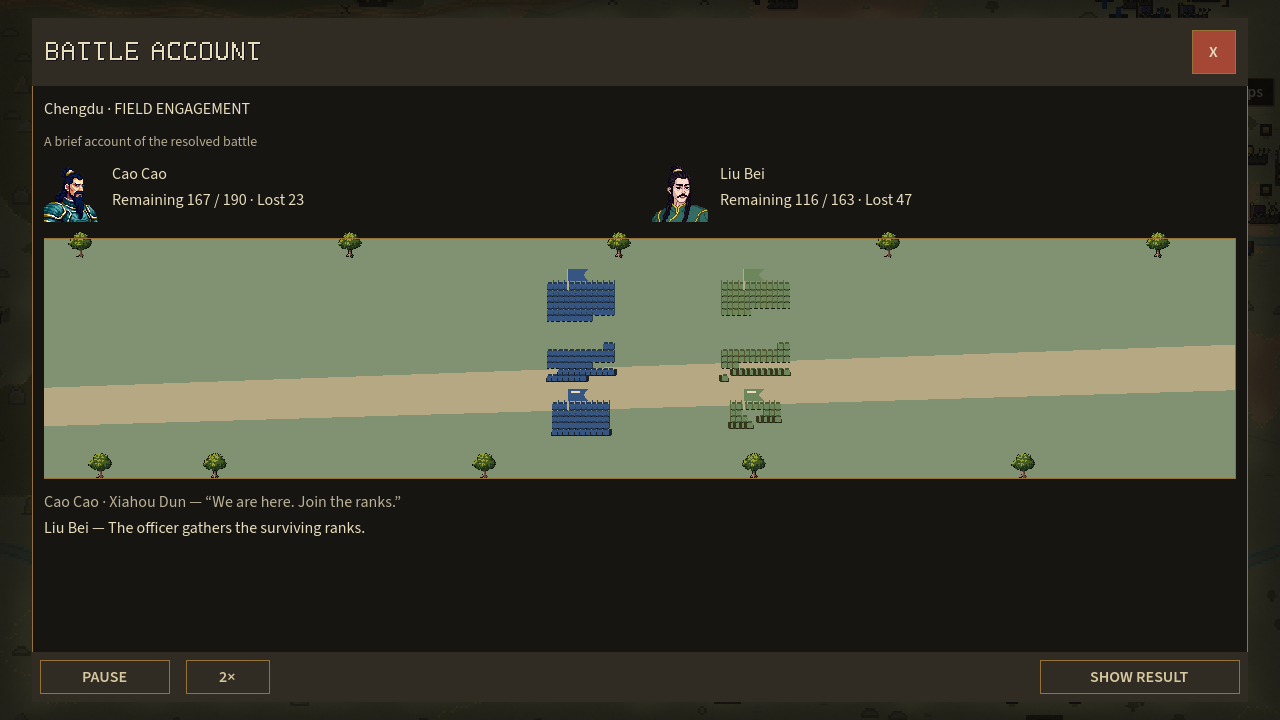
Fresh development-build capture: an allied contingent approaches and joins the field. The survivors and losses shown are those already calculated for the battle.
I wanted reinforcements to feel as though they arrived, rather than appearing in the middle of a formation. Siege accounts have their own setting and highlights, while small encounters get a shorter treatment. A small recent-history list helps keep the same eligible moments from repeating too often.
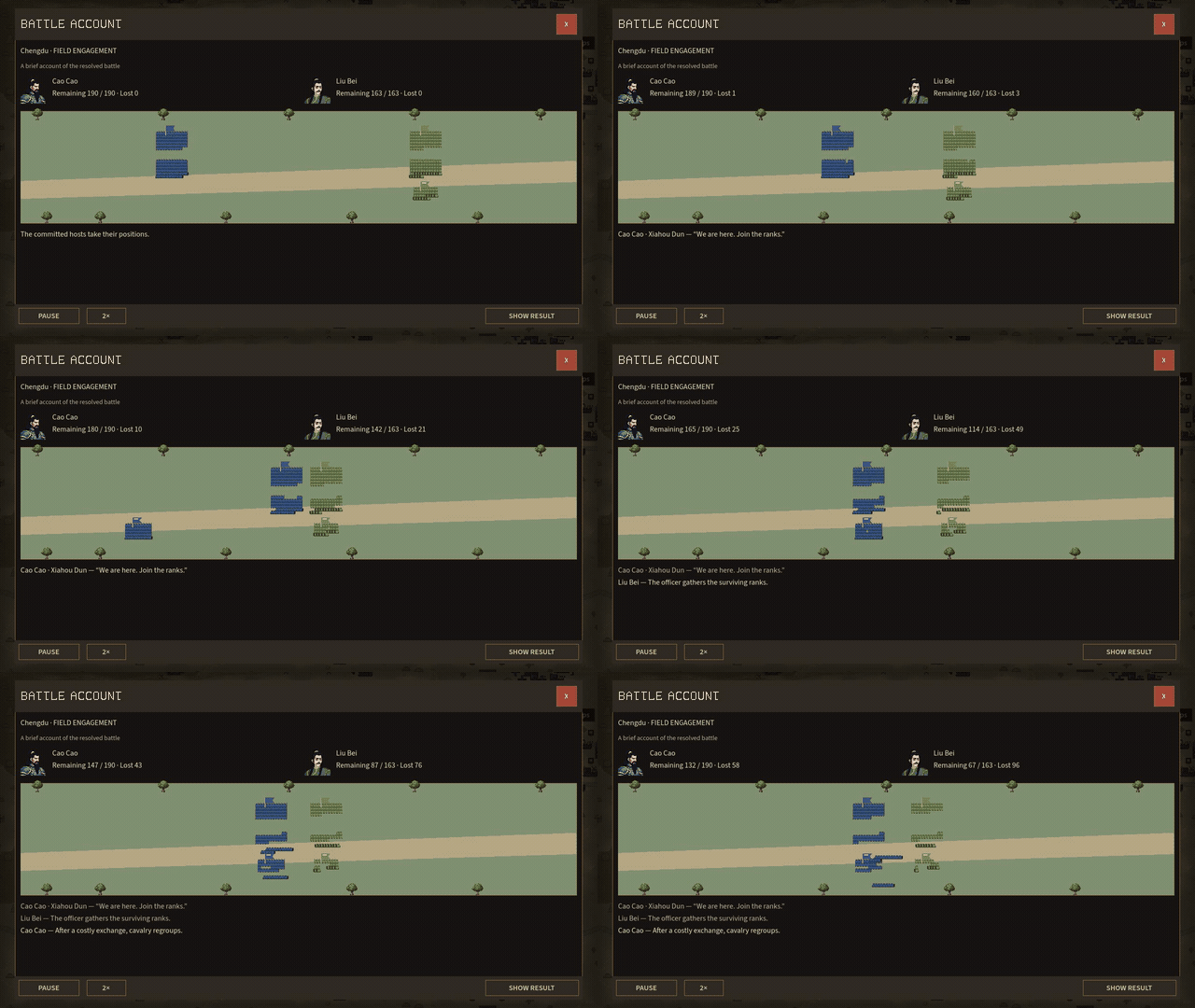
An 11-second silent excerpt from a fresh field-engagement capture. The full account leads into the static battle report.
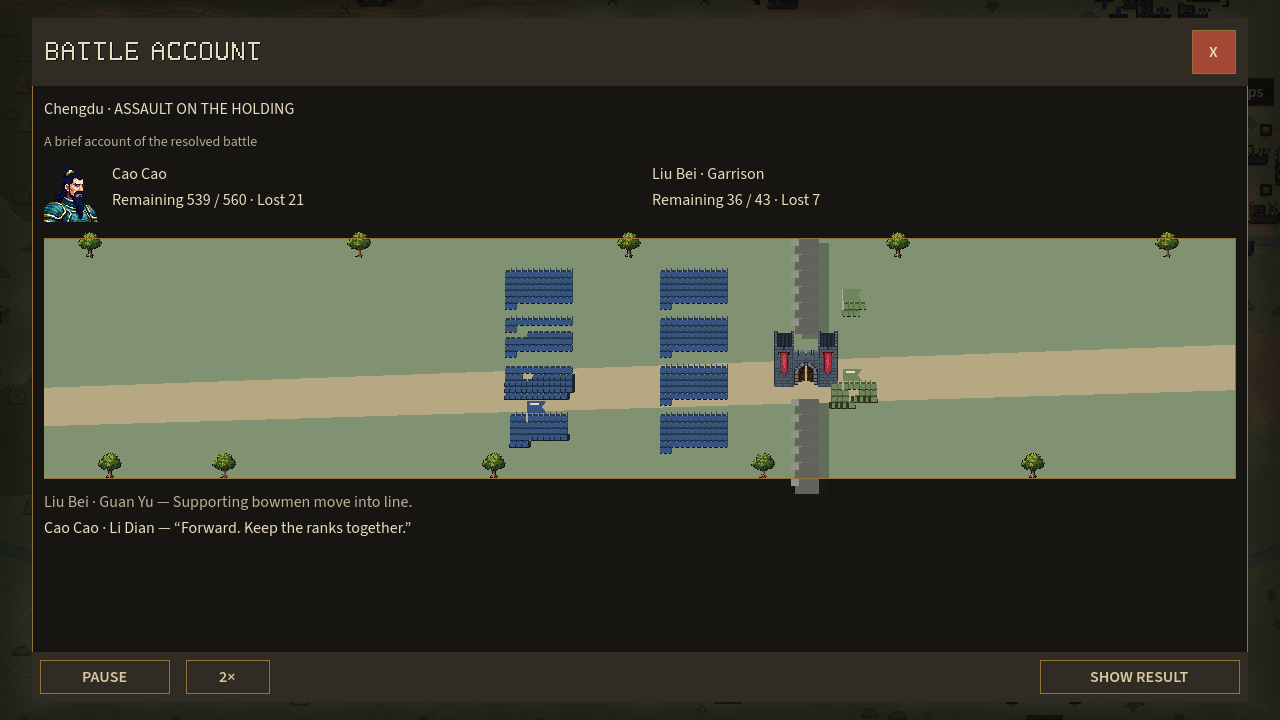
Staged siege encounter shown through the game's recap. The formations illustrate the result; they do not rerun the fight soldier by soldier.
Officer dialogue stays brief. Existing suitable recordings are reused, with text carrying moments that do not have an appropriate recording. The goal is to give the result some character without making every quick fight into a conversation.
Pause, speed it up to 2x, or choose Show Result immediately. The battle has already been resolved before the account opens. Watching, skipping, pausing or accelerating it leaves the same casualties, rewards and campaign consequences. The static report is still there at the end.
Giving the campaign room to recover
The campaign changes give a realm fighting on several fronts more ways to recover. Paid extended armistices buy time, and recovery orders let armies regroup. Before deciding, players can check the terms, readiness and time remaining in Campaign Outlook.
Containment coalitions and rival capital claims now add pressure around a dominant realm. I am still testing whether that pressure reliably becomes effective action: a coalition forming is not enough if its armies fail to threaten the leader. Further endgame variety is still being considered, so this is not a promise that every campaign will finish with the same coalition war.
I also worked on collection feedback, garrison upgrades, armoury production and reservations shared by construction projects. I reorganized save handling and battle-result bookkeeping to make them easier to maintain, and fixed problems with older long-campaign saves.
Making contact sound like contact
Combat audio has had a substantial pass across weapon and armour contacts, arrows, duels, siege impacts and battlefield ambience. Timing, perspective and restraint matter as much as the individual sound: a distant fight should not compete with every nearby impact.
The latest approved vocal layer adds brief anonymous exertions and reactions, ram-crew effort and occasional distant voices. The recap also respects existing narration, so a short battle moment does not cut off a more important line.
The next thing I am watching is how these changes behave together over a long campaign: whether armies recover usefully, whether dominant realms face credible pressure, and whether the battle account stays varied without delaying the next decision.
What would you most want a quick battle account to make clear: why you won, where the losses came from, or who made the difference?
Thanks for following along.
— Jeremy