The Three Kingdoms sandbox I want to make
As a solo developer, the vision I keep coming back to is a Three Kingdoms sandbox—or maybe a toybox is the better word—that players can truly make their own.
I love this period because I have come to know these characters, their ambitions, their friendships, and their grudges. But I do not want the game to simply march everyone toward the ending we already know. I want Cao Cao, Liu Bei, Yuan Shao, Sun Ce, Lu Bu, and the rest of the cast to enter the world with the identities we recognize, then give the player enough freedom to make an ahistorical story and reach an ending that belongs to that campaign.
The recent work on the game has all been aimed at making that idea feel more real. Armies needed to look like they were living in the world. Officers needed to remember the people they fought beside and against. Battles needed to leave more behind than a change in troop numbers.
The map should feel alive before you touch it
The first part of that work was making the armies on the campaign map feel like they have lives of their own. NPC-led banners can recruit, recover, patrol, pursue, assemble, march, defend, and fight for the needs of their house.
During quieter periods, officers can ride out for petitions, inspections, and village commissions. These are not extra decorative units moving around for show. They are the same officers and banners that can be called away when a siege begins or an enemy crosses into their territory.
I still want fog of war to matter, so the map only tells you what your ruler could reasonably know. Old reports remain old reports. You can watch the world moving without being handed perfect knowledge of what every rival is planning.
Old enemies should remember you
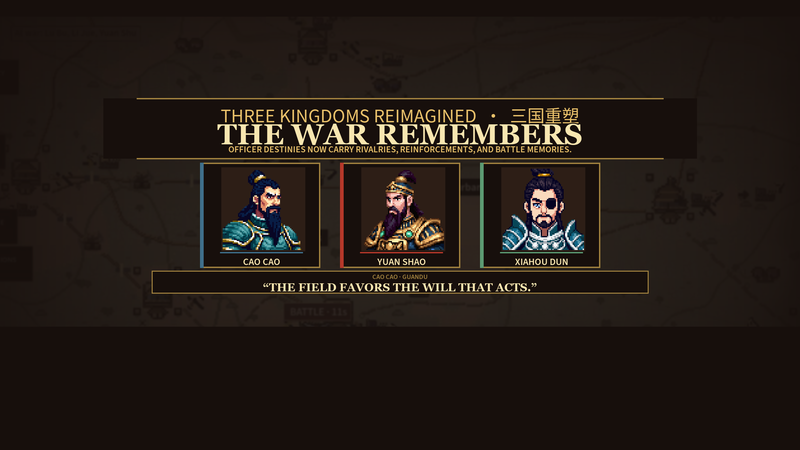
One thing I noticed early was that famous faction leaders such as Cao Cao and Yuan Shao were missing some of the charm of a personal grudge. They could meet, fight, and meet again, but the second battle did not always feel as if the first one had happened.
That has changed. Rival officers can now remember meetings, battle and duel results, captures, releases, mercy, reversals, and vindications. A first encounter can grow into a rematch. A former victor can be answered. Fighting the same faction repeatedly and seeing its officers gradually develop a rivalry with you was one of those moments when this whole idea really started to click for me.
Those rivalries can now reach the field before the armies clash. In an ordinary hostile encounter, a credible enemy officer may challenge your active champion to single combat. You can accept and open the battle with the duel, or decline and continue to the normal encounter choices without a hidden penalty. You can also issue your own challenge, even when it may not be wise.
Recreating the Cao Cao and Yuan Shao rivalry has been especially satisfying. At Guandu, Cao Cao can answer Yuan Shao before their duel:
“Yuan Shao—four generations of rank, a hundred advantages, and still you hesitate. Draw your blade.”
It is a small moment, but it brings together what I want from the game: familiar history, recognizable character, and a confrontation that is happening because these two people met in your campaign.
The people beside you should matter too
The same idea applies to the officers serving under your banner. A spouse, sworn companion, trusted champion, adviser, or commander who has served beside you for years should not feel like an interchangeable name on a roster.
Their history is now more visible when it matters. A close companion can be named when selected as a reinforcement and again when they actually answer the battle. Council responses can acknowledge whether advice from a trusted officer was adopted, rejected, or later vindicated. The Chronicle and officer dossier can carry that relationship into the consequences that follow.
This does not add arbitrary friendship bonuses. It lets the game recognize bonds and service that already happened, so the player has a better chance to remember why that officer matters.
A battle should leave a story behind
I also wanted battle results to tell me more than who won and how many soldiers survived. The statistics are still there, but the result can now pull out a few named events that actually shaped the field.
It might remember a duel, a trusted reinforcement arriving, a command passing to another officer, the first breach of a gate, a major wound or fall, or the defense of a particular place. It only uses things the battle truly recorded. The goal is a short account of who changed the battle, where it happened, and what it cost—not dramatic claims the game cannot support.
Those memories continue all the way to the end of a campaign. Securing the Mandate still means holding 15 of China's 29 capitals, but the victory recap now looks back at how you got there. It can recognize the officers who repeatedly shaped the realm, a defeat followed by recovery, counsel you trusted, acts of mercy, development work, captures, oaths, and relationships that survived from the beginning.
This part is important to my original vision. If the game lets you make your own ending, it should also be able to look back and tell you what made that ending yours.
Giving the famous rulers more presence
Selected battle moments now give distinct voices to Cao Cao, Liu Bei, Sun Ce, Lu Bu, Yuan Shao, Liu Biao, and Meng Huo. They can speak when armies meet, during duels, at breakthroughs and reinforcements, and after victory or defeat.
I do not want the campaign buried under constant dialogue, so these moments are limited and tied to rulers who are actually present. Ordinary officers remain text-first, which leaves room for a much larger cast to develop through counsel, relationships, rivalries, and remembered consequences without pretending that the entire game is fully voiced.
The English performances use synthetic voices produced with ElevenLabs, then cast, directed, edited, and mastered for the game. The dialogue is original writing inspired by each ruler's historical reputation and role in the campaign; it is not presented as historical quotation.
The difficult part was making it one world
Each of these ideas can work on its own. The difficult part was connecting them so they feel like one living ecosystem across both the campaign and the battles.
The officer who challenges you on the road has to be the same officer who enters the duel. A trusted companion arriving in battle has to be someone who already earned that relationship in the campaign. A result screen has to describe what actually happened, and the victory recap has to remember the same officers, places, defeats, and decisions that appeared along the way.
If those connections do not hold together, the sandbox starts to feel staged. When they do, a simple encounter can become part of a rivalry, that rivalry can shape another battle, and both can become part of the ending you remember.
What changed in this update
- NPC-led armies now show more of their military and civic activity on the campaign map.
- Credible enemy officers can challenge your champion during eligible field encounters.
- Authored rivals can remember repeated battles, duels, captures, releases, and reversals.
- Spouses, sworn companions, trusted champions, advisers, and long-serving officers receive more specific recognition.
- Battle results foreground a few named causes drawn from the battle that was actually fought.
- The victory recap now reflects the ruler, realm, officers, and turning points produced by the campaign.
- Seven major rulers have expanded voices at selected battle moments, while ordinary officers remain text-first.
Does the vision come alive?
If you are already playing the demo, I would love to know whether these connections make the campaign feel more alive. If you are new to the Steam page, this is the heart of what I am trying to build: a world full of familiar Three Kingdoms characters that can still surprise you and become your own story.
Do repeated enemies begin to feel like rivals? Do the officers beside you feel worth remembering? When a battle ends, does it feel like something happened that could matter later?
More than anything, does the vision come alive for you?
Thank you for following the project.
— Jeremy
The names you know. The story you make your own.