I kept running into the same problem while testing: the answer was in one place, and the action was in another. I could see that an army was selected without being able to tell which officers were in it. A commission named a settlement in the journal while the map asked me to interpret a different marker. None of those gaps is huge by itself, but together they make the campaign feel unfinished.
The Three Kingdoms sandbox I want to make still comes down to familiar people and an ending you can make your own. Cao Cao should sound like Cao Cao when he faces Yuan Shao. The rest of the game needs to make those decisions just as easy to follow: find an officer in a fight, understand the force you've selected, and know where a commission is sending you.
This is a look at the development build around commit 4e446a7. These changes are not live on Steam yet. The screenshots are fresh in-game captures of set-up scenarios, so they show the UI as it exists rather than pretending to be one continuous playthrough.
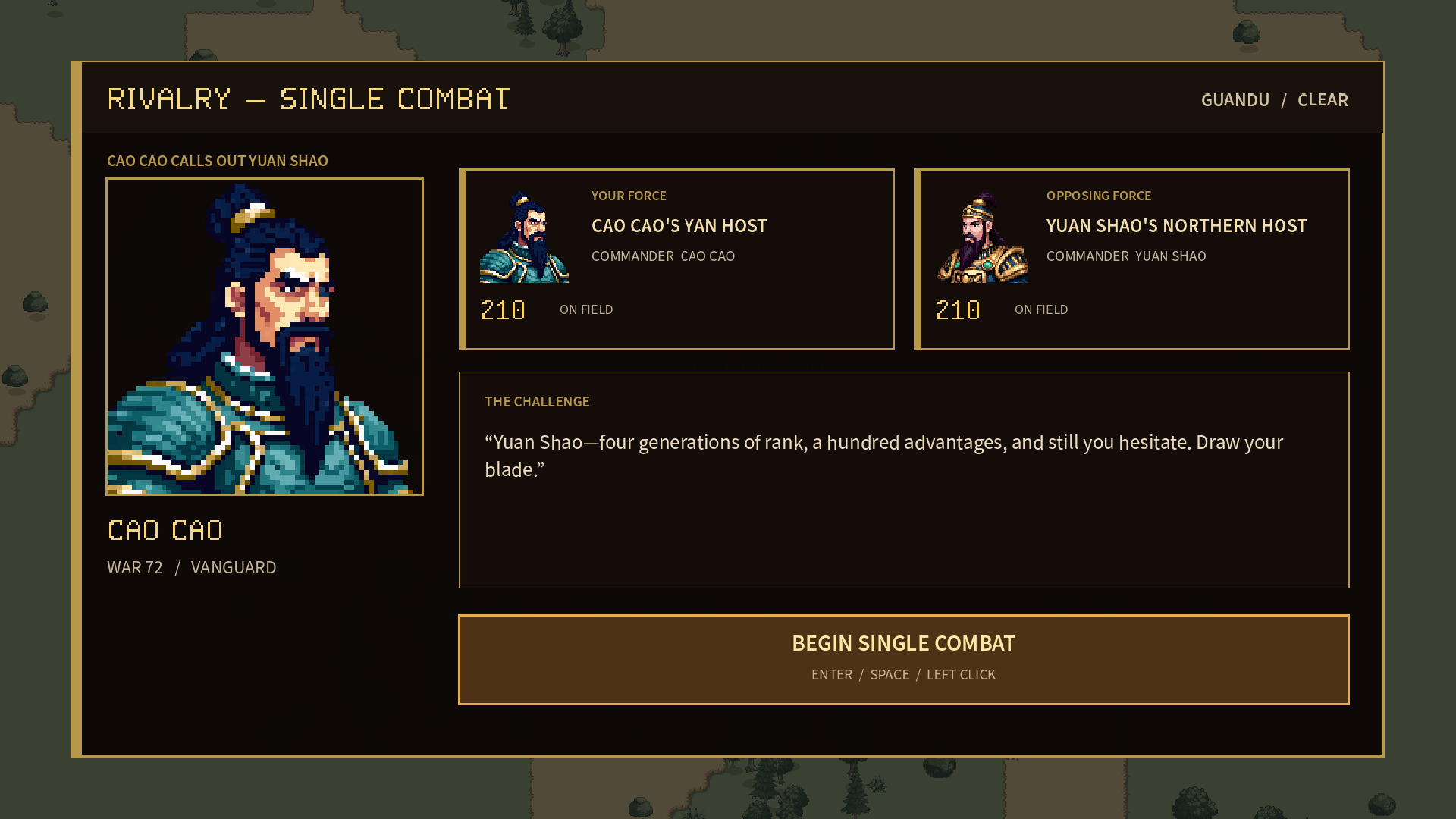
Cao Cao's challenge before a staged duel at Guandu. The scene uses the same duel presentation as a campaign encounter; the capture was set up to show it clearly.
Making room to command
The old officer cards could cover the very fight they were supposed to help you follow. I've moved that information into a compact officer strip, with a full roster you can open when you need it. Click an allied officer's portrait and the game focuses and selects that officer's unit for commands. You don't have to hunt for a tiny figure in the crowd.
I've also reworked deployment. You can keep panning around the battlefield, select a group or the whole army, and place it where you want before starting the fight.
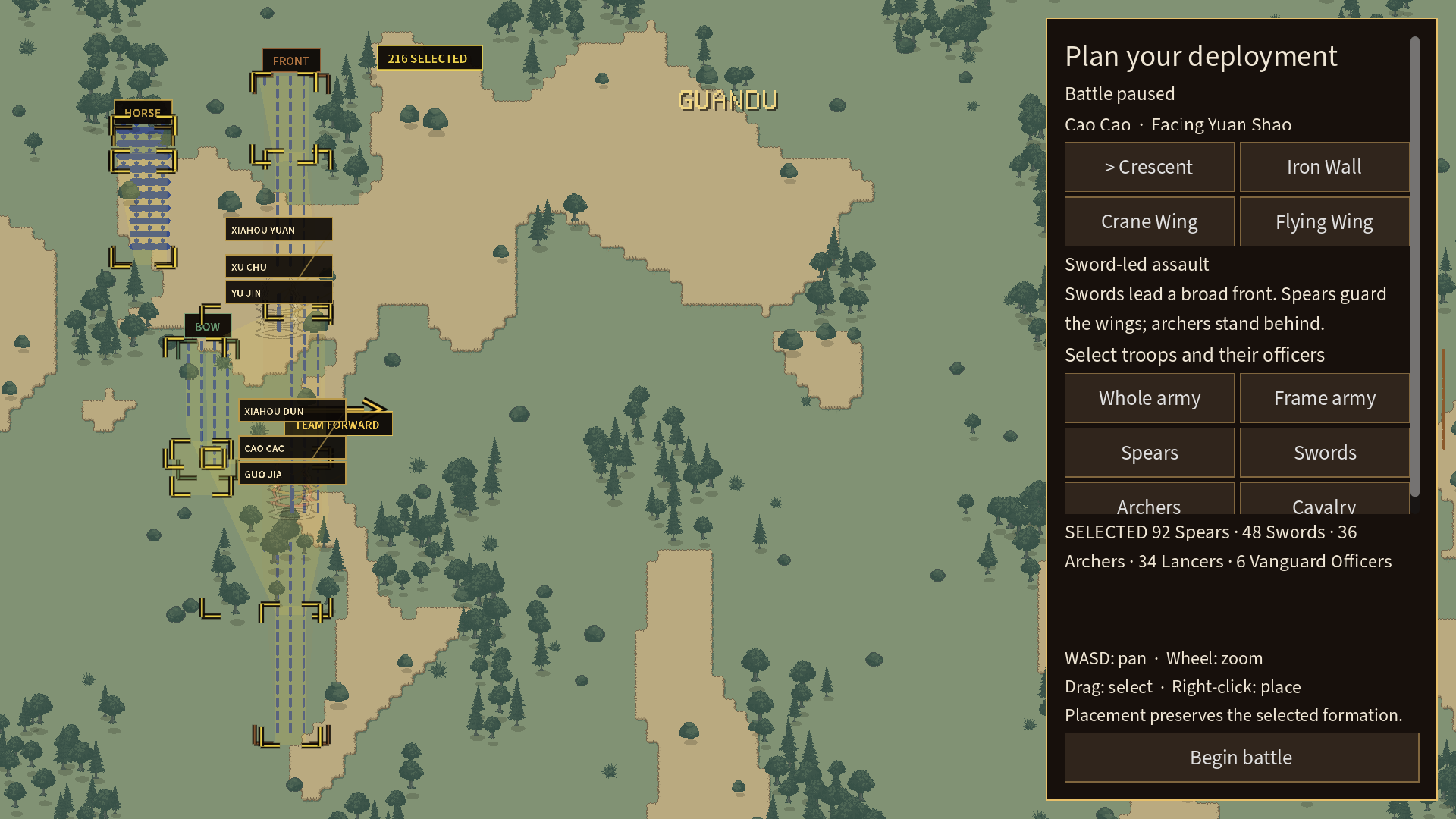
Crescent selected, with the troop breakdown visible beneath the group controls.
Crescent, Iron Wall, Crane Wing and Flying Wing now give you sword-, spear-, archer- and cavalry-led arrangements. I kept the names because they belong in this setting, but each one now says plainly what it puts forward.
These are positioning choices, not a way to leave troops out of the battle. Your party's troops still enter automatically; battlefield capacity and the arrival of reinforcements still matter. The selection readout breaks the total down by troop type, so “158 selected” is no longer the only thing you can see.
Where am I supposed to go?
Playtest feedback pointed out that campaign directions and quest indicators didn't always agree clearly enough. I found the cause: the journal, the tracked objective and the map were each carrying a slightly different version of the target.
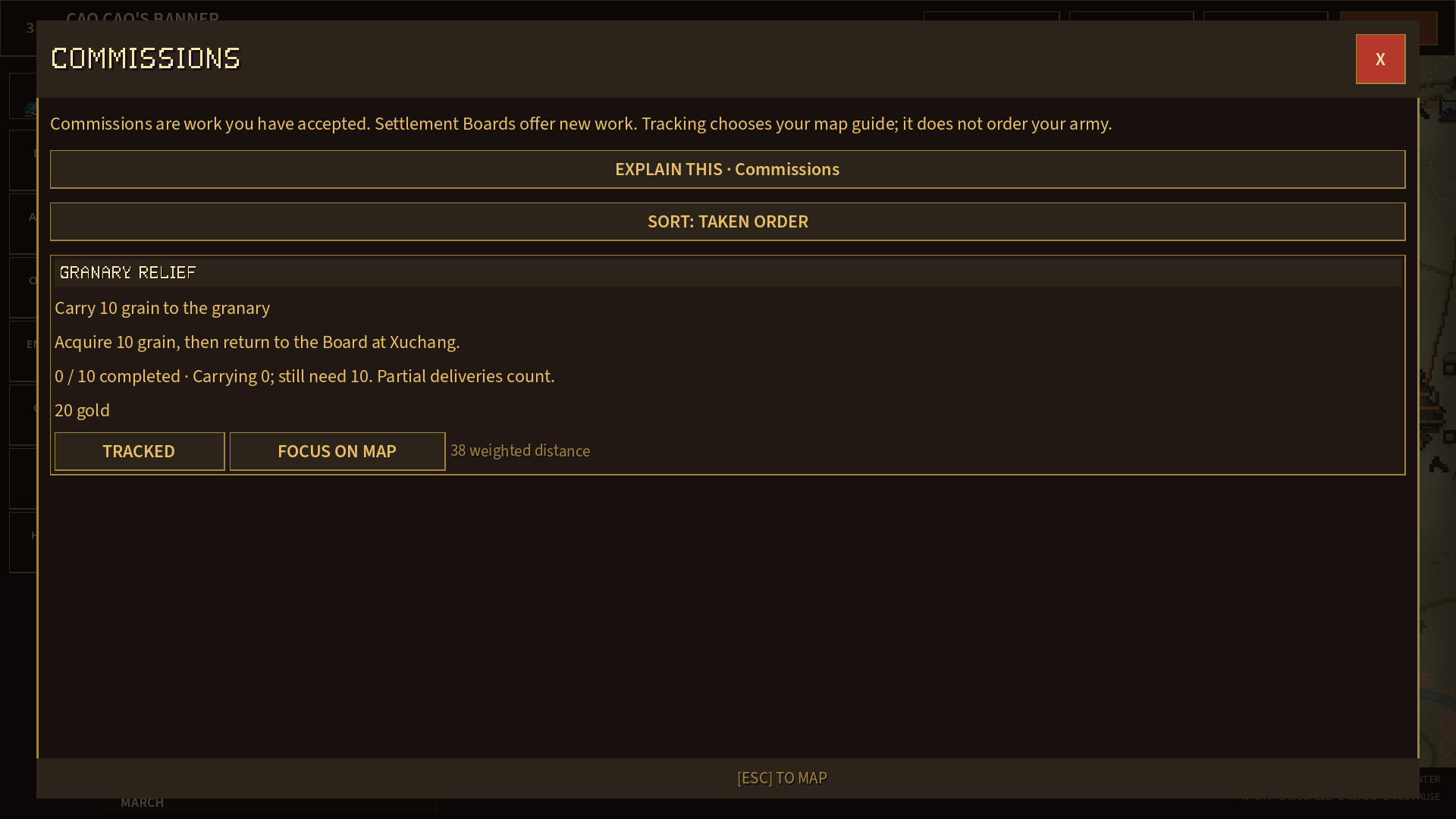
The commission tells you to acquire 10 grain and return to the Board at Xuchang. The capture is an accepted-delivery example staged to show the new link between journal, objective and map.
The commission journal, tracked objective and map focus now use the same target information. Relevant towns get a clearer commission indicator, including a red exclamation mark, and guidance inside the settlement points you toward the work.
Tracking a commission doesn't order your army to march. It chooses what the map is helping you find.
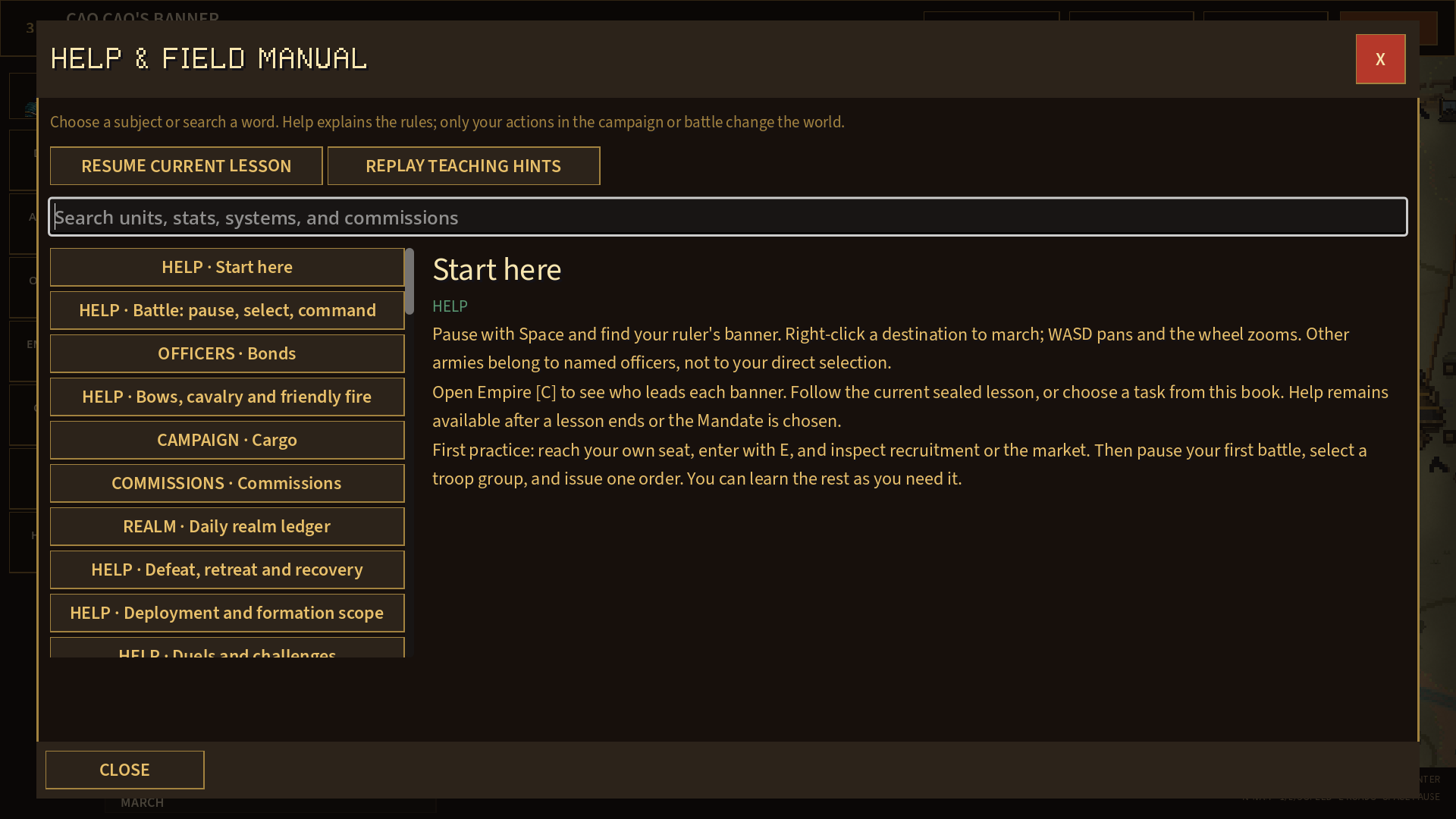
Help is easier to return to as well. You can search the field manual, resume your current lesson or replay teaching hints without starting another campaign.
Keeping the people in the picture
Alongside those controls, I've kept working on how officers' histories show through. A reinforcement can now read as a real person answering a call, a battle account can name the officer who held a breach, and the victory recap can point back to the relationships and reversals that actually shaped the campaign. It is a small amount of text, but it gives the names on the map somewhere to go.
I am not trying to turn every battle into a cutscene. The hard part is making the campaign and battles refer to the same people and places without adding a second layer of story that can drift away from what happened. That is the part I want to keep getting right.
If you've been trying the demo, where do you still stop to ask what to do next? And when you look at these changes, do the officers and places now feel more like they belong to your own Three Kingdoms story?
Thanks for following along.
— Jeremy