Playtest Beta v1.0 - the big one: 477 changes since the first build
New Game+ - Game Store Simulator Playtest · published · build 24423692
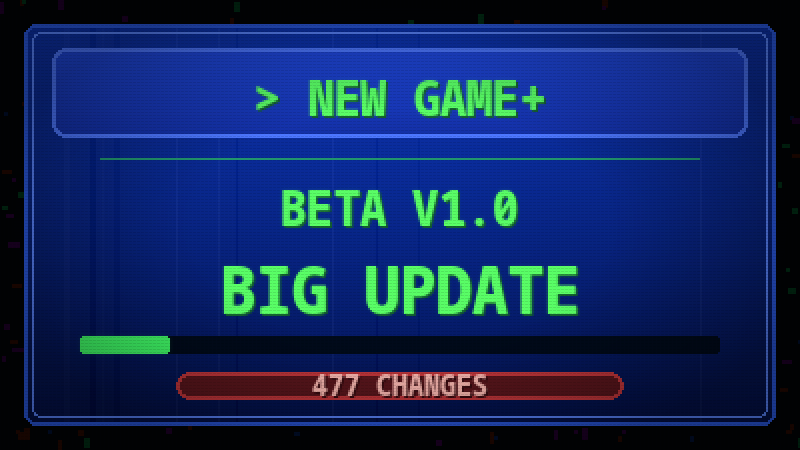
The First Big Playtest Update
It’s been quiet on this page, mostly because I’ve been buried in the game.
Since the first playtest build went live, I’ve made 477 changes, including 61 new features. This is the first proper update post, so there’s a lot to cover.
Here’s what’s changed.
The Store Now Starts Empty
This is probably the biggest change in the update.
You no longer inherit a fully furnished store. Instead, you begin with an empty, lit space and a catalog. From there, the layout is completely up to you.
Buy and place every fixture yourself, including shelves, glass cases, counters and racks.
There are now four distinct glass display cases instead of four copies of the same one.
Fixture prices are based on how much they hold and how well they present your products. Their names are also much clearer.
Customize the store with wall paint, wallpaper, slatwall, carpet and ceiling panels inspired by real early-2000s retail interiors.
Place posters, hanging signs and ceiling banners wherever you like. You can move or remove them later, and everything stays where you left it when you reload.
You can now freely look around while placing objects, place several copies in a row and undo your last placement with Ctrl+Z.
The goal was to make the store feel like something you actually built, rather than a space you were simply handed.
The Economy Has Been Reworked
A lot of the systems running behind the scenes have been rebuilt so that buying, selling and pricing feel more connected.
Customer buying decisions now come from one unified system. Demand, the current era, your prices, product placement and each customer’s personal interests all affect what they decide to buy.
Customers no longer feel like they’re following the same script. Different people can look at the same products and make completely different decisions.
When customers repeatedly ask for something you don’t carry, that unmet demand now affects what becomes popular in the wider market.
People selling items to your store have different levels of knowledge. Some know exactly what they have, while others may undervalue a rare item. You’ll need to appraise products, recognize valuable variants and decide when a deal is worth taking.
Rare finds can be listed on an online collector marketplace, where you can watch buyers bid against each other. You can also keep them in the store to attract collectors.
Pricing now matters much more. Every item has a reasonable value range, and setting the sticker price too high can drive customers away. Pricing items accurately also earns XP.
You now need to purchase a platform license before ordering that company’s games and hardware.
Rent and utility bills are now paid manually instead of money quietly disappearing in the background.
The Register Has Been Improved
Checkout has been tightened up so that it feels more physical without constantly interrupting the flow of the game.
Cash payments are now handled physically. Take the customer’s money, place it in the drawer and hand back the correct change.
The card reader on the counter now works.
Customers can bring several items to the register at once. Scan everything, then take a single payment for the full order.
Opening the register smoothly moves the camera toward the monitor, then returns you to the store when you’re finished.
Add-on sales are now handled through one clipboard and one sales pitch per transaction, rather than several prompts appearing one after another.
There are also age-rating situations involving a child, a parent and an ESRB rating. You can choose to complete the sale, warn the parent or refuse the sale entirely.
Customers Feel More Like People
The first playtest made it very clear that customer behavior needed more attention, so a lot of work went into how people look, move and shop.
NPCs now have more variation in their clothing, hair and colors, so the store no longer fills up with obvious clones.
Customers browse the part of a shelf where the product is actually located instead of staring at the middle of the fixture.
They now walk all the way to the register instead of stopping awkwardly a few feet away.
The long stand-offs where two customers blocked each other are gone.
Groups now behave properly. Parents and children, couples and groups of friends each keep their own identities instead of being treated like unrelated NPCs standing near one another.
Minigames and Progression
Several of the game’s side activities and progression systems have also been expanded.
There’s a new Lock & Key arcade prize machine.
Both trade-in inspections and the repair bench have received much deeper gameplay passes.
The upsell sequence is now an arcade-style sales board. You can keep pushing for another add-on, but every attempt uses some of the customer’s patience.
There are six level-gated skills spread across 19 categories and 70 tiers. These unlock changes you can actually see and use around the store.
The end-of-day level-up screen now tells you exactly what you unlocked.
A new Progression tab shows what you already have and what’s coming next.
Grails introduce rare trade-ins, collectible sets, a protected trophy case and a separate market for flipping valuable items.
Midnight launches now include a coming-soon teaser, a full launch-day presentation and a line of customers waiting outside the store at midnight.
Performance and Download Size
The game should now take up much less space and run more smoothly.
The download size has been cut by more than half and is now 5.4 GB, with no intended reduction in visual quality.
Old mobile textures, unused assets and unnecessarily large imports have been removed.
A Graphics Quality setting has been added under Settings → Display, with Low, Medium and High presets.
I’ve also tracked down a long list of small freezes and stutters caused by things such as NPC spawning, picking up boxes, scanning the first item, rebuilding shelves and opening the register screen.
Stability
For anyone who couldn’t get the first build running, please give this version another try.
The game now detects the AMD and Vulkan combination that was causing crashes and switches to D3D12 before loading the game.
If the game fails to launch twice, it will automatically try a different renderer.
The loading screen can no longer sit there forever. A watchdog now detects unusually long loads and lets you know when a slow disk may be the cause.
Crash logs now save correctly. Previously, the most important part of the log could be lost, which is why some reports arrived nearly empty.
The game now tells you when safe mode has lowered your graphics settings instead of silently making the game look worse.
You Reported It, I Fixed It
These fixes came directly from the first round of playtest reports.
New games freezing or crashing at 35%: This was caused by the AMD and Vulkan issue. The game now detects it and switches renderer before loading.
Display cases couldn’t be removed, making the store feel prebuilt: They can now be removed, and new stores begin completely empty.
Changing furniture controls from the main-menu settings caused a crash: Fixed.
Customers became stuck on each other: The long stand-offs have been removed.
Items could be picked up from across the store: Your interaction range is now properly limited.
Missing collision allowed players to leave the map: Those areas have been sealed.
NPCs walked through buildings: Fixed.
Customers sometimes disappeared while still inside the store: They now leave through the door before despawning.
Arcade machine screens broke after loading a saved game: Fixed.
Cars disappeared too quickly, and the taxi had no rear wheels: Both fixed.
Delivered boxes had oversized collision areas: Tightened.
Some online-order fields were missing text: Fixed.
The hint bar displayed controls for actions you weren’t performing: Fixed.
Some text was too small to read comfortably: The entire game has received a typography pass, and small labels have been moved to a consistent, readable size.
Stock could only be ordered one copy at a time: Every item now has +1, +5 and +10 quantity buttons.
Thank You
Seriously, thank you to everyone who tried the first build and sent feedback.
Those reports directly led to many of the changes above, especially the crash-on-launch fix and most of the improvements to customer behavior. They’ve been incredibly useful.
When something feels wrong, please report it directly or post it in the community hub. Even the small things help.
More soon.