Welcome to our fifth Dev Diary, where we return to the world of DREADMOOR and talk about something that sits at the heart of the game’s atmosphere: tension.
In our previous Dev Diaries, we looked at the world of DREADMOOR, the importance of fishing, the Sea Blight, and what came after the collapse. All of these things are connected by one shared idea, which is that danger in DREADMOOR should not only exist when something is attacking you, it needs to exist "in the world" as well.
Of course, there will be threats so players will need to defend themselves, however, constant combat is not what we are aiming for. Why? Because DREADMOOR is not meant to be a game where fear only begins when an enemy appears on screen, instead, we want tension to build from the world itself. This ranges from the fog that obscures your vision, the silence that makes every sound feel sharper, the distance between you and safety, and the very setting of the world (rotting, infected, mutating).

Here’s a new weapon teaser, very primitive, but effective when it comes to breaking objects!
Why Tension Matters
DREADMOOR is not being built as a traditional horror game, at least not in the sense of jump scares, sudden attacks, and endless encounters with monsters. Instead, it sits closer to something more horror-adjacent, a game built around tension, suspense, and the feeling that the world around the player is not fully safe.
That distinction is important to us because while there will be active threats, we do not want the player to feel that the game is constantly trying to scare them. There will be moments where they have to react quickly to defend themselves or to deal with something directly dangerous, but those moments work best when the tension has already been building before anything actually happens.
For DREADMOOR, much of that tension comes from uncertainty, as we want the player to not always know whether a sound, a place, a light, or a stretch of water is harmless or dangerous. Sometimes there will be a threat, sometimes there will not be, but the possibility should always be there in the back of their mind.
This is where the slower side of DREADMOOR comes in. If danger only exists during combat, then the player starts thinking only in terms of enemies, weapons, and reactions. That can work for more combat-focused games, but DREADMOOR needs space for something quieter and more uncertain.
We still want the player to understand early on that these dangers are real, but after that, tension should not rely only on repeated encounters. It should come from the atmosphere, the setting, and the player’s growing awareness that the world around them cannot be fully trusted.
To make sure that players know that the game has these threats, they will encounter some of them (in a scripted way) early on in the game during the tutorial phases.
Atmosphere Before Combat
Because DREADMOOR is built around travel, fishing, scavenging, and moving through places that are rarely fully safe, the quieter moments need to carry weight as well. How? Well, a ruined building does not need to be full of enemies to feel unsafe. Think about it like this: if you're in a swamp, it's dark, you're alone, and you come across a wooden house that is somewhat falling apart, you're not going to feel that safe.
When it comes to the water, we want players to know that calm water does not mean “safe” as you never quite know what lurks beneath. Then we have the day/night cycle, which changes the world itself. For example, fishing at night will not feel the same as fishing during the day. The same logic applies to pretty much all of the game.
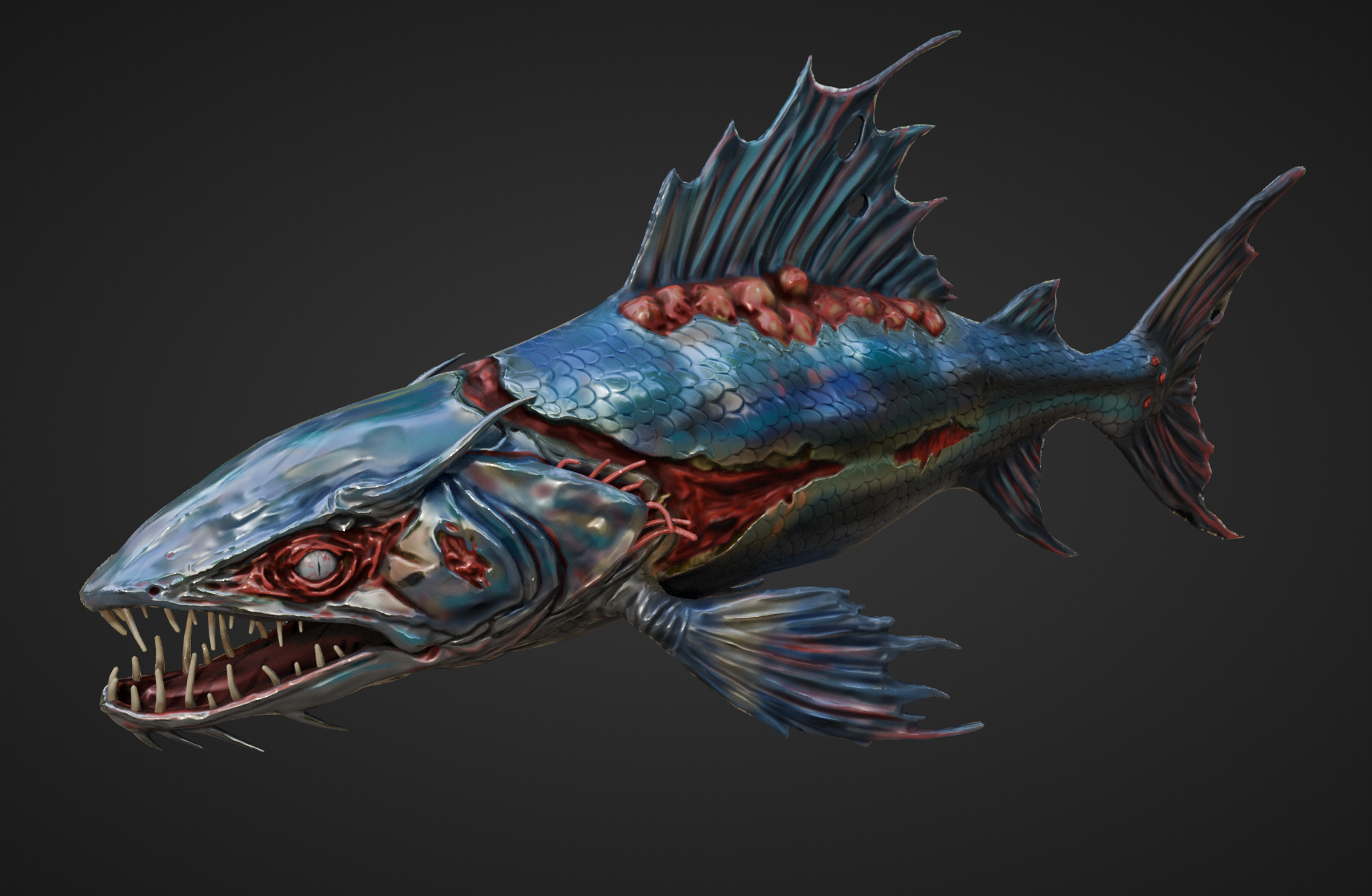
One of the new fish we’ve added, it can stealthily glide through the water!
This is where atmosphere becomes one of the most important tools we have.
Fog, for example, hides the world, but it also makes the world feel larger. When visibility is limited, the player has to imagine what might be beyond what they can see, and quite often, what the player imagines can be just as effective as what we show them.
Light works in a different way. In a world filled with rot and decay, warm light can feel rare and almost comforting. A light in the distance may suggest safety, but given the world as it is now, it can also be a trap as you can never be too sure what causes that light (think of the female Anglerfish and how they have a light to lure prey). At the same time, cold tones, low visibility, and strong contrast can make the player feel exposed, even before any threat appears.
Weather helps push that feeling further. Haze, rain, grey skies, and poor visibility can make the world feel heavier and more melancholic, while also changing how safe the player feels. The world does not need to be loud or chaotic to feel hostile. Sometimes, a quiet place under dull light can do more than an obvious monster.
Sound as Part of the World
Sound design is one of the main ways we want to make DREADMOOR feel alive. Not alive in a comfortable way, but alive in the sense that something may be moving, creaking, splashing, or shifting somewhere nearby. The player may hear danger before they see it, and that gives sound a lot of power.
Sounds such as a splash in the water, a distant cry, wind moving through broken structures, or the creaking of the boat can create tension without forcing combat to happen immediately. What matters is not only the sound itself, but the uncertainty that follows it. What we want is for the players to ask themselves (whenever they hear the sounds) questions like Was it just water? Was it the boat? Was it something in the distance? Was it something below?
The important part is that not every sound needs to be answered right away, that said, our goal is not to constantly trick the player, but to make the world feel active even when it is not directly attacking them.
Our thoughts on this is that a silent world can feel empty, whereas a world filled with quiet, uncertain sounds can feel inhabited, even if the player cannot see what is making those sounds.
Beauty, Decay, and Melancholy
If you read our previous dev log "Dev Diary #4: The World After the Collapse," the final section, titled "What we want DREADMOOR to feel like", introduces our vision that DREADMOOR is a dark world, but that does not mean it should be visually ugly all the time.
This is an important distinction for us, especially when it comes to tension. If everything is grotesque, hostile, and unpleasant to look at, the player may eventually stop looking closely. But if the world can also be beautiful, quiet, lonely, or almost peaceful, then the unsettling parts stand out more.
A flooded ruin can be beautiful because of the light hitting the water, a swamp can feel calm because of the stillness, and mutated creatures can still have brilliant rainbow like colours on their scales.

Material from creatures can still have an interesting color!
That contrast is where a lot of DREADMOOR’s mood comes from, the beauty draws the player in, while the decay reminds them that the world is broken. Then, on top of that, the silence gives them (the player) space to breathe, while the setting reminds them that silence can, in fact, be dangerous.
The world is frightening not only because there are monsters, but because it is a world after loss. Humanity survived, but survival did not mean recovery, and the places the player explores should carry that feeling with them.
Where Combat Fits
That said, DREADMOOR is not a game without combat or direct danger.
There are mutated creatures, dangerous regions, and times when the player will need to defend themselves. Though we steer away from constant combat, ultimately combat still matters because the world is dangerous, and that danger needs to feel real. With that in mind, we've made it so that combat works hand in hand with the tension found everywhere in our game.
If the player hears something before they see it, the encounter begins emotionally before it begins mechanically. If they know they are far from safety, then even a smaller threat can feel more serious. If resources are limited, the world becomes more frightening without needing to constantly throw enemies at the player.
And for us, that is the balance that we aim for. Combat should be part of the danger, but not the only source of it.
What We Want DREADMOOR to Feel Like
What we want is for DREADMOOR to feel like a world that is never fully still, even when it is quiet.
Not everything will attack you, not every sound means danger, and not every beautiful place is unsafe. But the player should never be completely certain. The tension should come from their relationship with the world itself, from the fog, the water, the distance from safety, the strange sounds, the infected places, the shifting light, and the knowledge of the game itself. After all, as we've said a few times now, DREADMOOR is a world where humanity survived the end, but survival did not mean comfort, safety, or recovery.
That is why we lean into tension and melancholy, because the world is not only dangerous when something attacks you, sometimes, the world is dangerous simply because you are there.
About DREADMOOR
DREADMOOR is a dark first-person fishing adventure game. Anglers explore both land and sea, fishing for a wide variety of aquatic creatures lurking in the depths of the treacherous waters, and fighting their way through a flooded wasteland filled with danger and mystery.
https://store.steampowered.com/app/3629430/DREADMOOR
OFFICIAL LINKS
Join us on Discord → https://discord.gg/dreadmoorgame
Follow on X → https://x.com/DreadmoorGame
Discuss on Reddit → https://www.reddit.com/r/DreadmoorGame
Watch on TikTok → https://tiktok.com/@DreadmoorGame
Explore on Instagram → https://www.instagram.com/DreadmoorGame