Feature spotlight #1: Highways & interchanges - when more lanes aren't enough
Traffic Architect · published
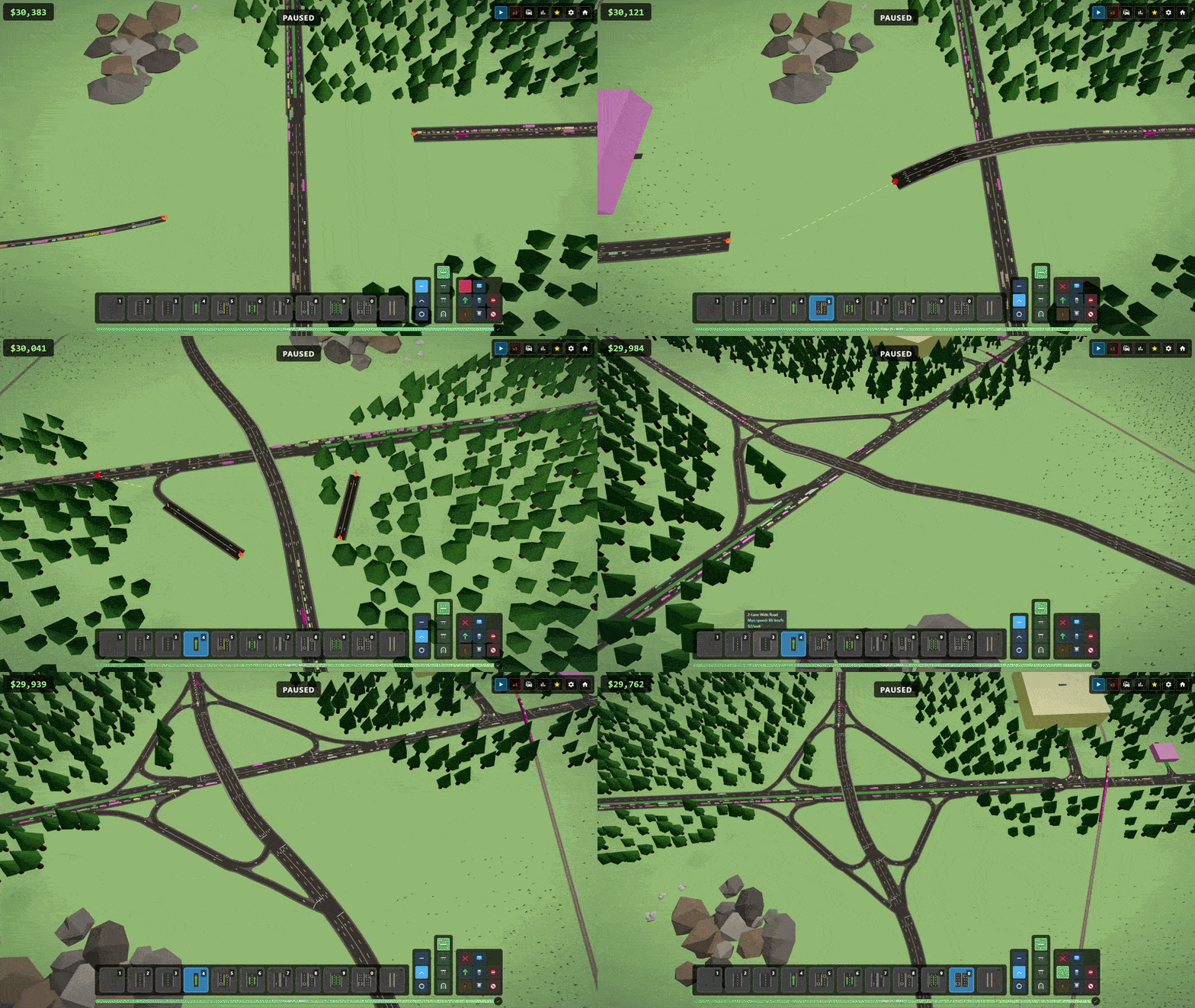
Every city in Traffic Architect hits this moment: a crossroad that used to work fine is now a parking lot. You've upgraded the roads, tuned the lights, and it's still red. The problem isn't the road anymore - it's the intersection. A signalized junction serves one direction at a time, and cars won't even enter it unless there's space on the other side ("don't block the box" is a hard rule in the sim) - so one overflowing exit can freeze the whole thing.
The real-world answer: grade separation. In the clip above, the same spot rebuilt as a cloverleaf interchange - through-traffic flies over, turns loop around, zero traffic lights. Same demand, no more queue.
The speed ladder
Every road tier has a real speed limit: gravel 30 km/h, normal streets 70, wide roads 86, boulevards 100-120 - and highways top out at 140 km/h. Trucks and buses run slower on every tier (112 km/h on a highway), so heavy traffic shapes flow differently than car traffic.
And this matters because of how routing works: cars don't take the shortest path, they take the fastest one. Route cost counts real speed limits, sharp turns (a U-turn "costs" ~30 seconds, a gentle merge costs nothing) and every traffic light on the way. Build a highway bypass and traffic genuinely prefers it - not because a script says so, but because it wins on travel time. A signal-free interchange makes the route cheaper the same way.
Curves have physics
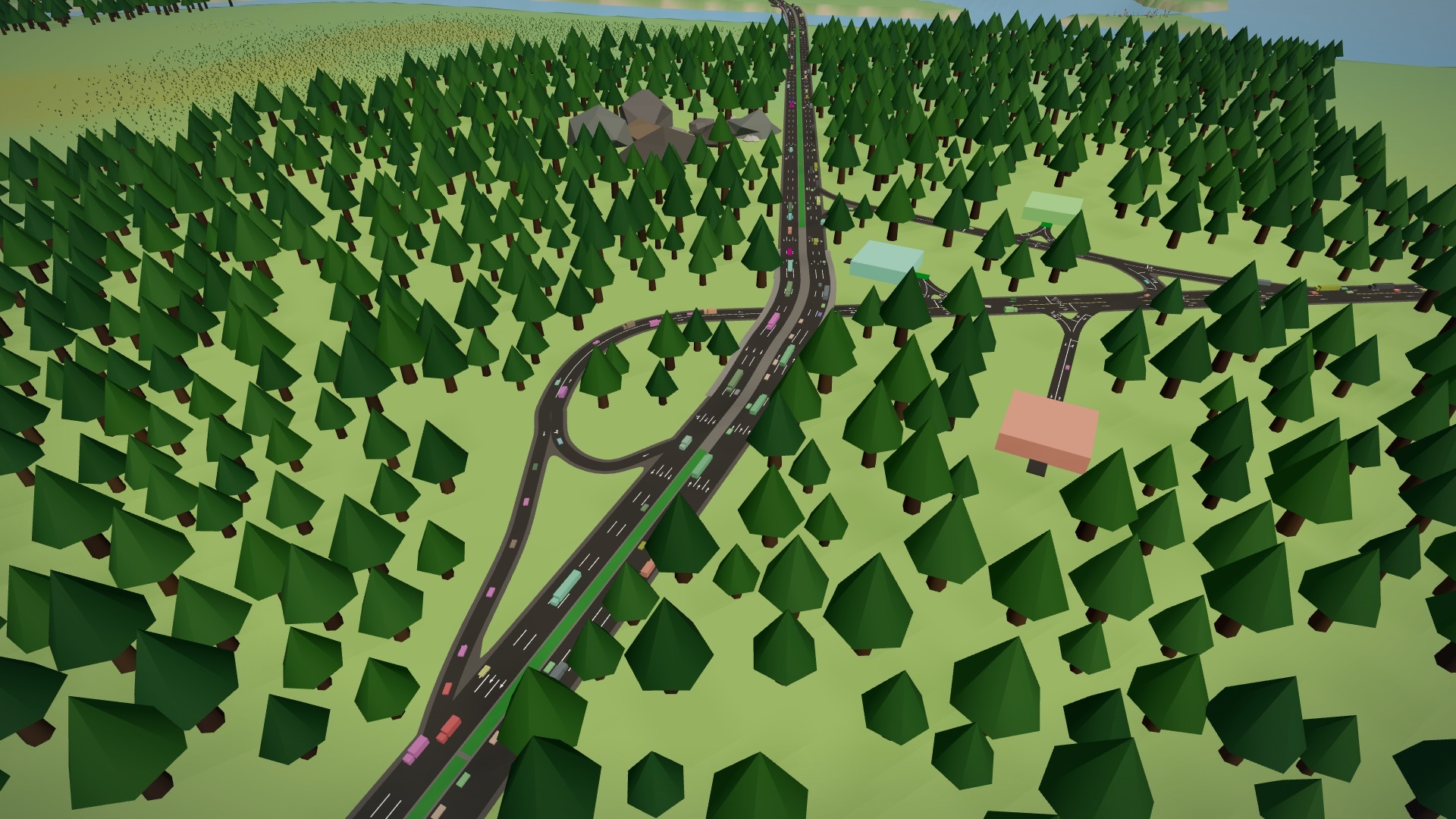
Ramp design isn't cosmetic. Curve speed limits come from actual physics - the same friction formula real traffic engineers use (v = sqrt(ugr)): the tighter the radius, the slower the car. A tight cloverleaf loop drops cars well below highway speed, a wide sweeping ramp barely slows them down. The build tooltip shows the resulting speed limit while you're drawing the curve - so "how tight can I make this loop?" is a real engineering decision with a number attached, and land is not free.
Lanes work like real lanes
Watch the lanes in the clip: nobody drifts randomly. Every car sorts itself by its exit - leaving at the next ramp means merging over in advance, going straight means holding the through lanes. Trucks keep to the outer cruise lanes while cars take the inner ones. And near a junction lane changes lock - no last-second cutting across three lanes. That's why one clogged off-ramp doesn't automatically kill the lanes going straight - and why watching where cars pre-sort tells you which movements are actually loaded.
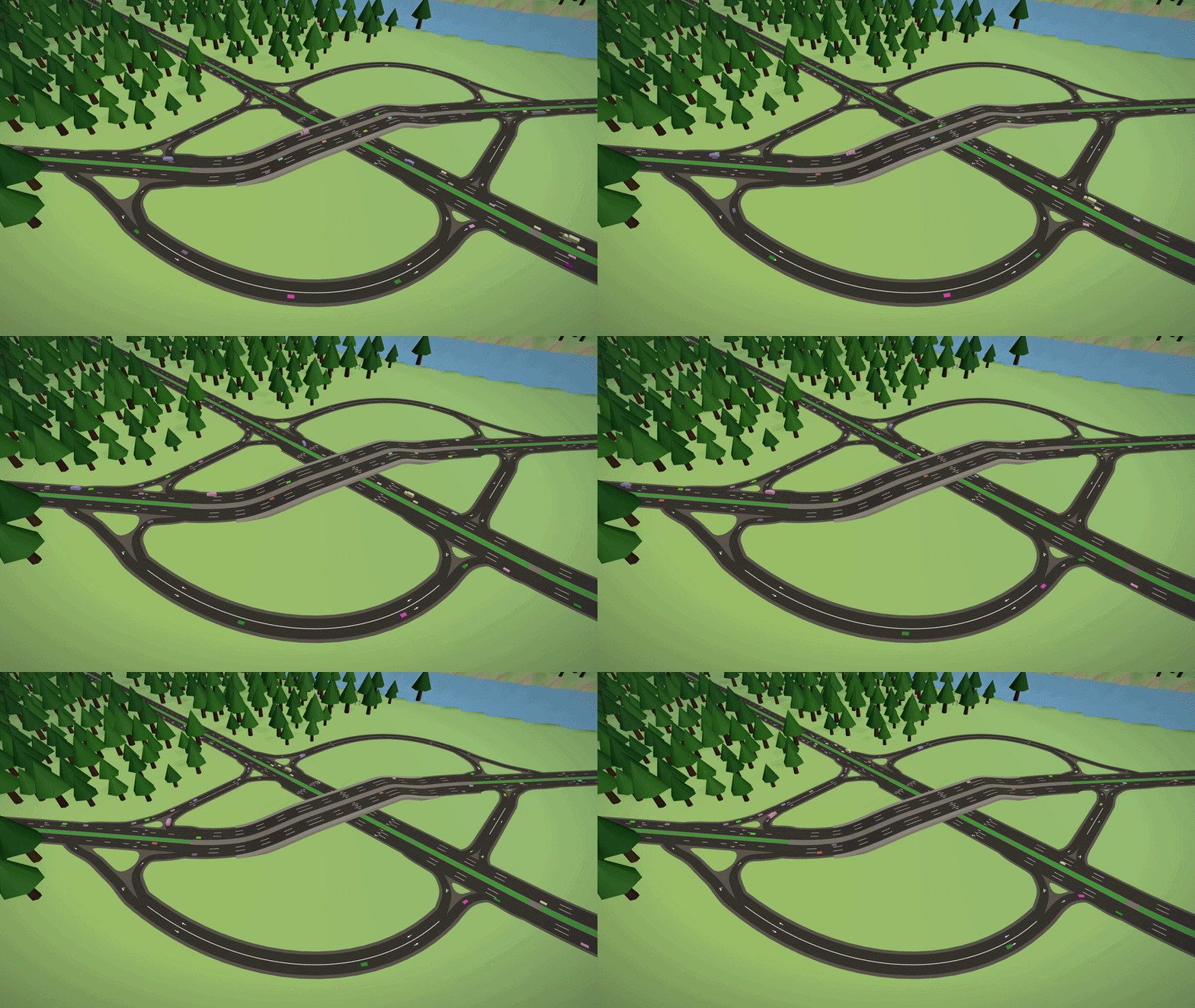
A flat junction trades throughput for order - everyone takes turns. An interchange removes the taking-turns part entirely. It costs more and eats more land, and that's the puzzle: where is it actually worth it?
What's next
This is the first post in a weekly series - bigger maps, smarter traffic tools, and public transport are coming up. Follow the page to catch each one, and if you like where this is going, a wishlist helps a lot.
https://store.steampowered.com/app/5028050/Traffic_Architect/