Traffic Architect is a traffic game first. You build the roads, the junctions and the interchanges; the city grows along them and fills them with cars. Public transport is how you take that load back off — and it's the part of the game nobody has seen yet.
A bus line is a loop
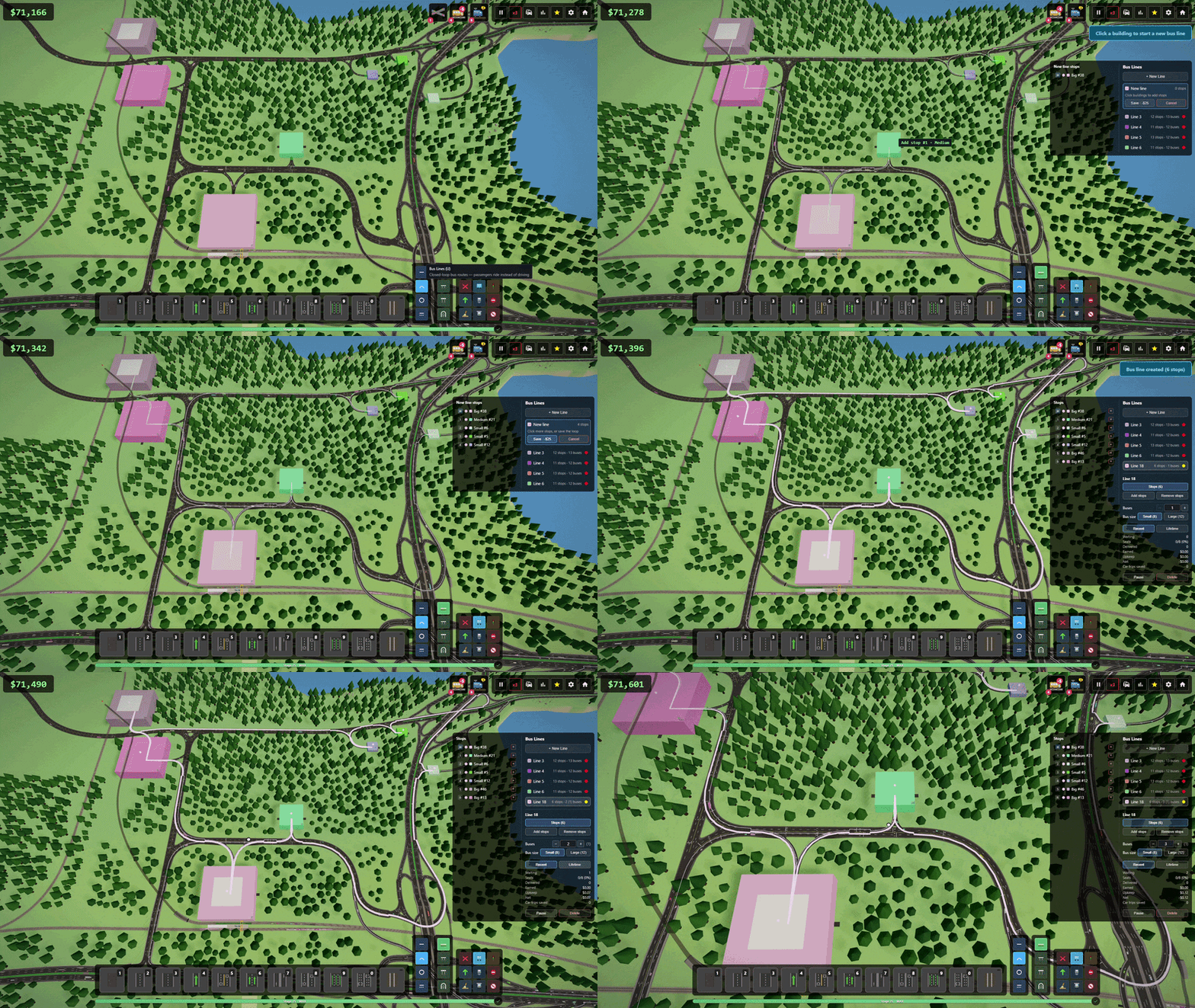
Pick a hub, add stops, and buses start running the loop.
A line is a hub building plus an ordered list of stops, and the route always closes back to the hub: hub, stops in order, hub. Buses dispatch from the hub, and the line takes its color from that building so you can read your network at a glance.
Two things you set per line. The fleet size — up to 40 buses on one line, though a route that short-cycles with 3 doesn't get better with 12. And the vehicle size: small buses seat 8, large ones seat 12 at higher upkeep and the same speed. Bigger buses are the answer to a full stop, more buses are the answer to a long wait — they aren't interchangeable.
Buses share the road with everyone else, which means they queue in the same jams your cars do. That's what bus-only roads are for: a restriction policy that lets only transit vehicles down a road, so the line keeps moving while the traffic beside it doesn't.
Who actually rides
Passengers aren't assigned to your lines. Each trip weighs the transit option — the wait plus the ride — against how long driving would take, and picks transit when it comes out close enough. People will accept a noticeably slower journey; they won't wait forever, and a line whose bus is always far away simply doesn't get used. Speeding up a line does two things at once: existing riders arrive sooner, and trips that were rejecting the line start choosing it.
The economics are a trade, not free money. A ticket costs the passenger half what the same trip would cost them by car — part of why they'll accept a slower journey — which means you collect half as much when they ride, while the line drains upkeep whether it's full or empty.
That doesn't mean lines lose money. A busy, well-shaped line pays for itself: the game charts transit profit, reports each line's profitability over a recent window, and flags any line whose upkeep has outgrown its fares. Optimize the route, run the right number of vehicles at the right size, and the line lands in the black.
Freight rail is the strongest case of all. A freight train intercepts deliveries that would otherwise have gone by road, and it pays only a dollar less than that road run would have — a far smaller discount than passengers take. A full wagon earns the same whether it's carrying people or goods, so the choice between them is about what your city actually demands, not about which one pays.
The way to read all of it: an empty line is the worst thing on your map. A busy one buys road capacity, and frequently pays for itself as well.
Trains, and what they do to your roads
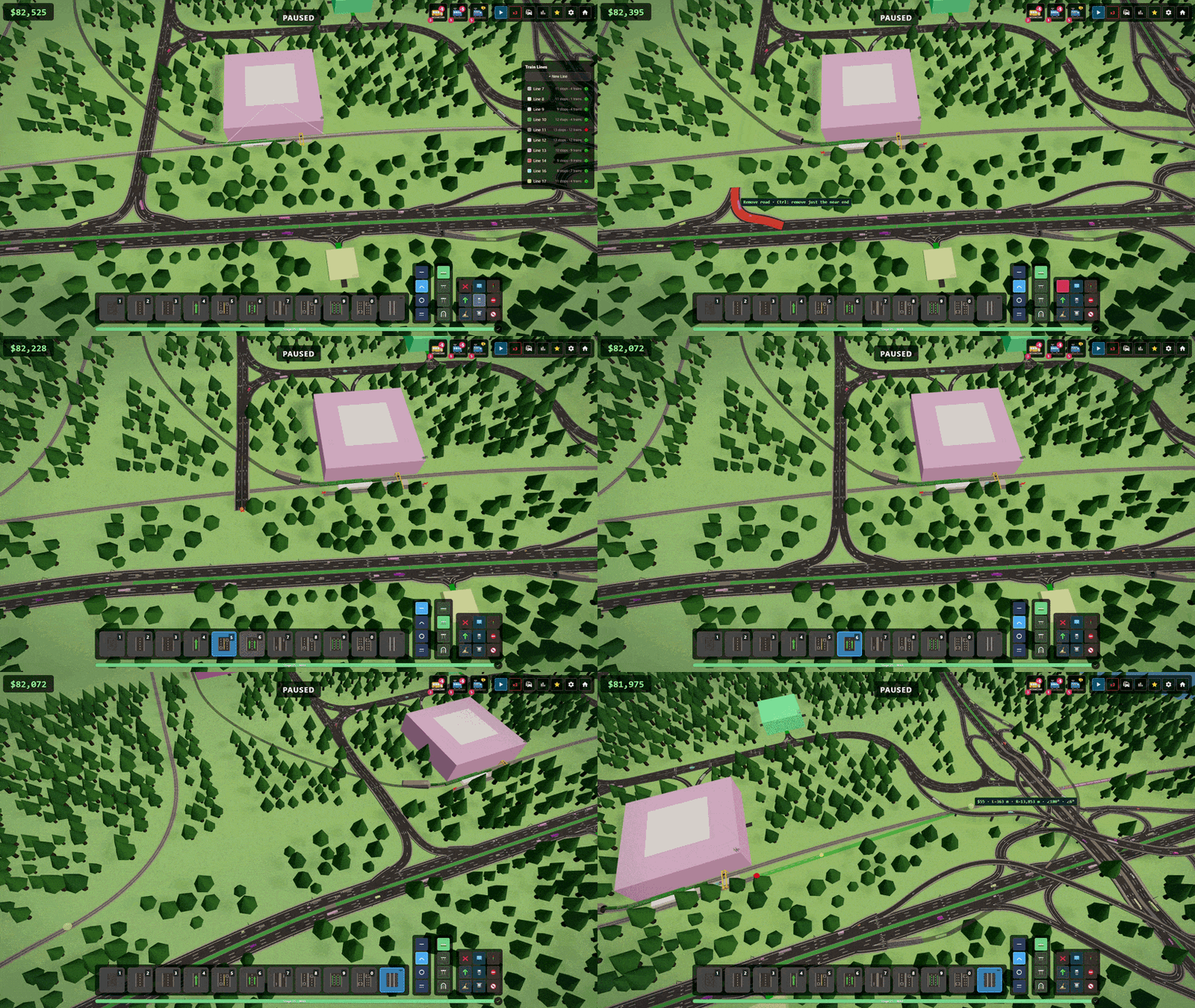
Upgrading a station to two tracks in place, then laying the rail to feed it.
A station is built onto a building and comes with its own platform track, locked in place along that face. Its two open ends are where your rail may connect — so a station is also a commitment about which way the line will run. From there you draw rail out across the map: over rivers, through hills, alongside the highways that are already there.
One track is fine until the line gets busy. Then the second train waits for the first, and the whole timetable stretches. Upgrading a station to two tracks happens in place and charges only the difference — no demolishing, no re-routing the line — and with the extra rail feeding it, both trains keep moving. A train is a locomotive plus wagons, so capacity per departure is large; the constraint you hit first is almost always the station, not the train.
Where rail crosses a road at grade you get a level crossing, and the cars stop every time a train comes. Early on that's a fair price. Once the line is busy it's a junction that jams on a timetable, and the answer is to tear out that piece of road and put a bridge over the railway instead — one drag: ramp up, span, ramp down.
Metro
No room on the surface? Go under it. A metro station is placed underground, and down there the platform rotates freely instead of being tied to the building above — which is the whole point of going under a downtown with nothing left to demolish. Metro track is passenger-only, so it never shares with freight.
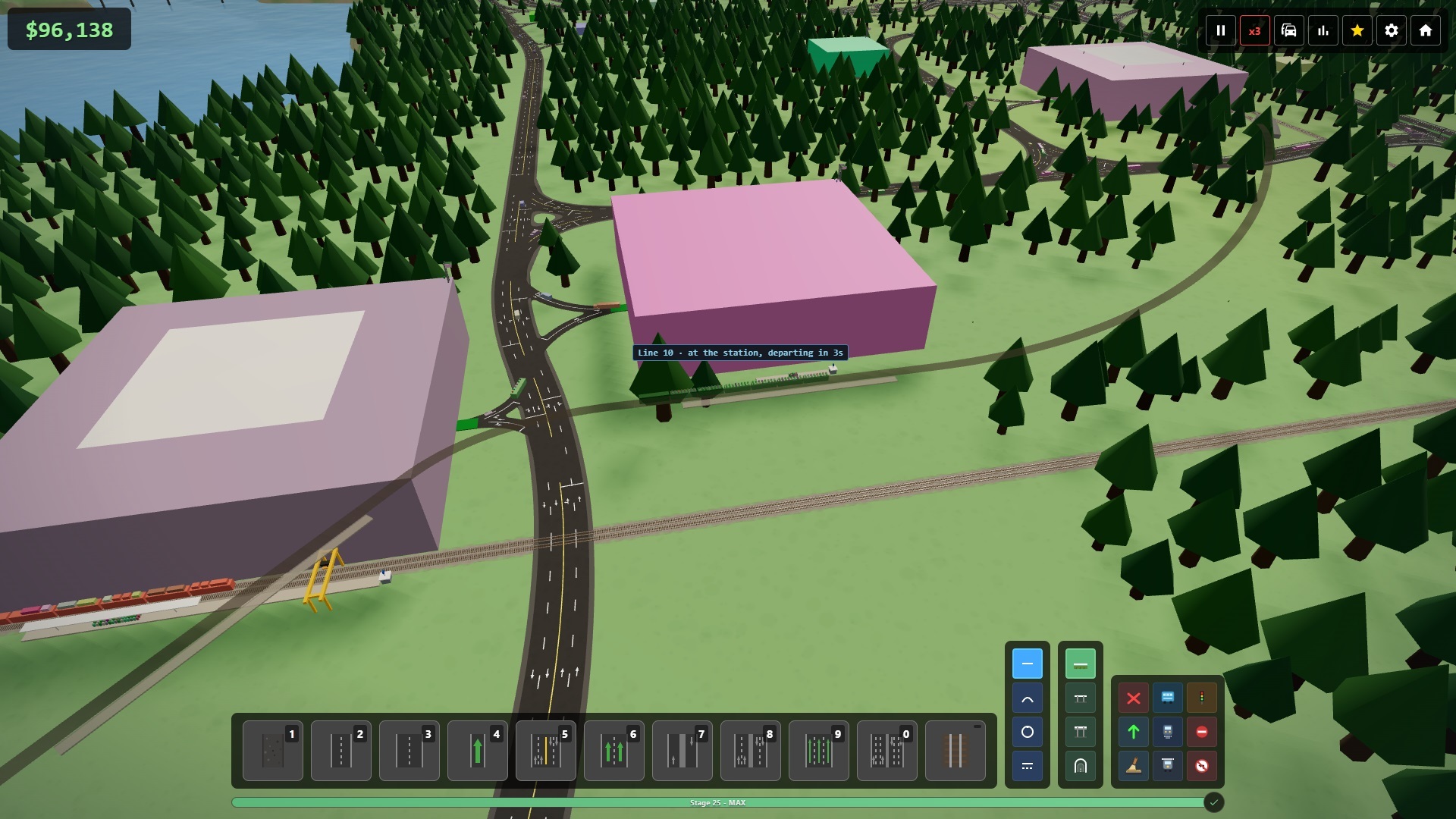
One station serving both surface rail and the metro line underneath it.
One network
Passengers route across your entire network — bus, rail, metro, transfers included. Build connections, and people will use them.
A journey can use one transfer, and it can cross modes: bus to train, train to bus, bus to bus, train to train are all found by the same search. The two lines split the credit — each books half the fare and half a saved car trip — so a feeder route that never carries anyone door to door still shows its work in its own stats. That's the number to look at when you're wondering whether a short connector line earns its upkeep.
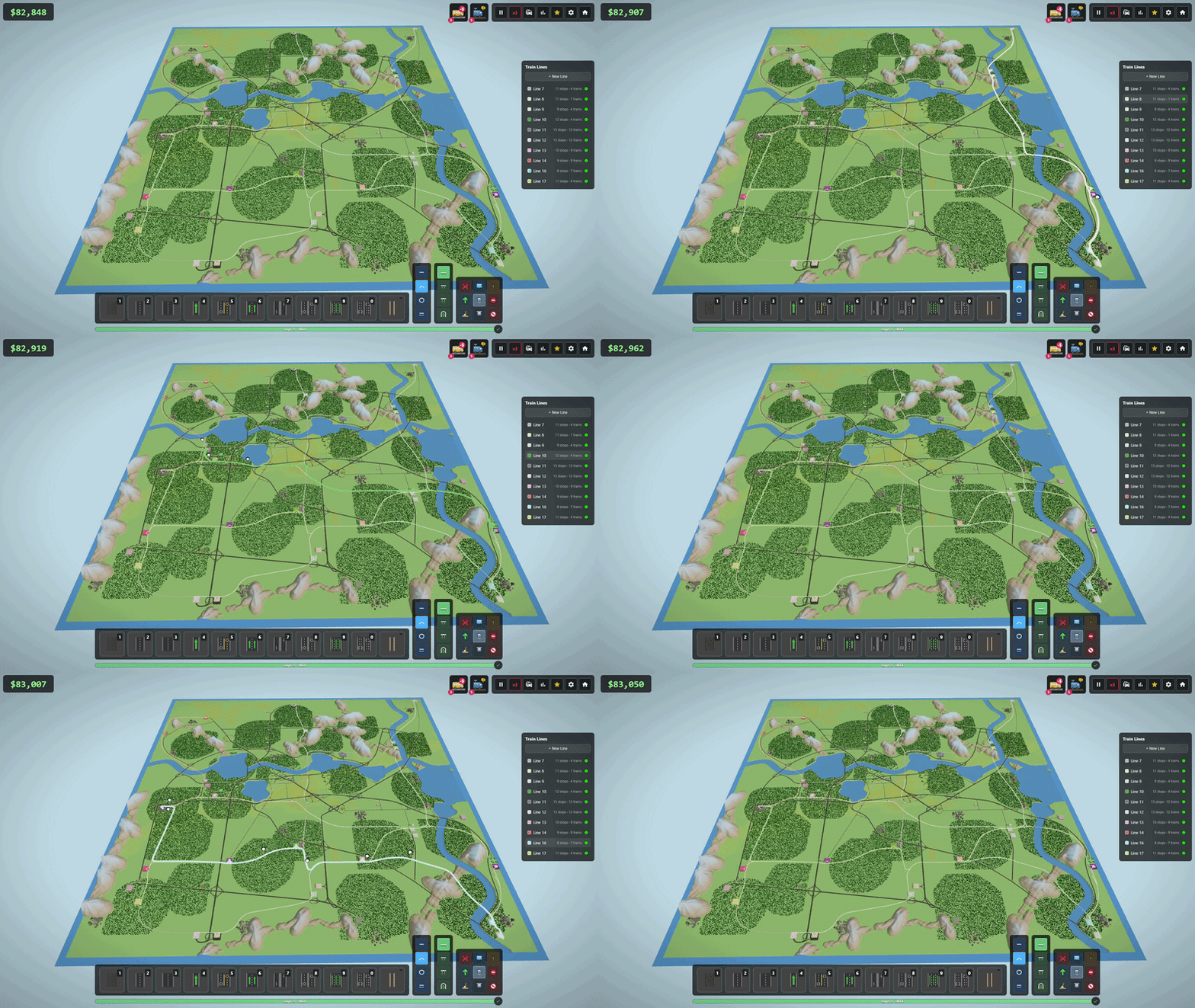
Ten lines running at once, late in one city.
Every line reports its own passengers delivered, car trips saved and money earned, and the transit-share chart tracks the split live: how much of all travel your network carries, bus and rail counted separately, against everything still going by road.
You don't have to hunt for problems
An icon appears in the corner only when there is something to see. Hover it to read what's wrong; click it and the camera flies to the offender, click again to cycle through the rest of them.
On the transit side that means:
- Crowded lines — people aren't fitting on: add vehicles, or larger ones; on rail, more wagons.
- Broken lines — the route no longer connects, usually because a road the line needed got demolished.
- Unprofitable lines — upkeep has outgrown the fares.
- Deadlocked trains — two trains blocking each other, and the track layout is what needs fixing.
And the road side keeps its own: disconnected buildings, overloaded buildings, congested junctions, dead ends created by one-way rules — and policy-isolated buildings, the one that catches you after a clever bus-only street: reachable by road, but blocked by your own access rules.
Nothing here is a pop-up demanding attention. The icons sit there while your city runs, and they're how you find the junction that's ruining your afternoon without knowing where to look.
The number that matters
That transit share is the whole point — and it only means anything because you built the roads underneath it.
Traffic Architect on Steam — wishlist to hear when it launches