Every article so far has been about carrying traffic — interchanges, then buses, trains and metro. This one is about where the traffic comes from. In Traffic Architect you don't need to worry about building the city: it grows on its own, and every building it grows is a machine that makes cars. This is how that machine works, and what it looks like now.
The city grows on a clock
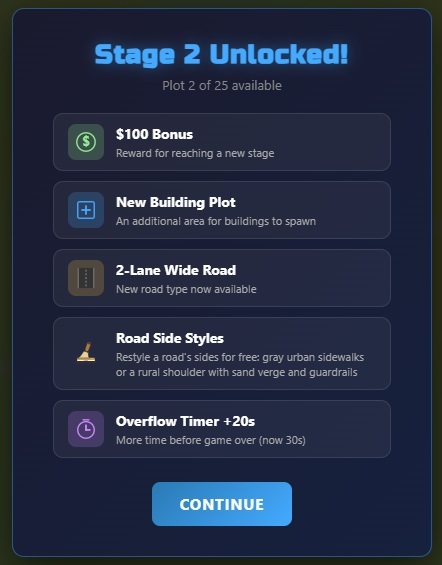
A new plot opening at the edge of town. Buildings will start appearing in it on their own.
The map is divided into plots, and you start with a few of them open. The clock starts the moment you lay your first road. From then on the game moves in stages: each one runs for a set time, and when it ends a neighbouring plot opens up — along with a reward. Some stages hand you money, some unlock a new road class or the traffic light tool, and some make every building on the map a little more forgiving, which you will care about in a minute.
Buildings appear inside the open plots by themselves, one at a time, and they keep their distance from your roads rather than lining them. They also gather. The first few form a downtown; later arrivals either join it or start a satellite town of their own, so a long run ends with a real centre and a scatter of suburbs, not an even sprinkle. You never choose where a building goes, and that is deliberate — the network has to answer the city, not the other way round.
Creative mode flips both rules. There, stages advance by the cars you deliver rather than by the clock, you pick which plot opens next, and you place the buildings yourself with permits you earned by serving traffic.
What a building is made of
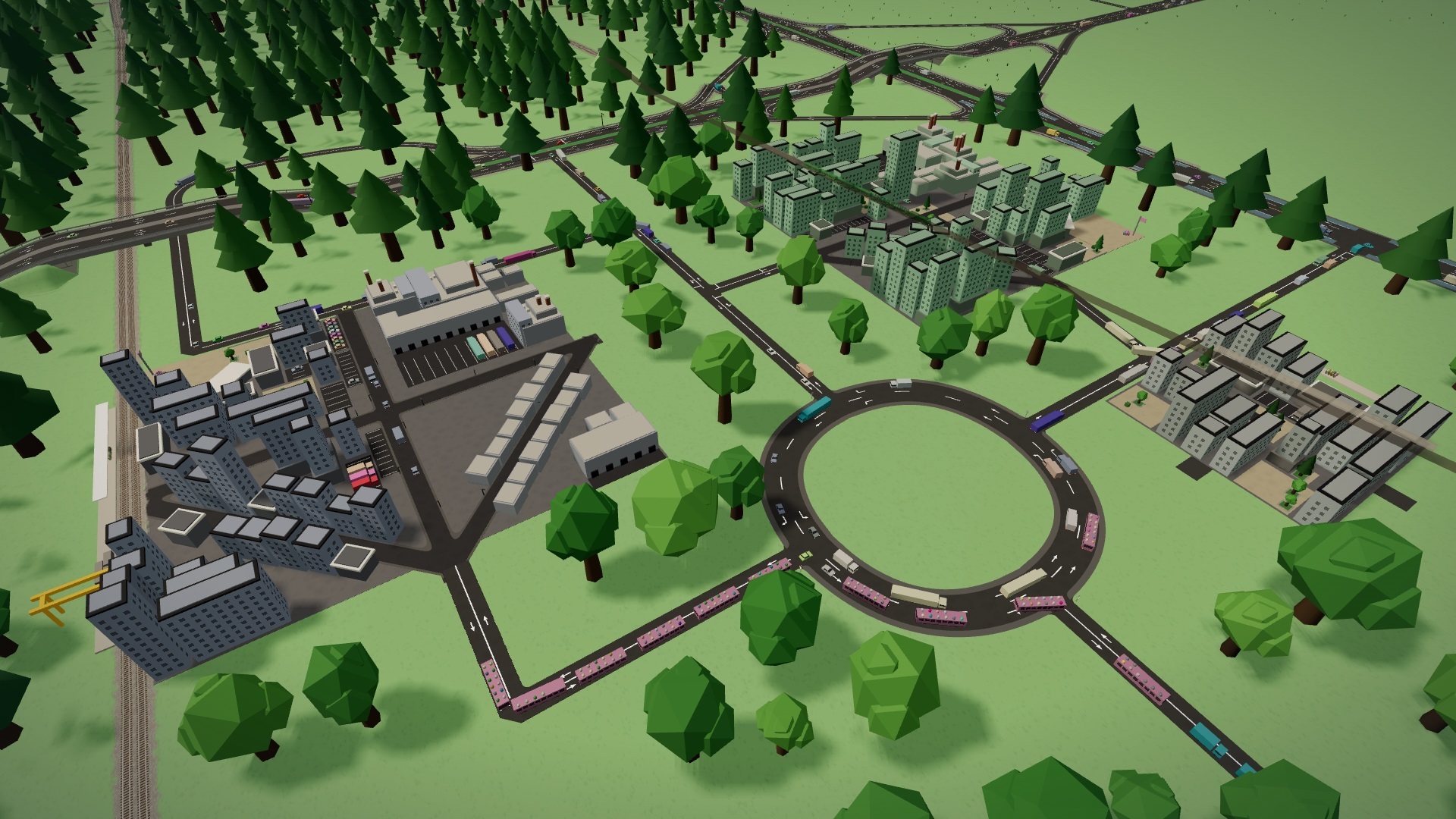
Districts up close: a block of streets with the buildings set along them.
Buildings come in three sizes — small, medium and big — and a bigger one generates traffic faster and pulls more of it in. Each one is a district now rather than a single shape: a small block of streets with buildings along them, a size and a character of its own.
Those streets are not decoration. Every building has always had a road network inside it, connecting its access points to each other, and through-traffic has been driving those lines the whole time — when you saw a car cut across a block, it was on a real road that simply had nothing drawn on it. The visual pass drew them. Same lines, same cars; you can just see them now.
Every building is both a source and a destination. On its own schedule it generates a trip, picks somewhere on the map to go, and puts a car in its queue. The car leaves as soon as there is a route to drive, and when it arrives you get paid. Delivered cars are the income; roads are the cost.
There are three kinds of car, and they don't go to the same places. Small cars go everywhere. Cargo vans go most places. Trailers only run between the buildings big enough to receive them — a house will get a delivery van, but a semi never turns into a residential street unless you route it there yourself. Where a trip goes is weighted by what the destination wants, which is the mechanic the special buildings below are built on.
The queue is the game
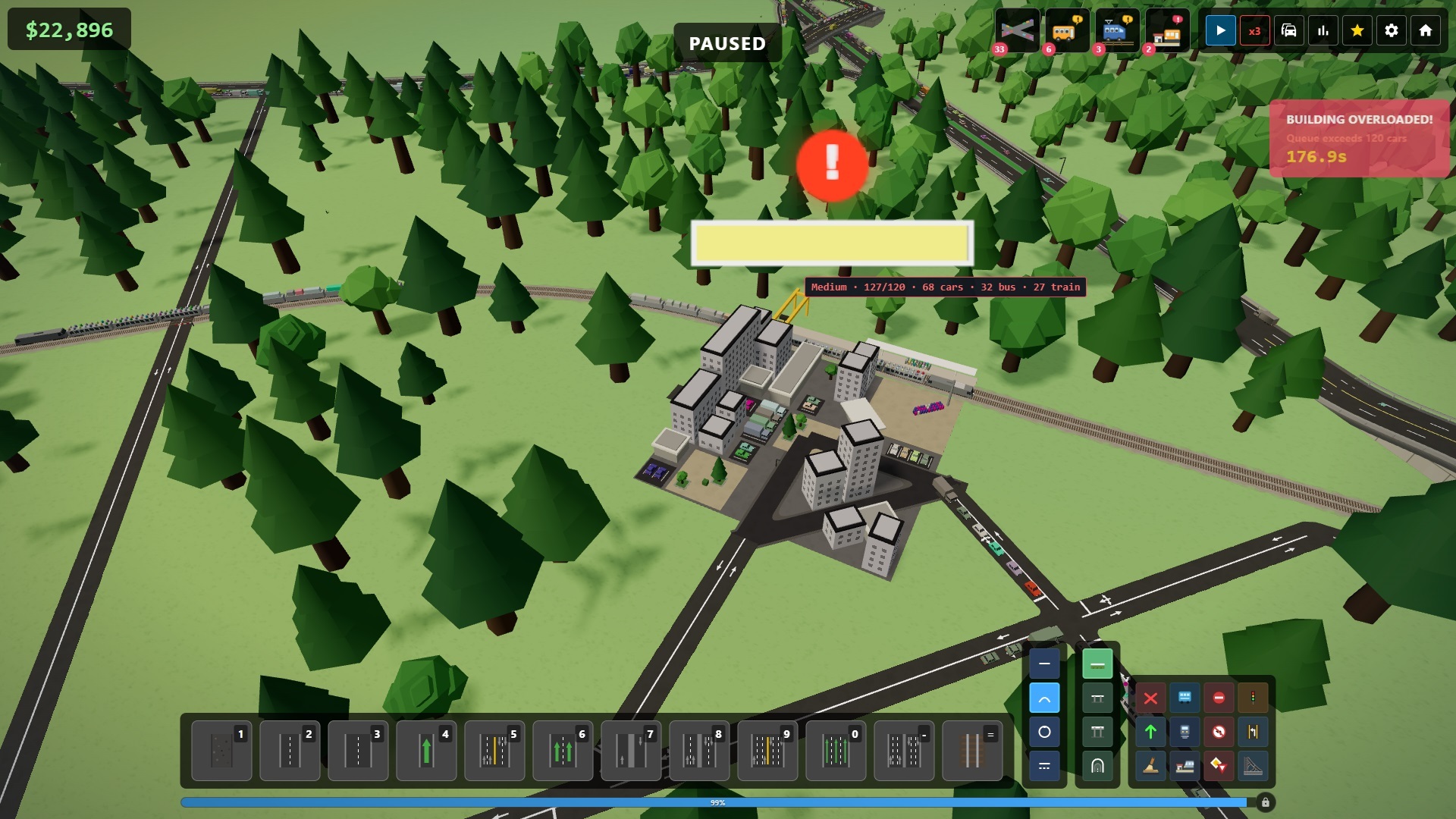
A building past capacity, with the countdown running. This is the only way to lose.
A building can hold a certain number of waiting cars. Push past that and a countdown starts; let it run out and the run is over. That is the whole fail condition — not money, not a happiness meter. A building nobody can leave.
Queues fill for three reasons, and the game names each one. Disconnected: there is no road from here to anywhere, usually a building that appeared in a plot you haven't reached yet. Overloaded: there is a route, but cars can't get onto it as fast as they are generated — the road outside is jammed, or the junction at its end is. And policy-isolated, the one that catches you after a clever bus-only street: reachable by road, but blocked by your own access rules. Cars are released from a queue one at a time, so a building's front door is a bottleneck in its own right; a big building on a gravel track is a countdown waiting to happen.
The forgiving part: some stage rewards raise every building's capacity, and some lengthen the countdown. A building that hosts a rail or metro station also holds more — the platform is literal extra waiting space. And there is an emergency tow: it clears the queue at the building nearest to failing, at the price of that building generating nothing for a while.
One thing worth knowing before you bulldoze. Cars already driving on a road you delete don't vanish; they pull into the nearest building with room and are released back onto the network from there, one at a time. Deleting a busy road dumps its traffic on the neighbours, so demolish the bottleneck when the queues around it can take it.
In Creative mode none of this can end the run — a full building just shows a "FULL" badge — but the queue is still the thing to read.
Seven buildings that break your network on purpose
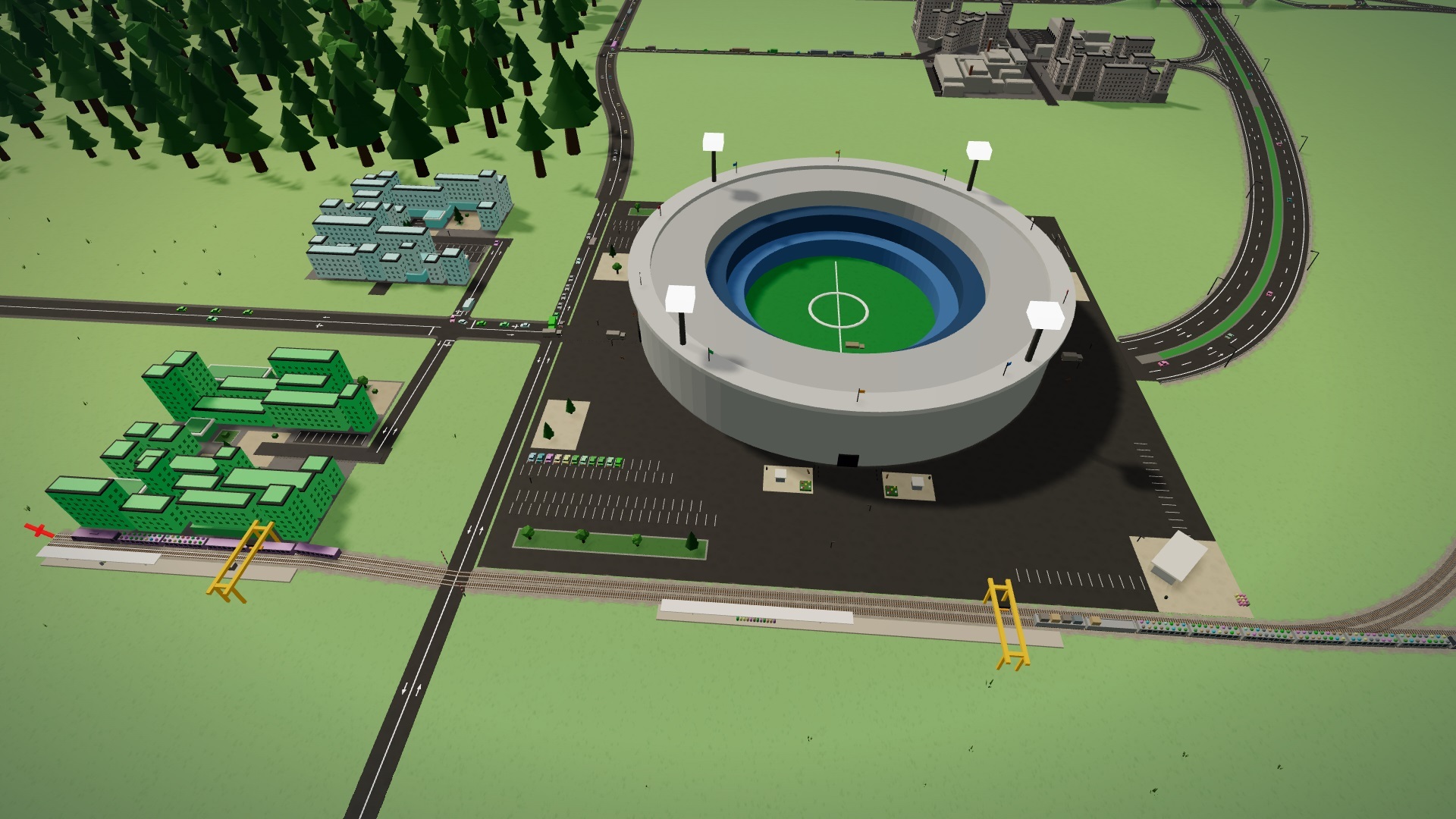
The stadium, between matches.
Late in a run the city starts producing buildings that are not districts. There are seven special buildings — the last two only on Medium and Large maps — each appears exactly once, and they arrive one at a time at fixed stage milestones, so there is always another one on the way. A banner announces each one, and it lands in the plot that just opened, which means the roads serving it don't exist yet. Every special generates a different kind of traffic, and each of them is a different road-engineering problem.
- Park — the gentle one. It pulls small cars from every direction at once, so the problem isn't volume, it's that four roads' worth of light traffic converges on one junction. A junction-design exam.
- Shopping Mall — sustained volume, cars and delivery vans together, all day. The average never lets up, and the question is throughput around a single point.
- Stadium — it does nothing for a long stretch, then the match ends and the whole crowd leaves at once. Your network has to survive the peak, not the average. A clickable toast tells you when a wave starts; click it and the camera goes there.
- Factory — a cargo source and a cargo magnet. Trucks in, trucks out, on a corridor to wherever the goods are wanted. Lane width and turning room start to matter.
- Logistics Hub — the strongest freight magnet in the game, and with the factory it creates an industrial corridor: a truck artery laid over a network that was built for cars.
- Office Tower — the only special that goes downtown instead of to the new plot, and the only one whose traffic reverses. All morning it draws commuters in; then the workday ends and it pours them back out. One fat inbound arterial survives the morning and gridlocks in the evening. It is the only building that teaches two-way capacity.
- Quarry — the last one. It idles quietly, then a blast clears and a whole convoy of trailers rolls out at once, straight into the arterial lanes. And while it empties, it also becomes the top trailer destination on the map, so the corridor between quarry and hub saturates in both directions at once.
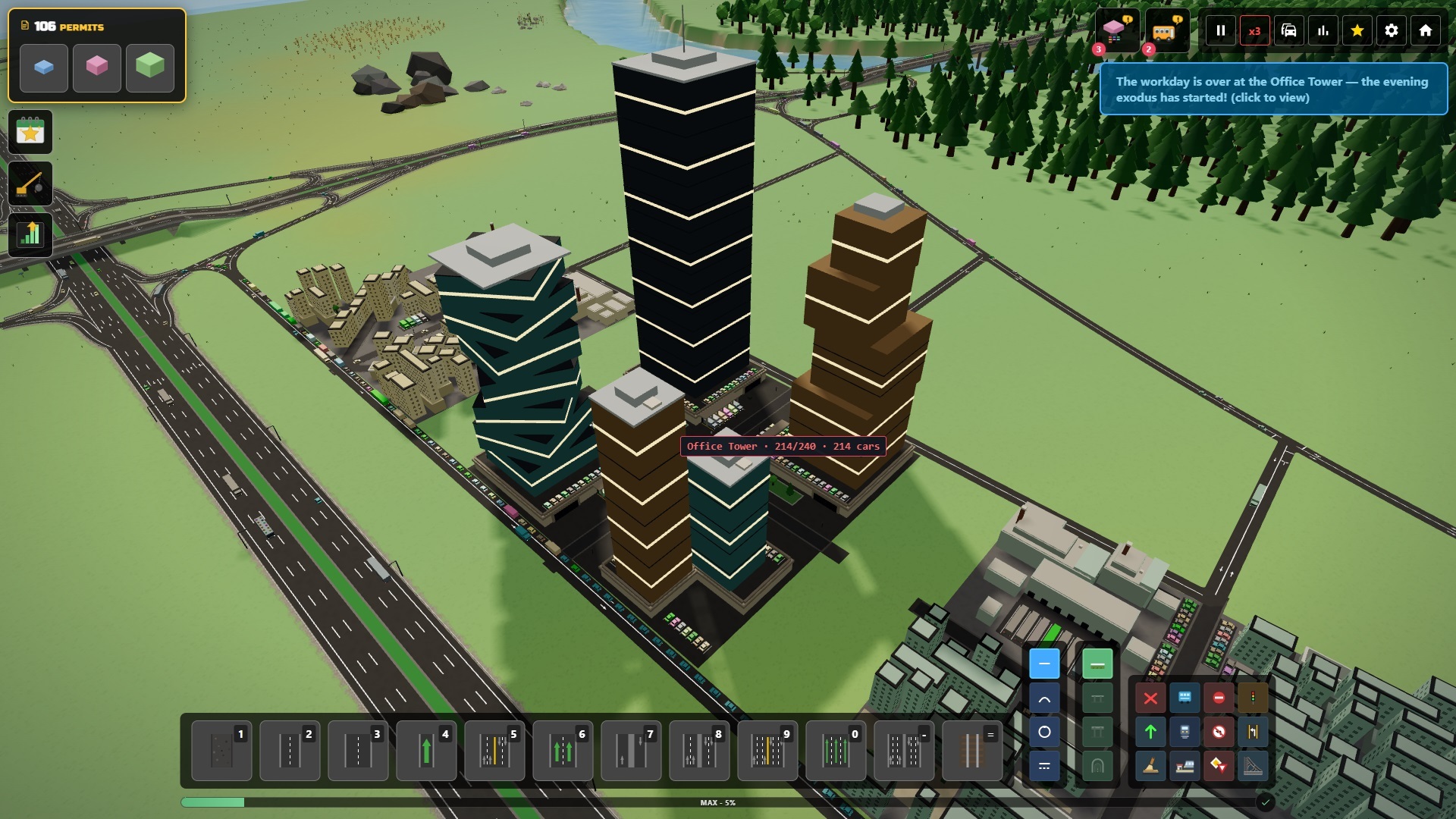
The office tower, placed into the downtown that grew around it.
Two things to know. A special never surges the moment it appears — there is a grace window to wire it up before the first wave. And specials follow the same rules as every other building: same queue, same countdown, same way to lose. There is no exemption for the interesting ones.
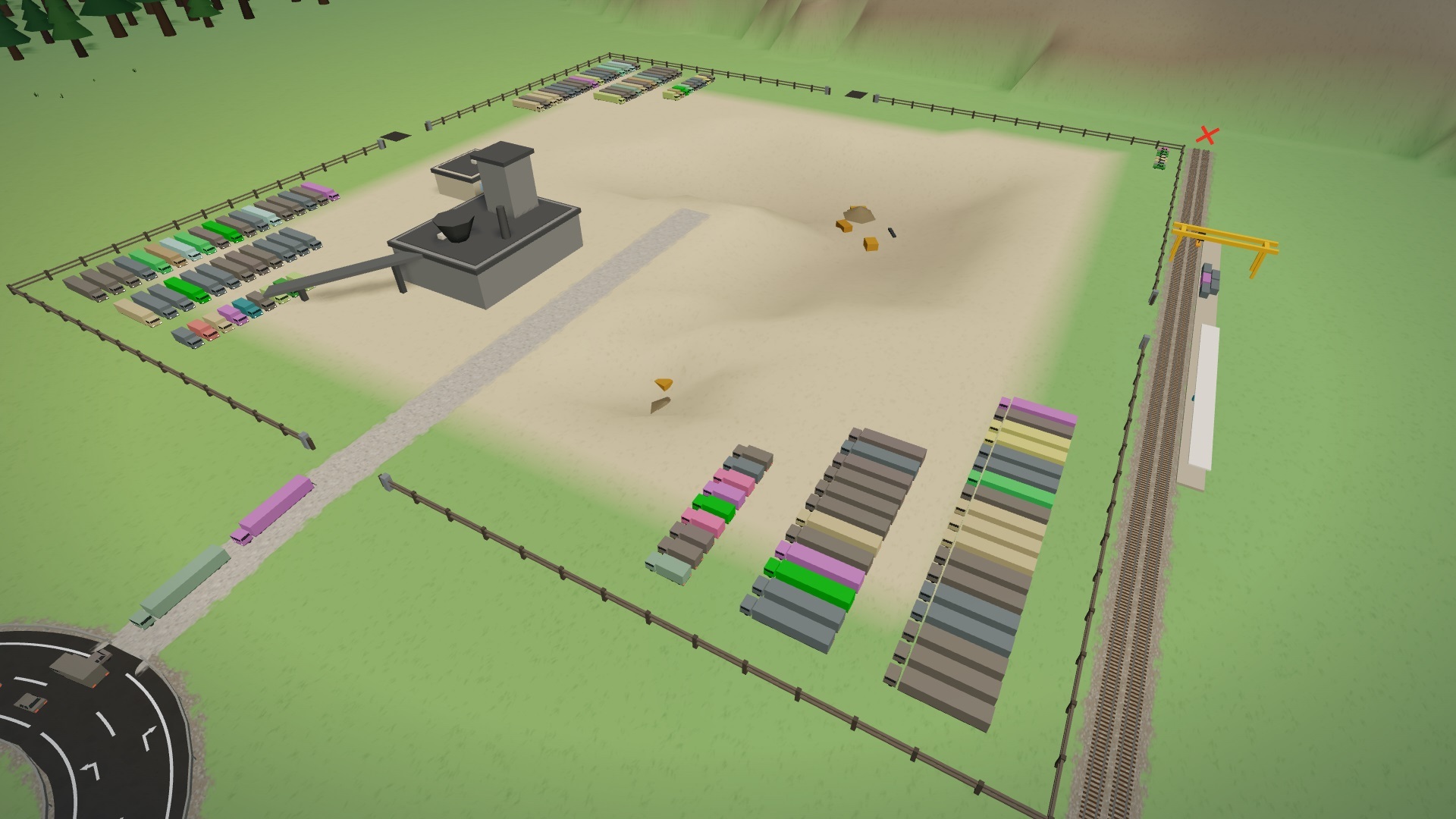
The quarry: a working pit, haul roads, and a truck yard that fills up between blasts.
Keeping the trucks off the high street
Freight is where the three car types stop being a detail. Trailers travel between big freight nodes — the factory, the hub, the quarry, the biggest districts — and they are long, slow and wide in a corner. Left alone they take the fastest route like every other car, and the fastest route often runs straight through your town centre.
The tools for that are road restrictions: a no-freight policy blocks trucks and trailers from a road, and a no-trailer policy blocks only the semis and lets the vans through. Pair a truck corridor with a no-trailer ring around the residential streets and the convoys stay where you put them. And where the corridor still can't cope, the answer from the previous article applies: freight rail intercepts deliveries that would otherwise go by road.
How to read all of it
You don't have to watch every building. When one is in trouble an icon appears in the corner — disconnected, overloaded, policy-isolated — and clicking it flies the camera to the offender, then to the next one. The queue itself is visible too: waiting cars stack up around the building, so a district that is filling up looks like one, and the countdown appears over it the moment it tips past capacity. The city will find the weak junction for you; the game only makes sure you hear about it in time.
The city will keep growing either way. Whether it keeps moving is up to you.
Traffic Architect on Steam — wishlist to hear when it launches