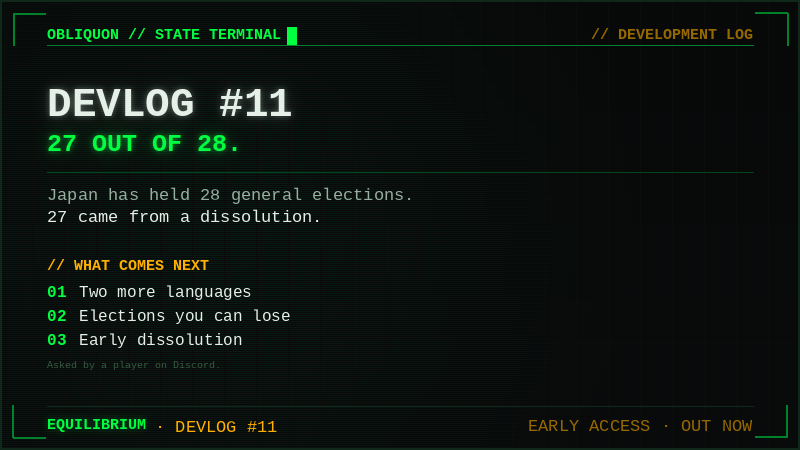
27 OUT OF 28
A few days ago a Japanese player on our Discord asked me a simple question: does the election system in EQUILIBRIUM reflect how each country really works?
The honest answer was: partly.
What came out of that conversation changed what I'm building next. So this devlog is about that.
THE NUMBER THAT STARTED IT
The first general election under Japan's current Constitution was in 1949. Since then there have been 28 of them. Only one happened because the term simply ran out, in 1976.
The other 27 came from a dissolution of the lower house.
In Japan, dissolving early isn't the exception. It's the normal way people end up voting.
WHO ACTUALLY DISSOLVES THE HOUSE
This is the part I found most interesting. On paper, dissolution is an act of the Emperor. But he can only do it with the advice and approval of the Cabinet. The Cabinet decides, the Emperor proclaims it, and the Speaker reads the proclamation out loud in the chamber.
Formal power and real power sit in two different places of the same gesture.
Italy works differently. Here the President of the Republic dissolves Parliament, and the President can refuse.
MINORITY GOVERNMENTS
The same player pointed out something else. In Japan a government can stay in office without a majority of the seats. EQUILIBRIUM already has a "minority government" state, but right now it's mostly a label. It doesn't really change how you play.
WHAT THE GAME DOES TODAY
Real seat counts for each country: 400 for the Italian Camera, 577 for the Assemblée Nationale, 435 for the House of Representatives, 465 for the Shūgiin
The right name for each chamber
Party landscapes that follow the real shape of each country: a fragmented Italy, a two-party US with independents, a France split into blocs
WHAT IT DOESN'T DO, SAID PLAINLY
One chamber for everyone. No Senate, no House of Lords, no Sangiin
The same electoral system for every country
A fixed term for every nation, with no real differences between them
Elections move the seats around, and the coalition can reshuffle with them. But you stay in charge no matter what. You can lose badly and still be running the country the next day
That last point matters most, so I'll say it straight. Today elections are pressure. They're not a real risk of losing power.
WHAT CHANGED IN THE ROADMAP
This is the order I shared on Discord, and I'm sticking to it:
1. The two extra languages that were already planned
2. Elections that can really go wrong: government formation, minority governments with real consequences, and the chance of losing power
3. Early dissolution, with different rules for each country
Why this order? Early dissolution means nothing as long as losing an election costs you nothing. If you can call a vote but the result can never take power away from you, you're just pressing a button. Defeat has to be possible first. Then dissolution becomes a real decision.
No dates on any of this. I'd rather get it right.
ALSO THIS WEEK
Parliament votes now take into account how loyal every party is, not just the ones in government. Before you confirm, you see how many votes in favor you can expect and how many you need.
In parliamentary systems, the governing majority is now rebuilt from the actual seats.
This morning commands stopped working for a few hours because of a limit on my side. It's fixed. Thanks to everyone who reported it so fast.
CREDIT WHERE IT'S DUE
Thanks to まぐ, a Japanese player on our Discord. He's a native speaker and knows his country's institutions better than any source I had found. He gave me permission to name him here.
One person on a Discord server asked one precise question, and it changed what gets built next. That's exactly why EQUILIBRIUM is in Early Access.
If you know a country well and think the game gets it wrong, come tell me on Discord. I read everything.
Andrea
Obliquon Corporation