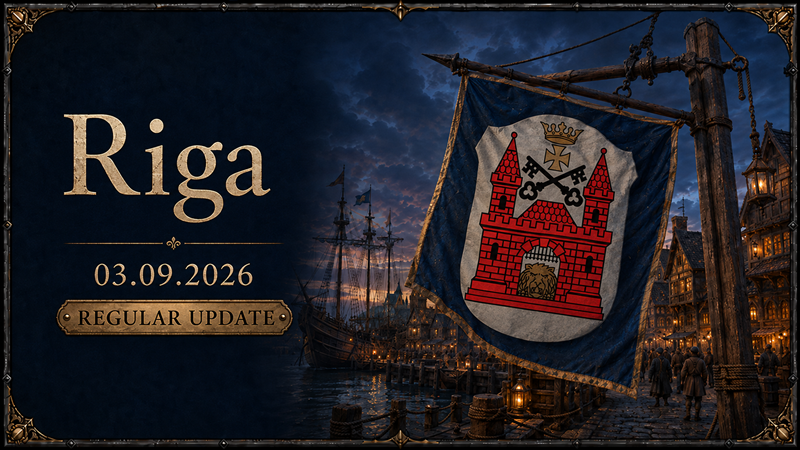
Patch Notes
Riga Renewed
- Riga now uses its renewed coastal city, with sixteen Houses, eight workplace sites, three usable Gates, connected streets, and a working harbor while preserving existing ownership and save identities.
- The Shipyard now has a complete harbor-facing side wall. Its two cranes stand on the timber piers and open the Trade Ledger when selected, while two static decorative ships have been removed.
- Riga's Houses now use narrower frontages while retaining their height and depth. Newly constructed Houses and Architect previews follow the same proportions.
- New buildings connect to Riga's flat cobblestone surface with matching stone scale, softened edges, and correct terrain clearance. Construction, save restoration, and demolition preserve the surrounding city layout.
Ships and Interface
- CityScene ship sizes now follow a clear class progression: Pinnace at 16 metres, Brig at 24 metres, Frigate at 32 metres, and Cog at 34 metres. Hulls, rigging, waterlines, and interaction colliders remain proportional.
- WorldScene uses one shared camera frame for every ship class, keeping their map silhouettes consistent without changing class identity or statistics.
- ShipPanel now shows each vessel's class beside its location and calls the smallest ship class Pinnace in both supported languages.
Performance and Reliability
- City visuals and on-demand panels now load through individual asset addresses. New games and legacy-save migration can resolve House identities without loading every city's visual prefab.
- City entry reuses prepared Terrain materials, tree data, pedestrian references, building-label materials, and workplace visual details instead of rebuilding or searching for them repeatedly.
- Guild Panel, Workplace panels, Ledger House panels, Convoy List, Town Hall Missions, and rank checks now avoid repeated refresh work while preserving their existing behavior and selections.
- Building placement reuses authored components and complete physics-query results. Architect construction clears trees only within the selected footprint and preserves nearby vegetation.
- Repeated Day/Night changes now preserve authored brightness and shadow strength, and paused music remains paused until the player resumes it or selects another track.
More from Hansa Forever
Other announcements
StockholmPatch Notes Stockholm Renewed · Stockholm has a renewed coastal layout with sixteen Houses, eight workplace sites, three usable Gates, connected streets and a working harbor. Existing city, ownership and save identities are preserved. · A tighter City Wall encloses the settlement. The Church and Guild stand fully inside it, the Guild and Town Hall no longer overlap, and all three Gate corridors…Oslo&TurkishPatch Notes Oslo Renewed · Oslo now uses its renewed city layout, with a redesigned coastline, City Wall, Shipyard, building parcels and connected street network. · All eight roads, including the Shipyard connection and outer approaches, now feature raised, worn stones in a neutral light-gray palette. Distance detail levels preserve close-up relief while reducing distant geometry. · New Archite…Better WorkplacesPatch Notes Better Workplaces · Fourteen production workplaces now use their approved authored models across every city, with complete timber, masonry, plaster, cloth, glass, roof, and detail materials. · Workplace roofs now have continuous structural decking, removing openings that could expose interiors from angled city cameras. · Production workplaces use a brighter and more readable medieva…