Patch Notes
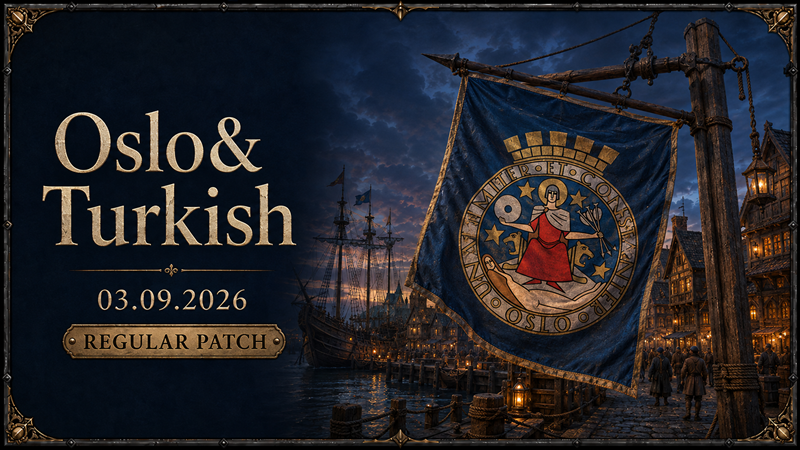
Oslo Renewed
- Oslo now uses its renewed city layout, with a redesigned coastline, City Wall, Shipyard, building parcels and connected street network.
- All eight roads, including the Shipyard connection and outer approaches, now feature raised, worn stones in a neutral light-gray palette. Distance detail levels preserve close-up relief while reducing distant geometry.
- New Architect buildings receive matching ground treatment and stone access roads. Connections remain consistent through construction, completion and saved-building restoration; demolition preserves neighbouring sites.
- Oslo's citizens now use six medieval character models. Unwanted primitive gull shapes and the two decorative ships beside the Shipyard have been removed.
Harbor Traffic
- Ships now complete their harbor approach before docked waiting time begins in every city. Route updates preserve the remaining stop, and berths remain reserved until departure finishes.
- Oslo's nine berths spread farther along both sides of the waterfront and follow the coastline closer to shore, with clearance for the largest current ship.
Turkish and City Information
- Trade Ledger navigation, reputation and production labels now have complete Turkish text.
- City Info now describes the selected city instead of always showing Lübeck. Produced-goods icons and names remain paired in the correct order through city and language changes; cities without production no longer show example goods.
Apiary Visuals
- Apiaries now retain distinct roof, wood, plaster, stone, glass, metal and hive materials. Duplicate floating decorations and the extra chimney have been removed.
More from Hansa Forever
Other announcements
StockholmPatch Notes Stockholm Renewed · Stockholm has a renewed coastal layout with sixteen Houses, eight workplace sites, three usable Gates, connected streets and a working harbor. Existing city, ownership and save identities are preserved. · A tighter City Wall encloses the settlement. The Church and Guild stand fully inside it, the Guild and Town Hall no longer overlap, and all three Gate corridors…RigaPatch Notes Riga Renewed · Riga now uses its renewed coastal city, with sixteen Houses, eight workplace sites, three usable Gates, connected streets, and a working harbor while preserving existing ownership and save identities. · The Shipyard now has a complete harbor-facing side wall. Its two cranes stand on the timber piers and open the Trade Ledger when selected, while two static decorative…Better WorkplacesPatch Notes Better Workplaces · Fourteen production workplaces now use their approved authored models across every city, with complete timber, masonry, plaster, cloth, glass, roof, and detail materials. · Workplace roofs now have continuous structural decking, removing openings that could expose interiors from angled city cameras. · Production workplaces use a brighter and more readable medieva…