Notes are the same from 0.30 experimental — now on main.
Four systems land in 0.3.0: named identities the crew hardens into, the departure board, genetic decline as a force that can end the voyage, and the science team's long projects. The voyage also runs materially longer before it comes apart.
Named identities
The ship becomes something, and it has a name. Ideology and the loss of knowledge now converge into named identities the crew forms from the decisions you already make. At a threshold the ship shows you what the crew has been becoming — the actual decisions, by year and outcome — and asks whether to make it official.
Eleven identities across two lines. Six are forms of rule — officer rule, shared rule, ship religion, engineer rule, family rule, charter rule. Five are what is left when the knowledge goes — by the manual, machine worship, hand skills, improvised repair, forbidden knowledge. A run can hold one of each, and the pair is its own society.
Identities harden; they do not switch. A formed identity moves through three tiers — Emerging, Established, Total — and only ever deepens. The crises you know grow options in its voice, appended at the second tier and replacing the neutral answers at the third; a standing action spends from the same yearly work budget as ship maintenance.
Refusing the identity breaks a faction. The faction carrying the strongest lean walks out and its remnant resists for the rest of the run. Refuse at every fork and the crew stays only a crew — a rarer arrival, with its own ending.
The readouts, the log, and the ending all speak it. A formed identity's name and tier show on the readouts; at the Total tier the log rereads its old entries in the identity's register; and what the ship became steers which ending fires and how the epilogue reads, down to a line for each founding practice that survived the crossing.
The departure board
The ship commits its departure corridor at the launch board. Year 1 offers three corridors on file — the nearest reachable system, the most promising world in the far window, and the densest cluster of onward stars — each a named, real star with its class, distance, and contact year. The choice sets your first system and the shape of the early voyage.
The pre-launch founding log lists the same board. The corridor you commit at Year 1 is the one the launch record promised. Holding course keeps the maiden heading — the cluster corridor.
The Sol system holds still when you commit. The drive keeps the maiden heading through the solar transit — the planets stay where they loaded, the flybys happen — and the committed corridor's course change executes at the heliopause exit, shown as a bend in the plotted route.
The Sol-transit briefings run on every corridor, not just the default heading.
Genetic decline
Genetic diversity can now end the voyage. Decline drains the pool across generations; a depleted pool kills colonists and suppresses births.
Founding bloodlines are load-bearing. When a founding line's last living carrier dies childless, that diversity is gone for good.
Two new endings record where the genome goes: GENETIC EXTINCTION, and ONE LINEAGE — a colony that survives as a single genome.
The long projects
The science team works decade-scale studies. Three standing projects begin at launch — a drive harmonics study, closed-loop agronomy, and a hull fatigue atlas. The pace follows the living science staff and slows under knowledge regression and class stratification; field data found during the voyage joins the same queue.
Found technologies are on the record. Everything acquired mid-voyage lists under SHIP LOADOUT with its year and source; live projects show progress and an estimated completion year.
The longer voyage
The voyage runs longer before it comes apart. The choices that erode the crew's knowledge now cost less per decision, so a well-kept ship holds together decades further into the crossing.
Crossing a social threshold no longer ends the run on the spot. Several endings that once fired the instant the crew's cohesion or knowledge crossed a line are now a yearly risk that climbs the deeper the ship goes; a ship near the break carries a warning that escalates.
The late voyage is no longer empty. The back half of a long run now carries decisions of its own, set past year 200.
Steam Deck
Lists scroll by trackpad drag, with a wider scrollbar to grab.
The Mission Archive closes when you click outside it, and its BACK button stays pinned in reach.
Ending text
A ship that loses power gets its ship-loss ending rather than a survival coda.
The abandoned-lifeboat line appears only on runs that landed.
A collapse epilogue no longer repeats its "eleven years" line.
Polish
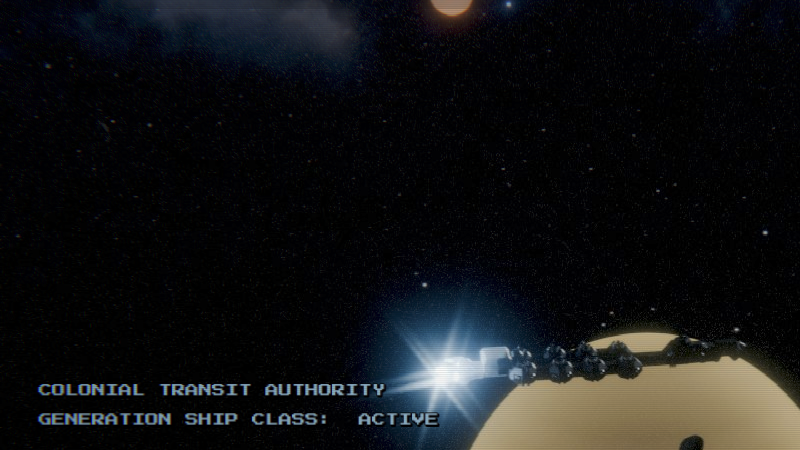
The intro sequence keeps its aspect ratio on 16:10 screens instead of stretching to fill.
Deep ideological drift now calls the ship the ark; the identity-total announcement names the identity that became total.
Languages
A number of new lines temporarily read in English in German, French, Italian, and Spanish while their translations are refreshed.