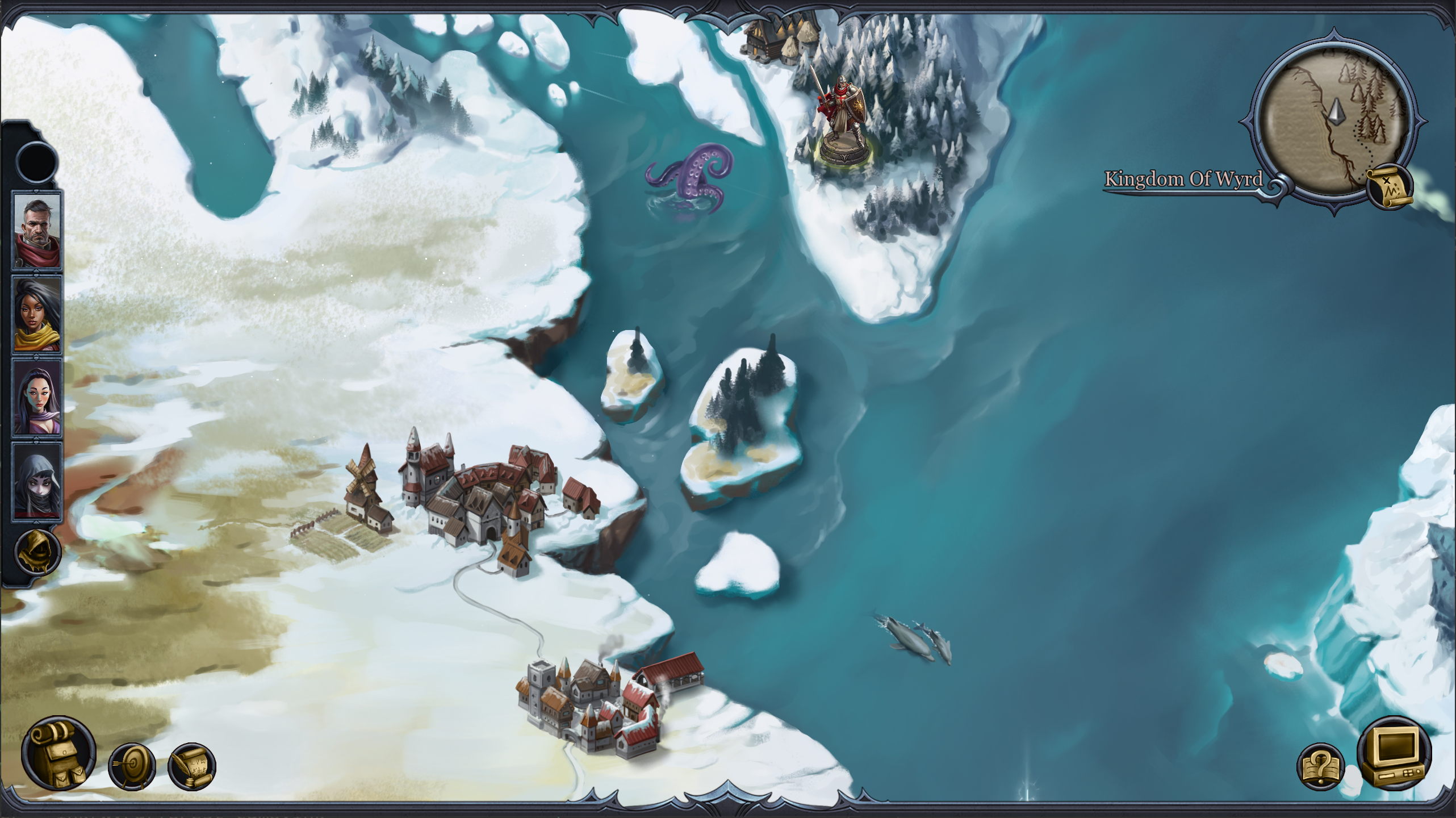
Hey everyone,
I shoved a werewolf into a field of caltrops last month and nothing happened.
It padded across the spikes without a scratch and went straight for my Sage on the other side. I sat there for a good while wondering which half of the plan was broken, the push or the caltrops, or whether I had invented the whole combination in my head. It turned out that knockback places a unit on a tile, while hazards only fire when something walks onto one. Two systems, both behaving correctly, politely ignoring each other. The fix took only a single line.
The part worth writing about is that I found it at all. I only found it because I had stopped testing abilities one at a time, like a programmer, and started playing all four heroes as a group with an actual plan, like a player. That shift is what this devlog is about.
What a fight is on the page
Credit where it is due. In 1987 Blood Sword did something almost no gamebook dared: it put a numbered grid in front of you and made you care where everybody stood. Most of its contemporaries handed you two numbers and told you to roll until one of them hit zero.
But sit down with the rules today and count your decisions. Each round you pick a target, roll, subtract Armour, cross out Endurance, and move to the next hero. Your Enchanter has something to think about. The other three have "who do I hit". Positioning matters at the start of a fight and rarely changes anything after that.
On paper this is fine, because the fight is the toll you pay to reach the next paragraph. On a screen, where the fight is the thing you came for, four people taking turns doing arithmetic is not enough.
One caster does not make a party
Last time I rewrote the Enchanter's magic around backlash and cooldowns, and I was pleased with it right up until I played a full encounter and noticed the other three were standing around waiting for the wizard to do something interesting.
So the Warrior, the Sage and the Trickster got trees of their own. There are 48 class skills in the game now, split across the four, and I could list them all at you, but the list is the least interesting thing about them. What matters is that they were designed pointing at each other.
The plans you can make now
Here is the sort of thing I mean.
Your Enchanter wants to stand still and throw spells, which makes them the most obvious target on the board. So the Trickster opens a Smoke Jar over the enemy line. Nothing in that cloud can shoot for two turns, and its Awareness drops. You have carved out a corner of the grid where your caster can work, and the enemy archers have to walk to you.
Or: your Sage summons a Mirage, an illusion with a single point of Endurance wearing the Sage's face. The enemies want to kill it, so they crowd around it. Now they are standing shoulder to shoulder, which is exactly the shape your Warrior's Whirlwind is looking for, and exactly the shape your Battle Cry wants when it strips Fighting Prowess from everything within two tiles.
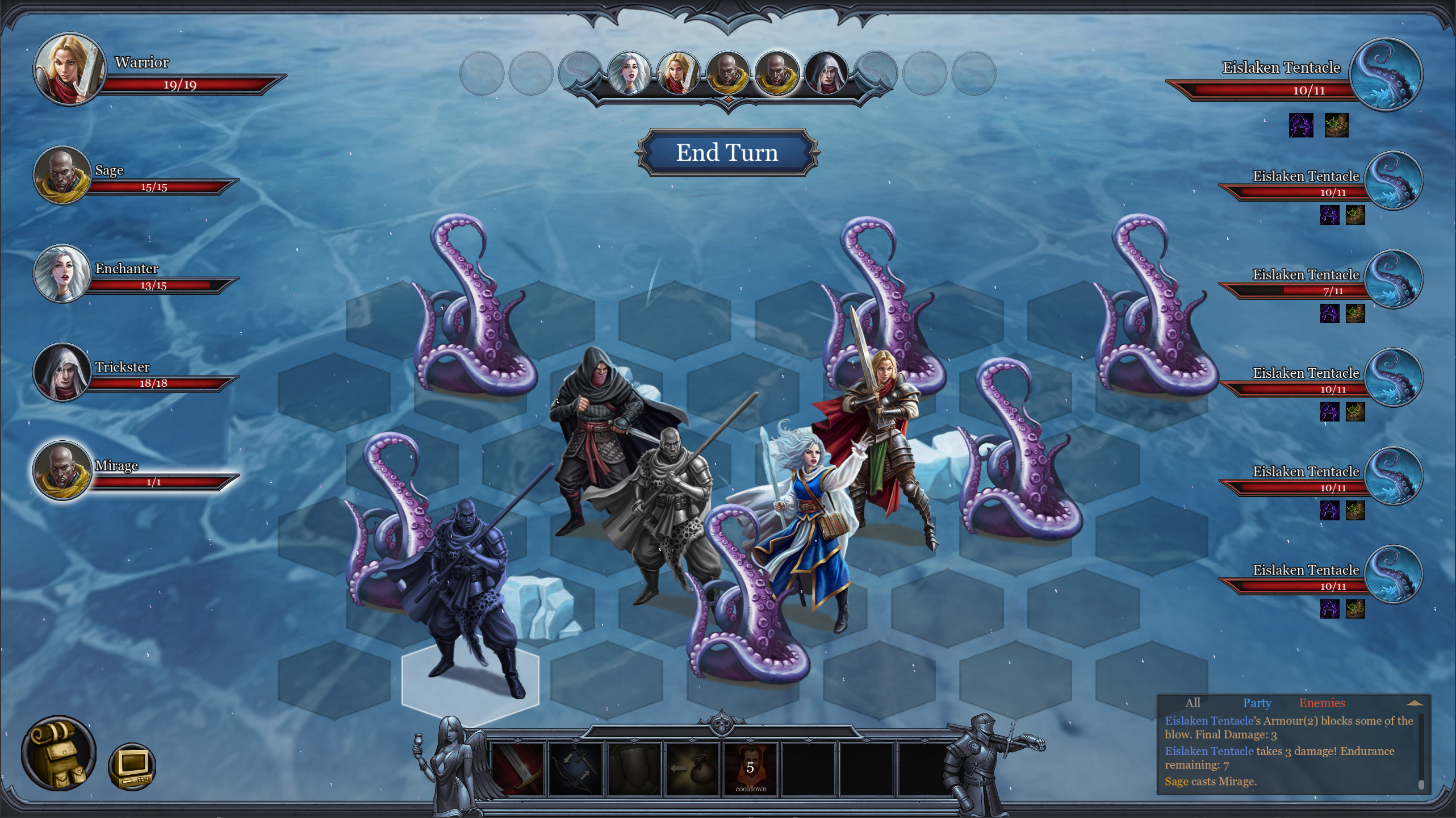
Or the one I opened with. The Trickster scatters Caltrops, the Warrior charges in and shoves an enemy backwards into them, and the spikes cut it up and end its movement on the spot. It works now.
My favourite one is quieter, and it starts before the fight does. The Sage has no healing spell to cast at you. Instead, while the party is travelling, they sit and meditate, draw their own life force out of themselves and seal it into a bottle, which then sits in your inventory like any other consumable. Anyone can drink it in the middle of a fight, at the cost of an Action.
The bill arrives when it is drunk. Pulling an ally back drains the Sage for half of whatever it gave, from wherever the Sage happens to be standing.
Now put that next to the Enchanter, whose magic bites back when the dice go wrong. Your Enchanter reaches for the spell that is a little too complex for them, takes the backlash across the face, and swallows the Sage's bottled life to stay upright. The Sage, at the back of the grid, having swung at nothing all fight, feels it.
The party's appetite for risk has a price, and it comes out of one specific person.
That is four people looking at each other's sheets before the fight and agreeing on a plan. It is the thing I have wanted out of this combat system since the first prototype, and it is finally there.
The monsters are allowed to plan too
None of this means anything if the enemy just walks at you.
Augustus forced the issue, because he is a caster and enemies had no way to cast. He can Shatter, he can conjure a Vaporous Serpent, and he can Bewilder you badly enough to knock the weapon out of your hand. Elsewhere, ambushes now hand the opening round to whoever set the trap. Some fights begin with one of your heroes Rooted where they stand. There is a fight where winning has nothing to do with killing anything and everything to do with what is still floating at the end of it.
And I have been rebalancing constantly. The werewolves are a good example of what I keep having to correct. In the books, their lycan form cannot be harmed by ordinary weapons at all. That is perfectly fair if you arrive carrying something enchanted out of the first book. We begin this adaptation at the second, with whatever you managed to scrape together yourself, which turns the fight into an execution. So the immunity is gone, their damage has come down, and the stretch where a bad decision earlier left you sitting there defending for three straight rounds before you were allowed to act has been reduced to one.
The fight starts long before the fight
Judged purely as tactical design, on its own, the combat in Blood Sword is conventional. Monsters, numbers, a grid. I am going to have to invent a good deal of my own tactical interest as the series goes on.
But that is the wrong place to look, and it took me a while to work that out.
No tactical RPG I know of lets a decision you made pages ago choose the battlefield for you. This one does, constantly. Take the werewolves. Did you notice the ambush before it landed? If you noticed, did you act on it, or sit tight and let it come? Did you decide to sleep instead? Those are not three difficulty settings. They are three different fights, with different ground under your feet.
Or the Stalker. It hunts you, and the longer you run, the stronger it gets. Run long enough and it will draw you somewhere of its choosing, and one of your party goes into a pit of sharpened stakes. Play it well and the thing in the pit is the Stalker.
My favourite is Augustus. You can face him on the deck of your own ship with a water elemental rising over the rail. You can face him in the air, aboard his flying carpet, mid-journey. Or you can concede to him early and wake up at his castle, handed over to his servants, which opens an entire section of rooms and loot that most players will never lay eyes on.
That is what a gamebook does that a tactical RPG cannot. The clever decision comes before the dice, and the tactics are how you live with it.
It is also, honestly, why this part of development is slow. One named enemy is not one encounter. It is three or four, each built, balanced and tested separately, and any given player will only ever see one of them. There is no way to make that cheaper without making it worse.
Time for the final push
You will get to tell me how wrong I have it in mid-September, when the demo goes out. If you want Steam to tell you when it does, the wishlist button is the only thing that works. I am genuinely more nervous about this change than about the magic rework, because giving the Warrior things to press is the furthest I have stepped away from the books so far.
Thanks for all the wishlists and the support, see you in the next one!
https://store.steampowered.com/app/3645170/Blood_Sword/