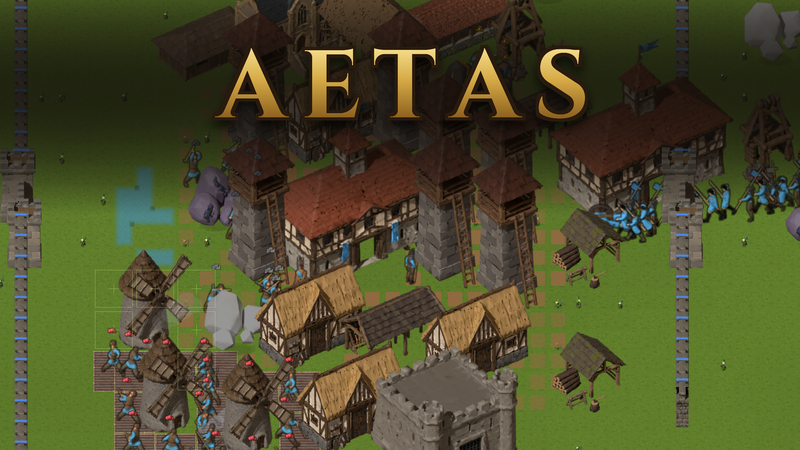
Aetas 0.2.0
Six peoples, six ways to play
The civilizations have been rebuilt from the ground up. You now pick your people in the lobby before the match starts, and each one plays differently from the very first minute:
- Franks raise walls, gates and towers 50% faster, and their towers reach 2 tiles further.
- Norse plunder: every enemy building they tear down pays out 40% of what it cost.
- Greeks fight in a phalanx: infantry standing next to other infantry takes 20% less damage.
- Mongols set up camp anywhere: lumber and mining camps are free and ready instantly, and their cavalry trains 25% faster.
- Arabs pay for what they're short on with gold.
- Chinese train their soldiers in groups of five, faster per soldier, and research costs 25% less.
All six are available straight away. Each people still has its own unique unit, and the civilizations have new names that fit their history. The once-per-match power is gone: your people's trait now sets it apart, all match long. Hover over your people's name in the top bar to see what it does.
The computer plays to its people too: Franks turtle up behind towers and walls, Norse riders go looking for undefended buildings, Mongols spread camps across the map, Arabs lean on gold, and so on. It also gives priority to its own unique units.
Six campaigns
The main menu has a new Campaign button. Every people has its own campaign of eight missions, based on real history: 48 missions in all.
The Franks, from Charles Martel to the siege of Paris:
- The Hammer (Tours, 732): towers on the Roman road, three charges of Umayyad horsemen, then strike back at their camp.
- The Rhône (Avignon, 737): your first siege, with sallies from the city.
- Over the Alps (754): break through a mountain fort with only the army you brought, then set up camp and take Pavia.
- The Saxon Wars (772): close the border with three forts and destroy the Eresburg, while raiders burn what you leave unguarded.
- Roncevaux (778): hold the pass with Roland's rearguard, then fight your way out when he sounds his horn.
- The Ring of the Avars (796): horse archers on an open plain, and two centuries of treasure behind one wall.
- Barcelona (801): close the city off, stop three relief armies and let hunger do the rest.
- Paris Holds (885): twenty minutes on the walls against ever larger Danish waves, then go out and burn their camp.
The Norse, from the first raid to the last battle:
- Lindisfarne (793): plunder a monastery and a village, and be back at the ships before the king arrives.
- The Great Army (866): take York while two kings of Northumbria quarrel, then defeat them both.
- The Winter Attack (878): take Chippenham in the middle of winter, then hunt King Alfred in the marshes.
- Rollo (911): hold your town on the Seine against three Frankish armies until the king makes peace.
- To the West (around 1000): find Greenland, Helluland and Vinland, and build a camp on each.
- Stiklestad (1030): King Olaf against a larger army of farmers. Hold the hill.
- The Varangians (1038): take Syracuse together with the Byzantine army.
- Stamford Bridge (1066): one berserker holds the bridge while the army arms itself, then back to the ships.
The Greeks, from Troy to Gaugamela:
- The Wooden Horse (around 1200 BC): build the horse, open the gate, take Troy's palace.
- Marathon (490 BC): break a larger Persian army before their cavalry returns from the ships.
- Thermopylae (480 BC): hold the pass for twelve minutes; after eight, they come from behind.
- Plataea (479 BC): build up with Sparta as your ally and destroy the Persian camp.
- Sphacteria (425 BC): wear down trapped Spartan hoplites with archers.
- Leuctra (371 BC): break the Spartan right with a deep left wing and kill their king.
- Chaeronea (338 BC): defeat Athens and Thebes with phalanx and cavalry.
- Gaugamela (331 BC): defeat Darius or destroy his camp.
The Arabs, from Palmyra to Ain Jalut:
- The Queen of Palmyra (270–272): build a market, grow rich on gold, and hold off Roman raids.
- Yarmuk (636): hold the line, then cut the Byzantine retreat with a flank.
- Alexandria (641): siege the walled city and take the citadel.
- Tariq's Rock (711): land in Spain, kill King Roderick and take Toledo.
- The Round City (762): build Baghdad's ring and four gates while rebels attack, before the uprising grows.
- The Horns of Hattin (1187): hold the springs and break the thirsty crusader army.
- Jerusalem (1187): besiege the city and take the citadel.
- Ain Jalut (1260): lure the Mongols into the valley and destroy their camp.
The Mongols, from Börte to Xiangyang:
- Börte (around 1180): raid the Merkit camp, free Börte and bring her home.
- The Tribes United (1204): plant camps across the map and defeat the Naiman.
- The Yellow River (1209): take the outer fort, build a dam, flood the walls.
- The Badger Mouth (1211): break the Jin in a mountain pass with a flank.
- Otrar and Bukhara (1219–1220): take three cities of Khwarezm.
- The Kalka (1223): lure the Rus into a trap, then spring the main force.
- Mohi (1241): take the bridge, cross downstream and smash the wagon fort.
- Xiangyang (1268–1273): the long siege of the twin cities on the Han.
The Chinese, from Changping to Ningyuan:
- Changping (260 BC): ring Zhao in with towers and starve them out.
- All Under Heaven (230–221 BC): conquer three rival states.
- Songs of Chu (202 BC): surround Xiang Yu until his army melts away.
- The Red Cliffs (208): burn the riverside posts, then sweep Cao Cao's camp.
- The Empty City (228): hold an almost empty town for six minutes.
- Hulao (621): hold the pass, then break Dou Jiande with cavalry.
- Xiangyang Holds (1268–1273): keep the city for twenty minutes against the Mongols.
- Ningyuan (1626): hold with cannon and muskets, then destroy the Jurchen camp.
Pick Easy, Normal or Hard before you start. Objectives stay in view at the top left (with a countdown where there is time pressure), a marker on the map shows where you need to be, and you can read back everything that was said under Messages. You can save and load in the middle of a mission.
Historic battles
Next to the campaigns there is a new Battles tab: six famous battles you can play on their own, all open from the start.
- Cannae (216 BC): as Hannibal, let your centre give way, drive off the Roman cavalry and close the ring.
- Alesia (52 BC): as Caesar, build your siege line, beat back the Gallic relief army and take the town.
- The Fei River (383): a small Jin army against the might of the Former Qin, until one shout turns their retreat into a rout.
- Hastings (1066): lure the English down from their hill, then break the shield wall.
- Ankara (1402): as Timur, take the only spring on the plain and wait for the sultan to come to you.
- Vienna (1683): take the Kahlenberg, bring in the winged hussars and destroy the siege camps before the walls give way.
Better maps
The map generator got a big overhaul after some strange-looking maps:
- Every player now starts exactly on their spot with the same amount of open land around them. No more starting squeezed between two lakes or on the edge of the map.
- The odd straight land bridges straight through lakes are gone. Where the map needs a way through, it finds the narrowest point and makes a natural, winding pass.
- Resources are shared out fairly. Every player gets the same extra mines at the same distance from their town, and the contested mines sit exactly halfway between neighbours. Before, some players could end up with several more mines nearby than others.
- With 3, 5, 6 or 7 players, everyone is now spaced evenly around the map.
- With 5 or more players the map is at least medium-sized, and with 7 or 8 at least large, so bases are no longer squeezed together.
- Every mine and berry patch can be reached by your workers. Before, some sat behind a row of trees where no one could get to them.
- Lakes now has many smaller lakes you can walk around, instead of a few huge ones that cut the map in half.
- Highlands has ridges and valleys instead of blobs of hills.
- Continental is a proper rounded continent with bays and headlands.
Three new map types
- Rivers: rivers run out from the middle of the map between every two players, with a few fords to cross. Gold and stone sit on the banks right next to each ford, so that is where the fighting happens.
- Mountain Pass: mountain ridges separate the players, with only a couple of narrow passes through the hills. Ideal for holding a choke point, or for team games.
- Desert: open sand with dunes. Wood only grows at oases: a small one near your town, bigger ones between neighbours and a large one in the middle.
From the playtest
- New Diplomacy window (F7 or the Esc menu): send resources to any player, offer or accept an alliance, or break one and declare war. The lobby has a new option, "Fixed alliances", which is always on in ranked. Computer players answer alliance offers too.
- New building: the Market (Bronze Age). Trade food, wood, stone and iron for gold on one market shared by everyone. It is expensive on purpose, and every purchase drives the price up for all players, so it is for emergencies, not a way around gathering. The Arabs trade better: selling returns more and their deals barely move the price. The computer builds one too.
- Multiplayer games can now be paused: every player gets 3 pauses of up to a minute, everyone sees who paused and how long is left, and the game counts down 3-2-1 before it continues.
- The multiplayer screen shows who is online, with their rating and whether they are in a game.
- The Rating leaderboard now shows everyone who has played a ranked match; ratings still in their first five games are marked with "~". Other tabs show each player's rating instead of a dash.
- Every ranged unit fires its own ammunition: bolts, arcing stones and cannonballs, musket shots with a puff of smoke.
- Siege weapons and armies no longer shoot walls in passing. Click a wall or gate to attack it.
- Forts are much tougher and count as fortifications, so wall upgrades and the Frankish bonus apply to them as well.
- Units can no longer slip through gates or between wall pieces that only touch at a corner, and an enemy caught in a closing gate is pushed back out the way it came.
- Computer players keep room for their wall and actually finish it.
- Up to three woodcutters per tree, each on their own spot, without shoving.
- Trees are 20% smaller, and clicking a tree picks the tree you actually see.
- A rally point on a tree sends new workers straight to chopping.
- New "All" button next to the idle worker button (or Ctrl+.) selects every idle worker.
- Queue counts on the unit icons are easier to read.
- Backspace now demolishes your selection too, just like Delete.
Menus and screen
- Every setting is now a drop-down list instead of left and right arrows, in every menu: New Game, lobby, settings and the diplomacy window. You see all choices at once and pick one in a single click. Esc closes an open list without leaving the screen.
- Player color: click the color to open a palette of 16 colors (up from 8). Colors someone else already has are crossed out. All colors are chosen to stand out on the minimap on every kind of terrain; dark gray, which disappeared on grass, is now white.
- "Reveal map" and "Fog of war" were two settings that overlapped. They are now one setting, Map visibility: Normal, Explored or All visible.
- The warning about the total number of units on the New Game screen is gone.
- The top bar is taller, with larger numbers and icons on wide screens.
- New Diplomacy and Menu buttons in the top right of the screen, next to the clock.
- The chapters of the tutorial and the challenges are laid out cleanly: name, description and medal requirements no longer overlap.
- Units that want to stand on the same spot no longer keep shaking back and forth. When their spot is taken, they stop right next to it.
Smaller things
- In every language, labels and buttons in the menus (New Game, multiplayer, diplomacy) no longer run into each other.
- Connection messages and the performance overlay (F3) are now translated.
- System messages in the lobby show up in each player's own language.
- The game now starts in the language you use on Steam, as long as you haven't picked one yourself in the settings.
- Aetas is now also available in German, Spanish, Brazilian Portuguese, Russian and Simplified Chinese.
- Every language now has a flag, and the language choice has a globe icon, also in the top right of the main menu. Picked a language you can't read? Look for the globe.
- Player names and chat in other alphabets now show up properly, such as Russian, Greek, Chinese, Japanese and Korean.
- Three wall technologies showed their English name in Dutch; fixed.
- Chinese text in briefings, the tutorial and challenges now wraps onto the next line instead of running off the panel.
- On smaller screens (1280 wide) the name of your age in the top bar no longer runs into the rest of the bar; when space is short it shows as a numeral.
- The tutorial now plays as the Franks.
- The version number is now shown in the main menu.
- Steam Cloud: your saved games and your progress in the campaigns, battles, challenges and tutorial now go with you to any PC you play on.
- Long names on the command buttons no longer break in the middle of a word without warning; they are hyphenated or set a little smaller.