Game update
Aetas 0.4.2: Smarter computer opponents and real mountains
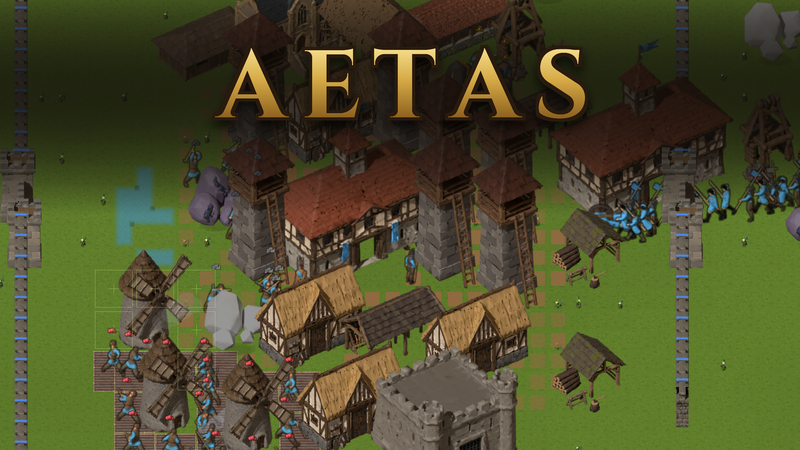
This update is mostly about the computer opponents. They now build bases that look like real towns, gather their armies before they attack, and finish the job. There are also real mountains on Highlands, four new technologies and a reworked XP system for online play.
Computer bases that look like towns
- Room between buildings, a clear square in front of the town center with the market on it, barracks grouped behind the front gate with an open field where the army gathers, and clear paths to gates, mines, forest and berries.
- Every computer has its own building style: Citadel, Ribbon, Quarters, Outpost or Open Village, depending on its civilization and the land around it. The results screen shows which style each computer had; spectators see it during the game.
- Walls come later, from the Iron Age (defensive computers from the Bronze Age), so the economy comes first. The gate on the enemy side is never blocked, towers stand in pairs by the gates, and a wall goes further out when a narrow pass makes it shorter. Computers use mountains in their walls and no longer wall off land that a ridge already closes.
- Computers remember where attacks came from and turn their base and new towers to that side. They rebuild further back after losing a building twice in the same spot, and don't build within range of towers they have seen.
- Easy computers build a bit messier with fewer towers, Hard ones neater.
Computer armies that attack like an army
- Armies gather before they attack, just outside your base and out of range of the towers they know about, then come in together in formation: infantry in front, archers behind, siege at the back. On large maps they regroup along the way, and reinforcements arrive in groups instead of one by one.
- Cavalry goes around to hit your archers, siege and workers. A retreat happens as a group with a rear guard. Wounded soldiers step back and heal before the next attack.
- Computers open in different ways: a tower rush, an early cavalry raid on your workers, a long build-up or the standard opening. Aggressive computers attack more often with smaller groups, defensive ones less often with bigger armies. Sometimes a small group hits another side just before the main army arrives.
- A fast unit takes a look before an attack, and the target can change. Computers go after remote gold and iron camps, and against a player who digs in they put towers at the exits and come back with siege.
- They bring more siege engines and break through walls and gates instead of waiting in front of them, so a beaten player is finished off faster.
- On defense they lock all their gates when you come close, put archers behind the wall and then sally out. A smaller army waits by its towers or in a pass instead of running into the open. Your early scout gets chased away.
- Computer allies attack together with you from two sides, warn you in chat with a ping on the minimap, send resources when you are almost out, and use your walls instead of building a second wall next to them. In free-for-all a computer may go after the winner of a fight between two others, and an army passing close to your base attacks you instead of marching past.
- On the biggest maps computers now always find you. Before, their scout could get stuck and no attack ever came.
- Easy and Beginner computers play as before.
Mountains
- Highlands now has real mountain ridges: dark rock you can't cross or build on, with passes in between. Holding a pass, or walling it off, really matters now.
- Mixed and Plains have scattered rock massifs, and Desert has mesas. Never near a starting position.
- Walls, gates and towers can now be built on hills, so you can close a pass right up against the rock. Other buildings still need flat ground.
- Mountains are darker on the minimap. Campaign missions, the tutorial and the challenges keep their old maps.
Four new technologies
- Oil Lamps (University, Iron Age): all research 20% faster.
- Horseshoes (Stable, Iron Age): cavalry and horse archers 5% faster.
- Coinage (Market, Middle Ages): all units cost 15% less gold.
- Guilds (University, Middle Ages): all research costs 15% less.
The computer researches them too.
Online: XP and ranked
- Points are now called XP. XP is what you earn by playing online; your rating is your skill, and only ranked matches change it.
- Per match: 10 XP for playing, 1 for every 2 minutes (up to 15), and 20 for a win against other players (10 against computers). Your first win of the day gives 15 XP extra.
- Giving up is always free. Leaving a match without giving up costs 25 XP of the month, in ranked and normal matches alike.
- In the lobby you can see how often a player left without giving up (after at least 5 online matches), so the host knows who joins.
- When you host, you see how many ranked lobbies are open and how many players are waiting in them.
- The button that balances teams now also works for players who never played ranked.
- Players without a ranked match for 30 days show as inactive on the rating leaderboard.
- A ranked match now always counts for everyone who played in it.
Smaller things
- New lobby option, on by default: shots from siege engines fly to where a unit stood when they were fired, so units that keep moving dodge them. Units standing still or fighting still get hit, and so do buildings.
- With several buildings selected, new units and research go to the building where they finish first. A town center that is advancing to the next age gets fewer workers.
- Hold Shift or Ctrl at the market to see the full price of that click.
- The training tooltip shows how much population a unit takes.
- The sandy paths between buildings are now smooth paths instead of a checkerboard of little squares.
- Deleting a healthy unit of your own no longer counts as a loss on the results screen.
Playing online? Everyone needs 0.4.2 to play together. If you see "different game version", restart Steam and it will fetch the update.
More from Aetas
Other announcements
Aetas is out in Early Access, with update 0.7.0Aetas is out in Early Access It's here: Aetas is now available in Early Access on Steam. The game is playable from start to finish: seven ages from the Stone Age to the Industrial Age, six peoples that each play their own way, six campaigns with 48 missions plus historical battles, skirmish against the computer and online multiplayer for up to eight players. It isn't finished yet. The art keeps…Aetas 0.5.0: turn the view, control your replaysAetas 0.5.0 A big update: you can now turn the view, replays get proper playback controls, you can place a whole row of buildings in one go, and the balance between archers, cavalry and siege has been reworked. Turn the view Rotate the view in quarter turns with Ctrl+Q and Ctrl+E, so you can look behind buildings and walls. The minimap turns with you. Replays you can control Replays now have pl…Aetas 0.4.1: walls at any angle, round fog of war, more woodA smaller update than 0.4, but you will notice it in every match. Walls at any angle Walls now join up properly when they run diagonally or in a curve. A diagonal wall used to look like a row of loose posts; now it is one wall. Drag straight or at an angle, and hold Ctrl while dragging to place a ring of wall around the point where you started. A round fog of war Every unit and building now see…