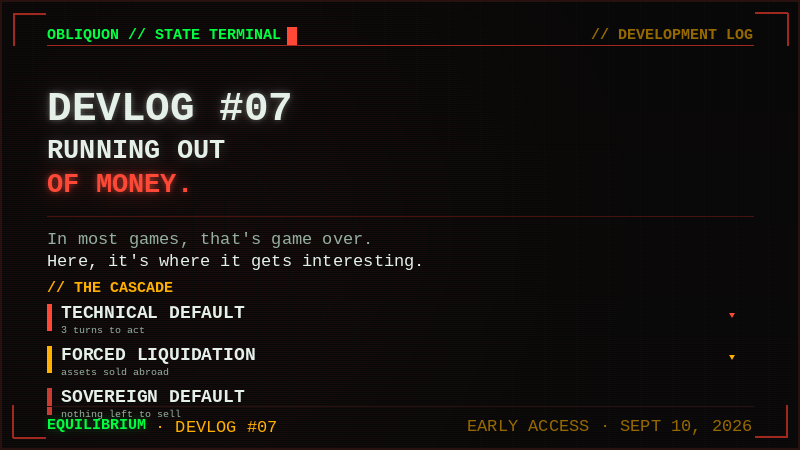
In most management simulators, running out of money means one thing: you lost, start over.
In EQUILIBRIUM, running out of money is where the interesting part begins.
Because a state that can no longer service its debt doesn't cease to exist. It still has something to sell — and someone ready to buy it.
TECHNICAL DEFAULT
When fiscal space drops below zero and stays there, the country enters technical default.
It isn't the end. It's a countdown.
The spread spikes to its ceiling, the rating collapses, and a banner warns you: three turns until forced liquidation. Three turns to climb out under your own power — cut, tax, negotiate — before someone else decides in your place.
Three turns is almost nothing. That's the point.
FORCED LIQUIDATION
If the countdown reaches zero, the national champions go to auction.
Not symbolically: they are actually sold. The large state-held companies — energy, banking, infrastructure, defence — change hands to foreign buyers, one by one, with a name and a price.
The proceeds enter the state's coffers and pull you back into positive territory. The immediate crisis is resolved.
You have just sold pieces of your country to pay the interest.
And this is where the game shows you what that really means: you didn't choose which assets to sell, or to whom. Default strips a state of sovereignty over its own economic decisions before it even strips it of money.
WHO BUYS MATTERS
The buyers aren't anonymous. They are powers with interests of their own, and they don't all carry the same political weight.
Selling a strategic asset to a long-standing partner is one thing. Watching it bought by a rival power is another — and the markets notice. The spread reacts to who bought it, not only to how much you collected.
Energy and defence are the most contested sectors: they hold a strategic value that goes beyond the balance sheet, and the bids reflect it.
AND WHEN NOTHING IS LEFT
Public assets aren't infinite.
You can go through more than one default, selling off another piece each time. But sooner or later comes the turn when the state falls into crisis and has nothing left to put up for auction.
That is sovereign default, and it's the end of the run. Not a defeat on points: the simple fact that nothing remains with which to pay.
WHY WE CHOSE IT THIS WAY
It would have been simpler to set a threshold: below a certain level of debt, you lose.
But a threshold tells you nothing. The bankruptcy of a state isn't a number falling below a line: it's a process, with stages, and at each one you lose something that won't come back. First your credit. Then your control. Then your assets. Then the rest.
We wanted the player to live through it, not read about it on a game over screen.
And if their nation really does hit the bottom, to know exactly which decisions took it there.
EQUILIBRIUM launches into Early Access on September 10, 2026. If the project interests you, adding it to your wishlist is the most concrete way to help — it helps me get it in front of more people.
The next devlog arrives next week.
— Andrea, Obliquon Corporation