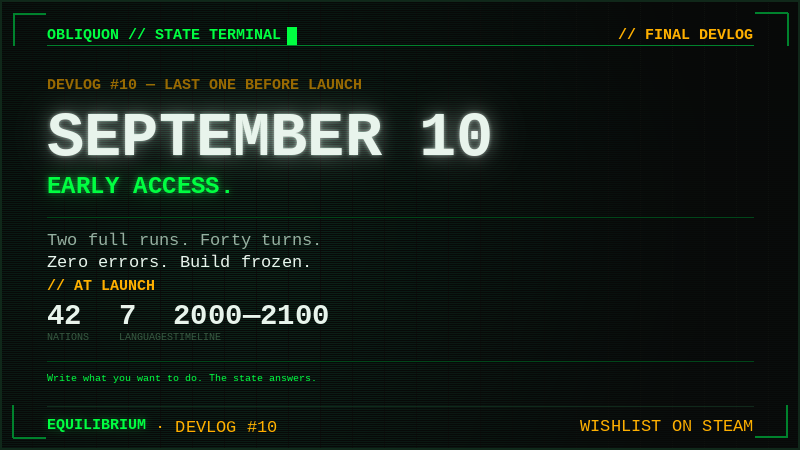
SEPTEMBER 10
This is the tenth devlog and the last one before release.
The first nine were written for people following the project while I built it. This one has to work for someone arriving now, who has no idea what they're looking at. So I'll start there, and anyone already here can skip the first part.
WHAT EQUILIBRIUM IS
You run a government. You pick one of forty-two nations and take it forward through time, one turn at a time, from 2000 to 2100 if you get that far.
What sets it apart from other political management games is how you issue decisions. You don't pick from a menu. You write what you want to do, in your own language, and the State answers.
Sometimes it just does it. Sometimes it tells you a parliamentary vote is required. Sometimes it refuses and explains which law stands in the way, offering you the legal routes that remain open.
Here's a real example, from the last verification session before the build was frozen.
I typed a command to reduce tax breaks for energy companies. The game classified it as legislation — not a decree — took it to parliament, and the governing coalition voted it down.
That isn't a scenario I wrote by hand. There's no list of expected commands with their answers already prepared. The system reads the command, works out what kind of act it requires, and puts it to a parliament that votes according to its composition and the loyalty of its members.
That rejection is worth more than any description I could write.
HOW YOU DECIDE A GAME IS READY
There's a question I've asked myself every week, and it isn't "have I closed every bug."
That answer is always no. It'll be no on September 10, and it'll be no a year from now. It isn't a useful test.
The real question is this one: does someone playing for two hours run into something that ruins their session?
For weeks the answer was yes. A command that broke the interpreter, a crash to a black screen, a nation going bankrupt without the player having done anything wrong. The day the answer became no, I froze the build.
There's a practical constraint that changes how you work in the final month, and it's worth explaining because it isn't obvious.
There is no separate test environment. Every publish is instantly live for anyone who has the game. So either you publish, or you send keys to the people who need to play it before release. The two don't coexist: the moment someone is playing, you can't change the game under their feet anymore.
Which means the last week isn't like the others. You close things, you verify, and you stop.
The number I stopped on: two complete playthroughs, forty turn transitions, zero errors.
It isn't a spectacular milestone. It's just the point where I stopped fixing.
WHAT TO EXPECT FROM EARLY ACCESS
Date: September 10, 2026. The price is on the Steam page, in your currency.
What's in it: forty-two playable nations, seven languages, the 2000 to 2100 span. Parliaments built on each country's real party systems. An economy with public debt, spreads, credit ratings, regional conflicts and crises that last over time instead of resolving in a single turn.
What's still being worked on, said plainly:
Economic balancing is under active tuning. The game is stable and playable, but the numbers will keep moving over the coming weeks. If a nation feels too harsh or too easy to you, you're probably right and it'll probably change.
The "How to Play" screen is English-only for now. Translations arrive after launch.
Why Early Access and not a finished version.
Because I can test as much as I like, but no automated check tells me what an actual person playing tells me. The most significant bugs of these past weeks were found by someone else, not by me: whoever wrote the game types commands they already know will work.
EQUILIBRIUM gets better with people playing it. That's the only reason it's coming out this way.
See you on the 10th.
If the project interests you, adding it to your wishlist is the most concrete way to help: it lets me show it to more people.
— Andrea, Obliquon Corporation