THE ECONOMY HAD NO INCOME
This week I found a flaw that had been there from the start, and that nobody — myself included — had seen.
In the formula that calculates fiscal space each turn — how much room the State has to spend — there was no income term. Not one.
GDP was growing. Reforms were working. The economy was expanding. But that growth never turned into revenue.
WHAT IT MEANT IN PRACTICE
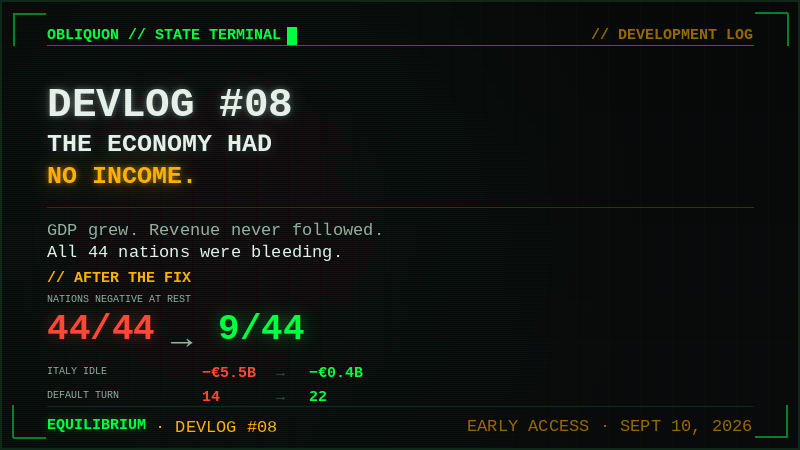
That all 44 nations in the game were net negative.
A country doing absolutely nothing — no decrees, no reforms, just end turn — lost money every single turn. Italy went bankrupt on turn 12 without the player having done anything wrong.
It wasn't a matter of difficulty. It was that the numbers couldn't add up.
There was a second problem too, more mundane but with the same effect: debt servicing costs were being subtracted twice, once by the interface and once by the engine. The same interest paid twice, every turn, for the whole game.
WHY I HADN'T SEEN IT BEFORE
Because until a few weeks ago the game was running at half capacity.
Events didn't actually last. Policy cooldowns never triggered. Time advanced by two turns for every end turn instead of one. They were all separate flaws, and each one masked the others.
When I fixed them — one at a time, over the past weeks — the engine started running the way it should. And the structural flaw surfaced, because there was finally enough signal to see it.
It's something you learn quickly when you develop alone: bugs hide behind other bugs. Until the system works, you can't know what inside that system is broken.
AFTER THE FIX
The numbers, verified:
— Nations that are net negative at rest go from 44 out of 44 to 9 out of 44
— Only one defaults within 20 turns with no player action at all: Argentina, with its spread at 1200 basis points. Which, given its real economic history, is probably correct
— Italy left idle goes from −5.5 billion to −0.4 billion per turn
— A realistic scenario, with an ongoing regional conflict and two domestic crises: default shifts from turn 14 to turn 22
The game is still hard. But now it's hard because governing is hard, not because the arithmetic was broken.
THE REST OF THE WEEK
A crash that led to a black screen has been tracked down and closed. I've also added a safety net: an unexpected error is now recoverable instead of ending the session.
Nine presentation flaws fixed: a spread that could reach absurd values under certain conditions, numbers that didn't match between panels, dirty decimals in the text.
A new "How to Play" screen on the home page, because the terminal is powerful but not obvious, and anyone arriving deserves to understand right away what they can do with it.
The descriptions of all 93 national companies translated into all seven languages. And four duplicate company records removed — they were appearing twice for Italy and Germany.
WHY I'M TELLING YOU THIS
I could have written "this week: economic balancing." It would have been true and nobody would have asked questions.
But an economic simulator where the economy had no income is too good not to tell. And it's how development actually goes: not a straight line to the finish, but a series of broken things hiding other broken things, until one by one they surface.
The game launching on September 10 is better than it was a week ago. Not because I added something, but because I removed an error that had always been there.
EQUILIBRIUM launches in Early Access on September 10, 2026. If the project interests you, adding it to your wishlist is the most concrete way to help — it helps me show it to more people.
The next devlog arrives next week.
— Andrea, Obliquon Corporation