The new Foundations update brought a lot of great discussion about all of the new game modes available, but one of the conversations in particular reminded me of the greatest question you can ever ask yourself or others while discussing solutions: "What problem are you trying to solve?". It sounds so trite and obvious, but if you take that question seriously, I find the value of the exercise incomparable.
I’ll try to unpack it through one recent example and the broader concept it points to.

Best Laid Power Plans
The Foundation in question is Islands of Power, which has a simple idea - Power costs increase with each structure in the same network. I made this Foundation because Power systems in MoteMancer are a little atypical in that each system has some form of exponential growth. On the face of it there's a world where I 'fix' this, but the result is just building more power structures, which isn't that interesting. Plus you need to create at least a handful of power systems in a given playthrough because you are jumping from plane to plane, so solving power for a given plane serves as its own benchmark and I think on balance that actually works out well.
But so back to Islands of Power, this is a direct assault on the exponential scaling of generation, by creating an exponential tax per structure in a network. My first thought was a simple flat tax-per-structure so that the Foundation does what it says on the tin. The cost is simple and understandable. I even had 13 different equations in the running before I settled on one.
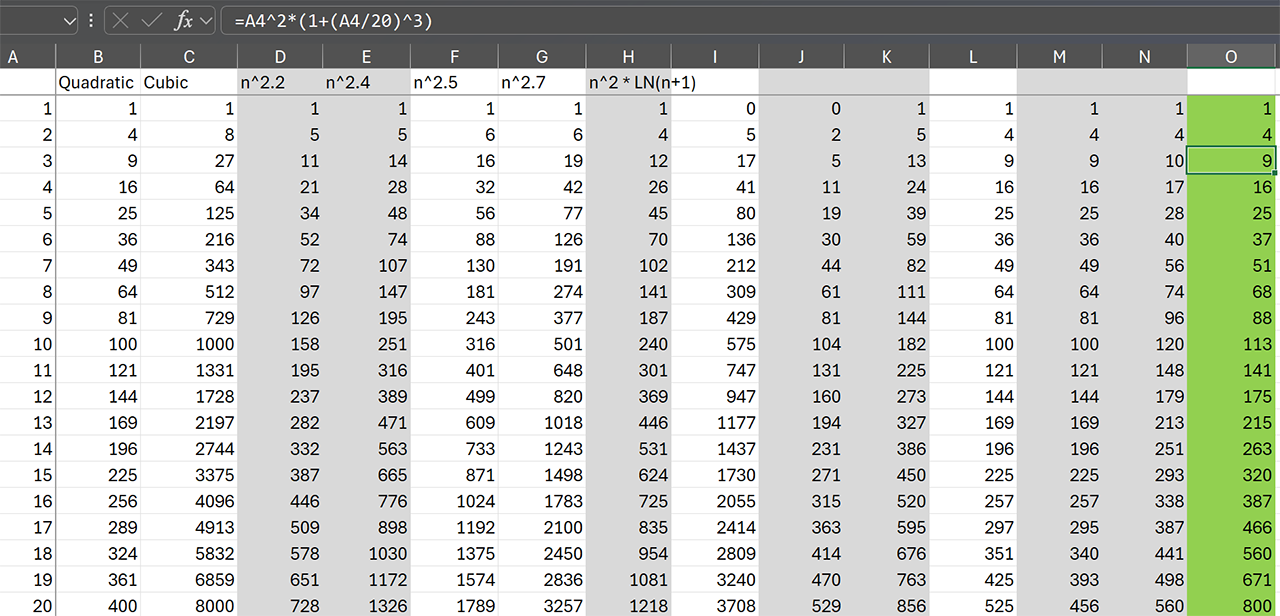
How many equations do you need? At least one more...
Player Pain and Problem Solving
But I got feedback that Islands of Power was too painful, too punitive. It was doing it's job, but even in its simple form, it didn't feel good to puzzle around. My first instinct was simply to cut the tax by some multiple (half or a quarter), but then the correct honest question was asked: "What is the design intent?"
I want to pause here - I'd been circling intent, but was so deep in the problem-solving weeds that simply asking the top level question brought everything into sharp focus. It reminds me of what my old boss used to say whenever he needed more information or wanted to gently push back on some solution I was presenting "What problem are you trying to solve?"
This matters because there are so many useful immediate implications:
- Is the solution you are proposing actually addressing the problem directly?
- If you are collaborating, do you agree that it's the correct problem to solve in the first place?
- Are you solving the problem at the correct level of player cognition?
There are more, but simply stepping back from the solution itself and evaluating the problem-solving meta state you are in is always a useful exercise. It's so easy to jump right in at the point of pain and trying to address the pain itself, but that can lead you to thrashing in the fog without a purposeful direction.
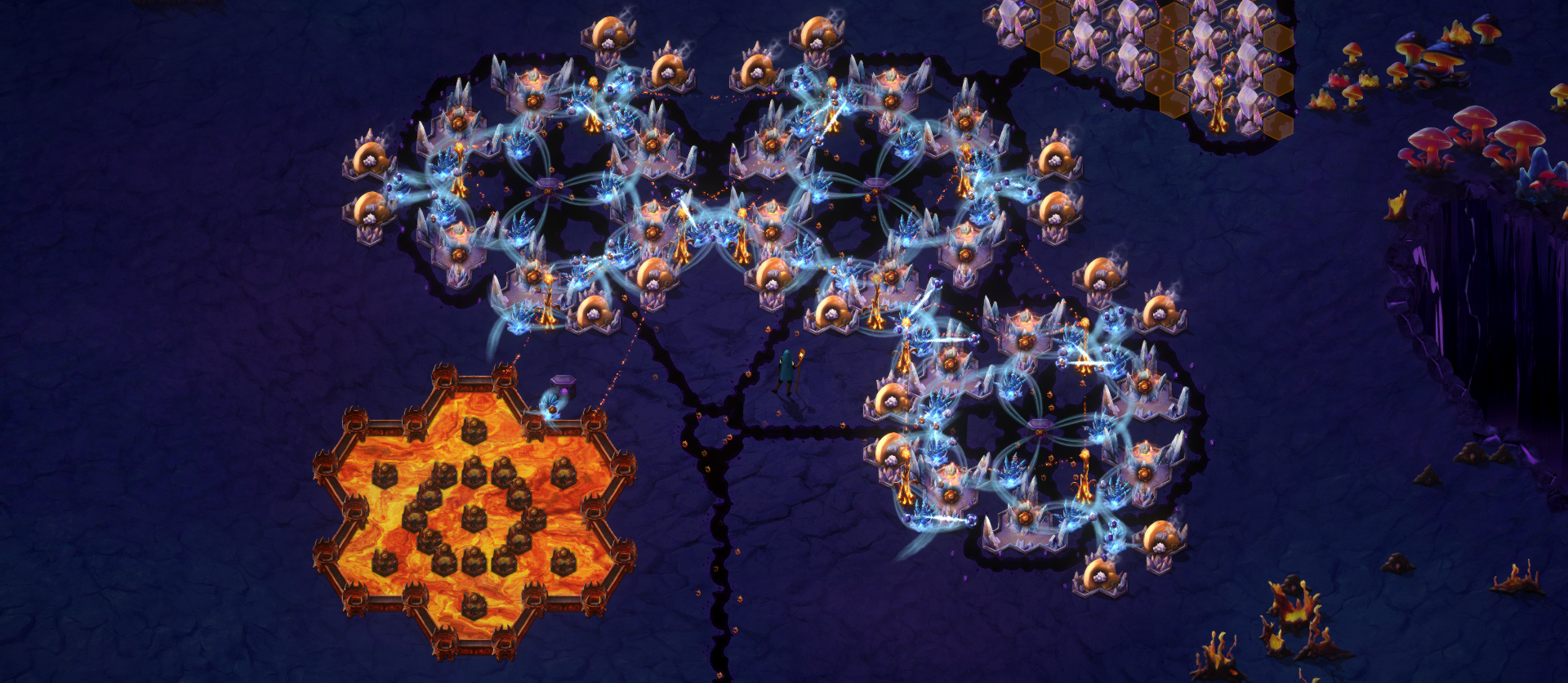
So back to design intent. Really what I want experientially is for players to make several discrete power sections for their base per plane, avoiding the runaway effect of exponential power growth on a single base. And just as importantly, it does not mean wanting players to agonize over whether a single gripper is worth the additional power draw opportunity cost.
Focus on the Goal, Not the Task
In reality, the right level of cognition for this Foundation is not per-structure scrutiny. It's an intuitive "This is getting expensive, I should start a new power network after this cluster of structures". Per-structure cost is not inherently bad, it just introduces a series of micro stutters in your thought process where every single structure placed has an added cognitive burden, and that isn't worth it.
So to solve this for real, a new 14th equation was added that simply takes the maximum potential demand from a system and uses that to tax power consumption. The trade-off is that you don't necessarily have an intuitive "this next gripper will tax 8 additional power", but that is also the benefit. You aren't thinking about the cost of a small add, you are thinking about the overall cost of the cluster. And, hungrier structures will add a higher tax than less demanding ones, matching how an organic power cluster grows naturally.
Zooming Out
Sometimes you can just solve a problem where it lives and move on, but if you ever catch yourself spinning your wheels or a collaborative conversation isn't quite flowing smoothly, take a moment to step back and ask "What is the actual problem are we trying to solve?"
Shed all of the details, reframe from a clean slate, assess which of your current thoughts/solutions are relevant or not, move forward with a clearer, more zoomed-out perspective. The details matter, but only after you’ve framed the right problem. That’s true in systems design, collaboration, and most kinds of craft.
I’ve got a bunch of cleanup and bug-fixing to do this week. As soon as the reports dry up, it’s back to full swing art and performance work. Happy Monday!
Back to the lab 🌿
~CyanAvatar