Dear Players,
Missed our previous devlog? Discover the new Employees & Skills system here:Devlog #2 — Employees & Skills
Welcome to our third devlog dedicated to the next major update for Parisian Bistro Simulator.In our previous devlogs, we introduced new systems designed to make your decisions more meaningful, from planning your Menu du Jour to recruiting and training your employees.Today, we will be taking a closer look at another major part of restaurant management: invoices, taxes, and cash flow.
💰 Making Money Matter
Until now, financial management in Parisian Bistro Simulator offered relatively little long-term challenge.The beginning of a new game could require some careful spending, but once enough employees had been recruited and the restaurant became increasingly automated, progression often became much more linear.Missions provided additional income, dishes were unlocked quickly, and profits gradually increased as the restaurant expanded. After a certain point, there were few reasons to carefully plan your future expenses or maintain a financial reserve.With the next major update, managing your money will become a much more important part of running your bistro.
🧾 A New Invoice and Tax System
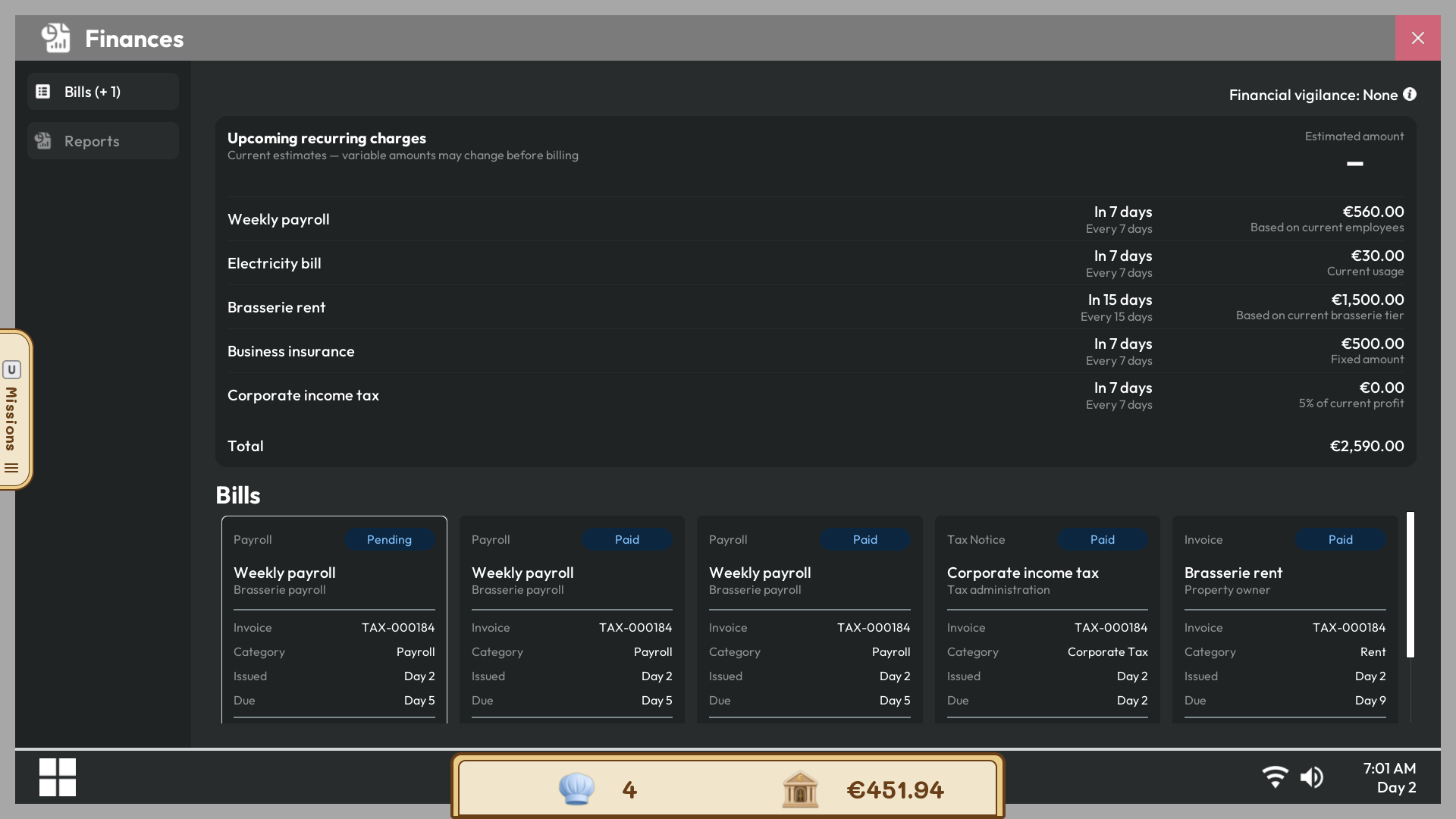
Your restaurant will now have several recurring operating costs, each represented through the new invoice system.These expenses will include:
- Employee salaries
- Electricity bills
- Rent
- Municipal taxes for your terrace
- Business insurance
- A new profit tax
As explained in our previous devlog, employee salaries have also been rebalanced according to each candidate's abilities at the time of recruitment.More experienced and capable employees will generally require a higher salary, while less experienced candidates may be cheaper to employ and can be developed through training.Building an efficient team will therefore require you to consider not only employee performance, but also the long-term cost of your payroll.
📅 A Seven-Day Payment Cycle
Recurring expenses will no longer be automatically deducted from your account every day at midnight.Instead, salaries, taxes, rent, insurance, and other recurring costs will be accumulated and paid every seven in-game days.Direct purchases, such as ingredient and supply orders, will still be paid immediately.This new payment cycle means that the money currently available in your account will not always represent the amount you can safely spend.You may have enough money to purchase new equipment, decorations, ingredients, or supplies, but spending too much could leave you unable to cover your upcoming payroll and tax payments.Maintaining sufficient cash reserves will therefore become essential.
⏳ Deadlines and Late-Payment Penalties
Certain invoices will need to be paid manually before their deadline.Failing to pay them on time will result in penalties, which will vary depending on the type of invoice.For example:
- Employees may stop coming to work if payroll remains unpaid
- Unpaid terrace taxes may generate additional fines each day
- Certain critical unpaid expenses may eventually force your bistro to close
Ignoring an invoice will therefore not simply increase a number on the finance screen. It may directly affect your employees, your services, and your ability to keep the restaurant operating.
📊 Planning Your Cash Flow
The finance interface has been redesigned to help you anticipate these expenses.It will display your upcoming payment deadlines, the amount due for each invoice, and the recurring costs you will need to cover during the next payment cycle.This will allow you to plan your spending more effectively and decide whether your current cash should be invested immediately or reserved for future obligations.Your objective will no longer be only to generate as much revenue as possible. You will also need to control your costs, anticipate upcoming payments, and ensure that your restaurant remains financially stable.
📈 A Tax on Your Profits
Your bistro will also be subject to a new profit tax.This tax will represent 5% of the profit generated by your restaurant. Profit is calculated from your total revenue after deducting your expenses.Increasing your revenue will remain important, but controlling your operating costs will now have an equally important role in determining how much money your restaurant truly earns.Efficient employees, well-managed salaries, controlled stock purchases, and a successful Menu du Jour will all contribute to improving your final profitability.
👀 A Hint About Our Next Devlog
Of course, we have also thought about those restaurant owners who may prefer a more... creative approach to accounting.In our next devlog, we will introduce a new system that may allow the craftiest players to avoid paying this profit tax.It will not be particularly legal, and it will certainly not be without risk.
⚙️ A Deeper Management Experience
The purpose of this system is to add a genuine layer of financial planning to the management of your restaurant.In addition to managing each service, you will need to consider the long-term development of your bistro, anticipate future expenses, control your payroll, and decide when it is safe to invest.Combined with the Menu du Jour and employee management systems, these changes will give you more opportunities to optimize your restaurant from one playthrough to another.A profitable Menu du Jour, a carefully trained team, an efficient distribution of tasks, and well-managed operating costs can significantly change how quickly your bistro develops and how profitable it becomes.
❤️ Conclusion
Invoices and taxes are the third major system we are presenting as part of the new direction for Parisian Bistro Simulator.Our objective is to make financial decisions more meaningful and give you more control over the growth, efficiency, and long-term stability of your establishment.Thank you for reading this third devlog.Feel free to react, share the post, and tell us what you think about the new financial management system. We will be back soon with another devlog introducing a rather different way of managing your restaurant's profits.In the meantime, you can join our Discord or our QQ group to discuss the game with the community.Discord
https://discord.gg/BcDbU6dgF9QQ Group
QQ 982613648We look forward to showing you more.