For two devblogs running we promised the same thing: the drill is next. Here it is. It no longer wins on its own — but it no longer loses unnoticed either.
The Empire can win on Kepler in three ways. It can hold out for seventy turns until the fortress stands. It can storm the Alpha Nest — get in, strike down the queen, hold for three turns. Or it can fire up the planetary core drill and settle the question for good.
Twice now we have promised you something about that drill. The first time because across seventeen thousand test games it fired not once. The second time because it did fire — and nobody cared: across 540 games the drill site was attacked not a single time. The Swarm had exactly zero influence on that victory condition. A final boss that fails to show up for the finale.
This issue is about what became of that — with numbers from a single night: 200 games, five maps, shipping build.
First, the skin
We still owe you one issue. We announced we would dig into the creep — the biomass the Swarm leaves behind where its dead fall. That issue never appeared; the mechanic did.
It now does three things. It carries: on dense friendly tissue the Swarm heals faster and moves faster — purple ground is its ground. It dies: tissue only lives within reach of a hive; sever the seam between them and it rots inward from the edges. And you see it: a creeping membrane, thick at the seam, pale at the rim. The Swarm maintains no supply line you can cut. It wears its logistics as skin — which is exactly why the seam is the point of attack, not the mass.
That was the detour. Now the drill.
What the drill used to be
A counter that went up. Nothing more.
The colony placed it, the counter counted, eventually a result stood. The Swarm marched across the map in the same span of time, grew, hunted — and walked past the drill site as though it were a rock. Not out of negligence: to the Swarm it was a rock. Nothing in its perception distinguished the structure cracking open the planet from any random barracks.
That is the most uncomfortable flaw a strategy game can have. Not an enemy that is too strong or too weak — but an enemy that does not see the thing that matters.
What we built
The finished drill now calls. That is the mechanism's name in the code too: the drill's call. Swarm formations within reach are drawn to the site and stay assigned until they fall or the drill does. It is not target-seeking you can outwit — it is a pull.
With one exception we rather like: hunger breaks the call. An unsupplied formation lets go of the drill site and looks after itself. Cut the Swarm's seam and you relieve your own shaft as well — two mechanics that know about each other without being told.
What the night says
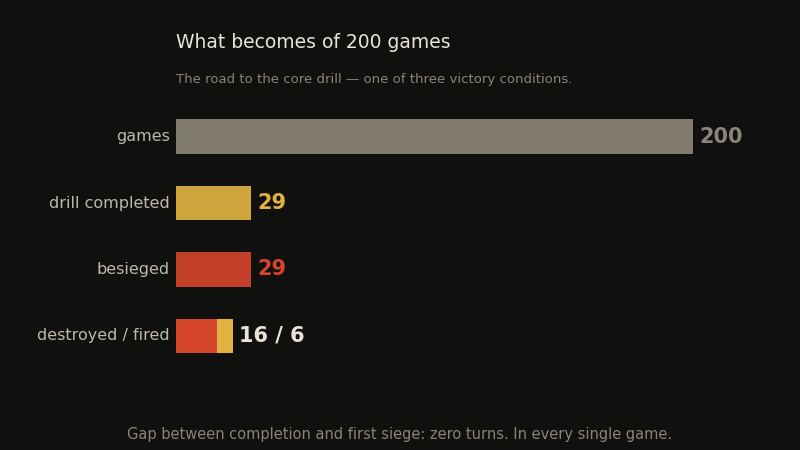
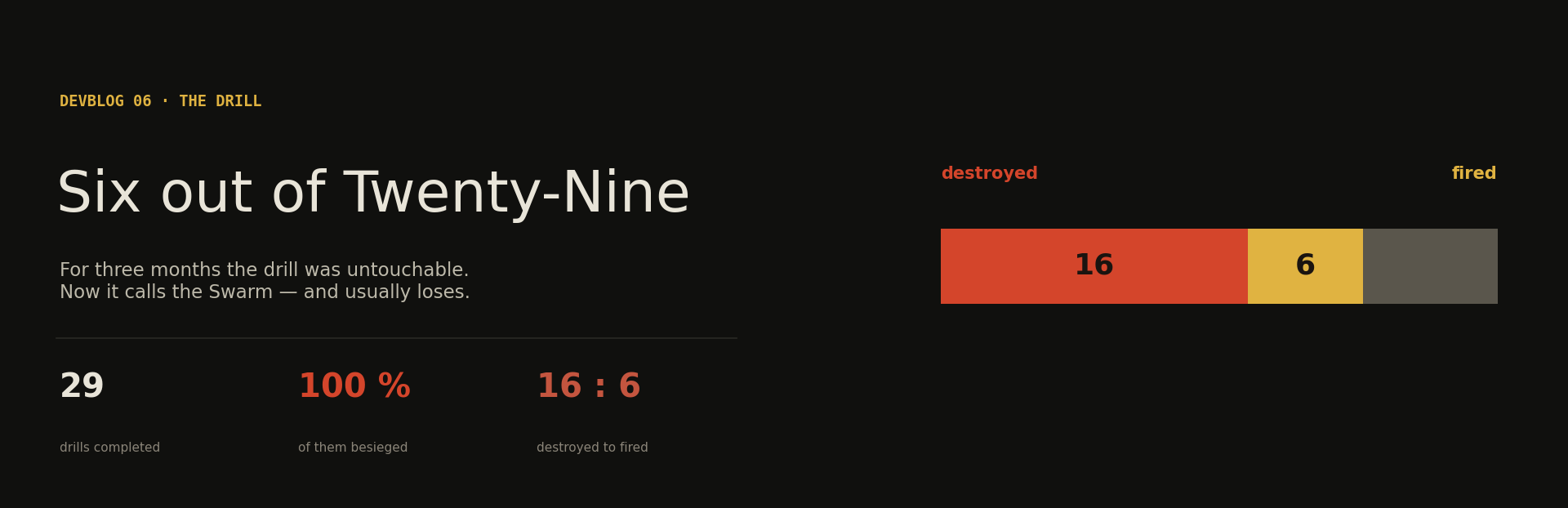
Across 200 games the drill is completed in 29 — median turn 39. What happens next is the whole devblog:
All 29 come under siege. Without exception. The gap between completion and first siege is zero turns — in every single game. As a counter-check we counted how often a siege is reported without a finished drill: zero times. The call is tied to the thing, not to chance.
Of those 29 drills:
- 16 are destroyed — 55 percent. Every one of them ends the game as a defeat.
- 6 fire — 21 percent.
- The rest end earlier for other reasons: thirst, decay, being overrun.
The Swarm wins the duel at the drill site 16 to 6. Three months ago it stood at 0 to everything.
Where it hurts
We could stop here and call it a success. The map Amboss forbids that.
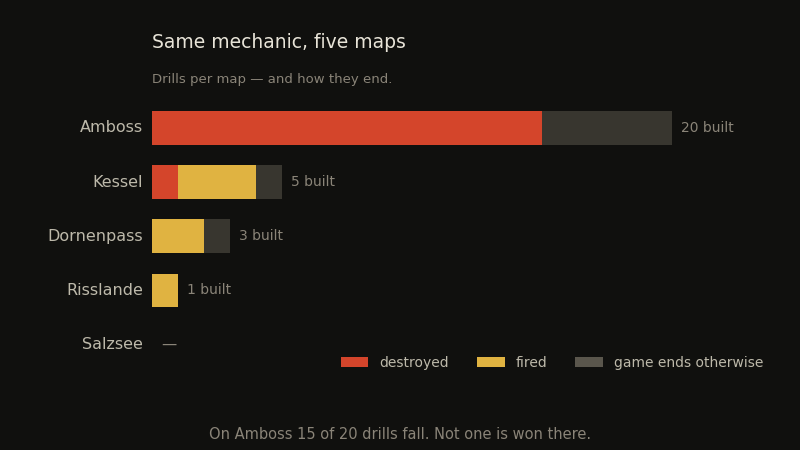
Amboss is the open map — short routes, little cover. Twenty of the 29 drills are built there, every second game turns into a siege there, and 38 percent of the drills fall there. And there the colony wins by drill not once. Not rarely. Not narrowly. Zero out of twenty.
At the other end sits Salzsee: zero sieges, zero destructions, zero drill victories. The Swarm never reaches the site — the distances are too great, the game ends first.
Same mechanic, same night, two maps, and an outcome ranging from "hopeless" to "never happens". That is not balance, that is a spread we have to close.
And two numbers stand above all of it. The drill is only completed in 14.5 percent of games at all — in the other 85 percent the match is decided before the victory condition is even available. We now know why: by that point the colony has no free hands left to crew it.
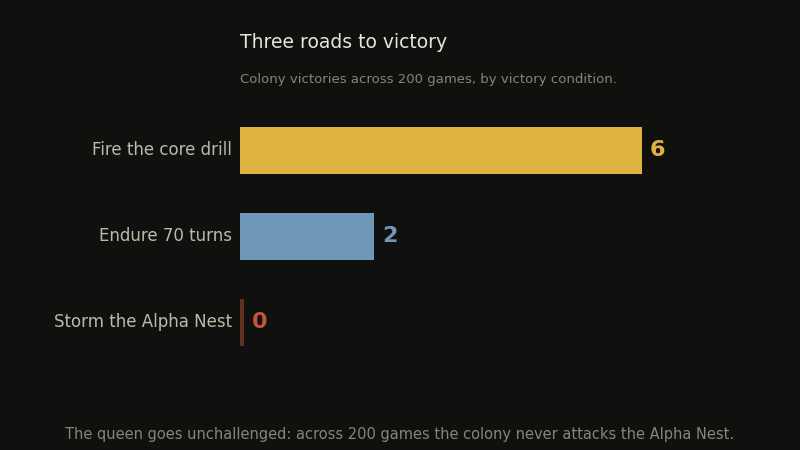
The second number is quieter. Of the three roads to victory, across 200 games the drill was taken six times, endurance twice — and the Alpha Nest not once. The colony does not storm the queen. It never even gets close.
Lore fragment
From the drilling log, Shaft Theta. Entry by the officer of the watch.
Since yesterday the ground has been different. The men say it breathes. I took it for exhaustion until the survey party came back with the canisters: the samples from the surrounding area carry the same signature as our drill cuttings — only older. As though something had drilled here once before and stopped.
Clause 4 of the regulations requires a report to Staff at this point. I report: we are not the first. And whatever was here before us noticed our drilling before Staff had authorised it.
What comes next
The drill has an enemy. Now it needs a defence worthy of the name.
Because the same night showed something else: when the colony sends its troops into the field, it sends them one at a time. It maintains formations of seven brigades — and regularly fields two in combat. Not because it split them, but because the wrong army is standing where the fighting is. A staff that concentrates force instead of spreading it evenly is the next thing we build. After that, the siege of Shaft Theta will have an outcome that is not already decided.
Follow along
Wishlist on Steam: Kepler Protocol
Early Access: November 2026
Next devblog: The staff that scatters its army — and what happens when it stops
Kepler Protocol — 4X strategy on an alien planet. Discipline against swarm. Codex against pheromone. A red sun over both.