LIVORA Update: Social Events, Free Time & Deeper Choices
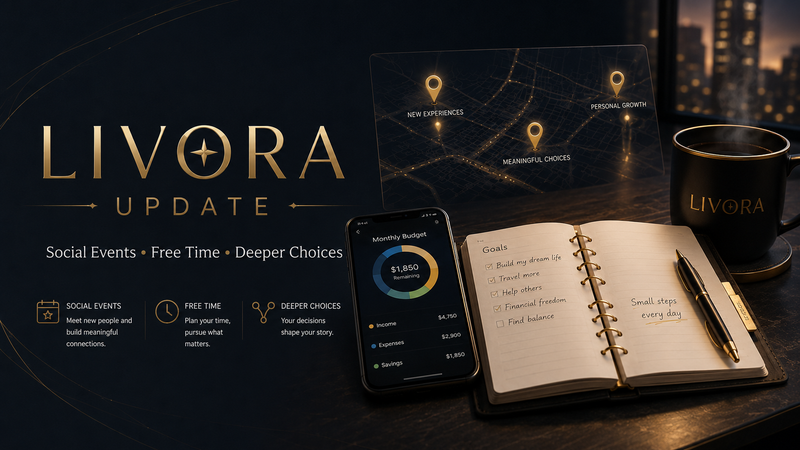
A big update for LIVORA
We have been working on a substantial update designed to make every life feel more personal, connected and believable.
This update introduces meaningful social occasions that develop over time, more ways to spend your free time, stronger long-term storytelling and clearer consequences throughout the game.
Big Social Events
Important occasions are no longer limited to a single decision.
You may now receive invitations to birthdays, weddings, anniversaries, graduations, family gatherings, reunions, school events, work celebrations, community events and other meaningful moments.
Each event can develop across several stages:
Respond to the invitation and decide whether to attend.
Arrange travel, clothing, gifts, childcare, time away from work or a plus-one.
Follow the countdown as the event approaches.
Deal with complications such as bad weather, transport disruption, additional costs, family tension or a change of plans.
Make decisions throughout the event itself.
Live with the emotional, financial and relationship consequences afterwards.
Showing up well can strengthen relationships, create lasting memories and lead to warmer invitations in the future. Missing an important occasion, overspending or handling a difficult moment badly can also stay with the life.
Plan and host your own events
You can now organise events rather than only attending them.
Host a birthday party, dinner, house gathering, barbecue, family celebration, anniversary, children’s party, seasonal gathering or another important occasion.
You will need to consider:
The venue and available space.
Your budget and guest list.
Food, drinks and entertainment.
Invitations and guest responses.
Preparation tasks before the event.
Unexpected problems on the day.
The effect hosting has on your money, energy, relationships and reputation.
A successful event does not need to be expensive. Thoughtful planning, realistic expectations and the way you treat people can matter more than the amount you spend.
Richer Free Time
Free Time is now a much deeper part of the Day Planner Map.
Available activities respond to the time of day, weather, location, finances, energy, relationships and the people currently present in your life.
You might choose to:
Have a quiet evening at home.
Return to a hobby.
Cook something you enjoy.
Meet a friend or spend time with family.
Go for lunch, attend the cinema or plan a date.
Join work drinks, a quiz night or a community evening.
Go out for dinner, visit a club or continue the night somewhere else.
Stay home and recover when the life cannot realistically carry another commitment.
Some activities now develop into connected outings with follow-up moments, changing plans and decisions during the experience. They are no longer simply a button that adjusts a few numbers.
More meaningful everyday planning
The Day Planner Map now does more to show what is approaching and what needs your attention.
Social-event countdowns and preparation tasks can appear directly on the map, helping important plans feel connected to the rest of the life.
Supermarket visits have also been expanded. You can choose between different baskets based on what the household needs and what the life can afford. Buying the cheapest food, choosing healthier options, feeding a family, relying on reduced items, skipping the shop or using credit can all create different immediate and future pressures.
Future Pulse has been rewritten
Future Pulse has received a major writing overhaul.
Future developments across technology, employment, education, healthcare, finance, housing, relationships, climate, infrastructure, identity, public life and personal wellbeing now have more distinctive scenes, headlines, decisions and outcomes.
The aim is to make the changing world feel like something your character is actually living through, rather than a collection of repeated templates.
Your response to these developments can still affect your opportunities, relationships, finances, security and the direction of the wider world.
Clearer choices and consequences
Thousands of choice outcomes have been reviewed and improved.
A complete set of 500 long-term life scenarios now has individually written decision prompts, choice descriptions and consequence text across areas including money, work, housing, relationships, parenting, health, business, ageing, legal responsibilities, community life and modern digital pressure.
We have also corrected a number of situations where the effect of a choice did not properly match what the option appeared to promise.
Choices should now be easier to understand before you make them, while still keeping the uncertainty and difficult trade-offs that define LIVORA.
Improved Command Centre and guidance
The desktop Command Centre has received further navigation and presentation improvements, making it easier to find the information that matters without turning the game into a wall of menus.
The How To Play section has also been completely rebuilt with:
A clearer explanation of the daily gameplay loop.
Guidance on money, energy, mental load and stability.
A searchable reference section.
Better explanations of the Command Centre and Day Planner Map.
The ability to replay the Guided First Day without affecting your saves.
Language coverage and interface text have also been expanded across LIVORA’s supported languages.
Additional fixes and polish
The update includes a broad range of smaller improvements across the desktop interface, map presentation, world news, onboarding, summaries, scenario wording, consequence reporting and general gameplay stability.
The update has been designed to work with existing saves, allowing you to continue a current life or begin a new one to experience the new systems from the beginning.
Thank you to everyone who has played LIVORA, reported problems and shared feedback. This update is focused on making the game more readable, more reactive and more human. MORE TO COME!
Build a life. Make choices. Live with the consequences.