Patch - 0.0.45
Corner King: Boxing Tycoon · published · build 24880798
0.0.45 — 2026-08-22
Added
- Settings has separate volume sliders for walkout music and punch sounds.
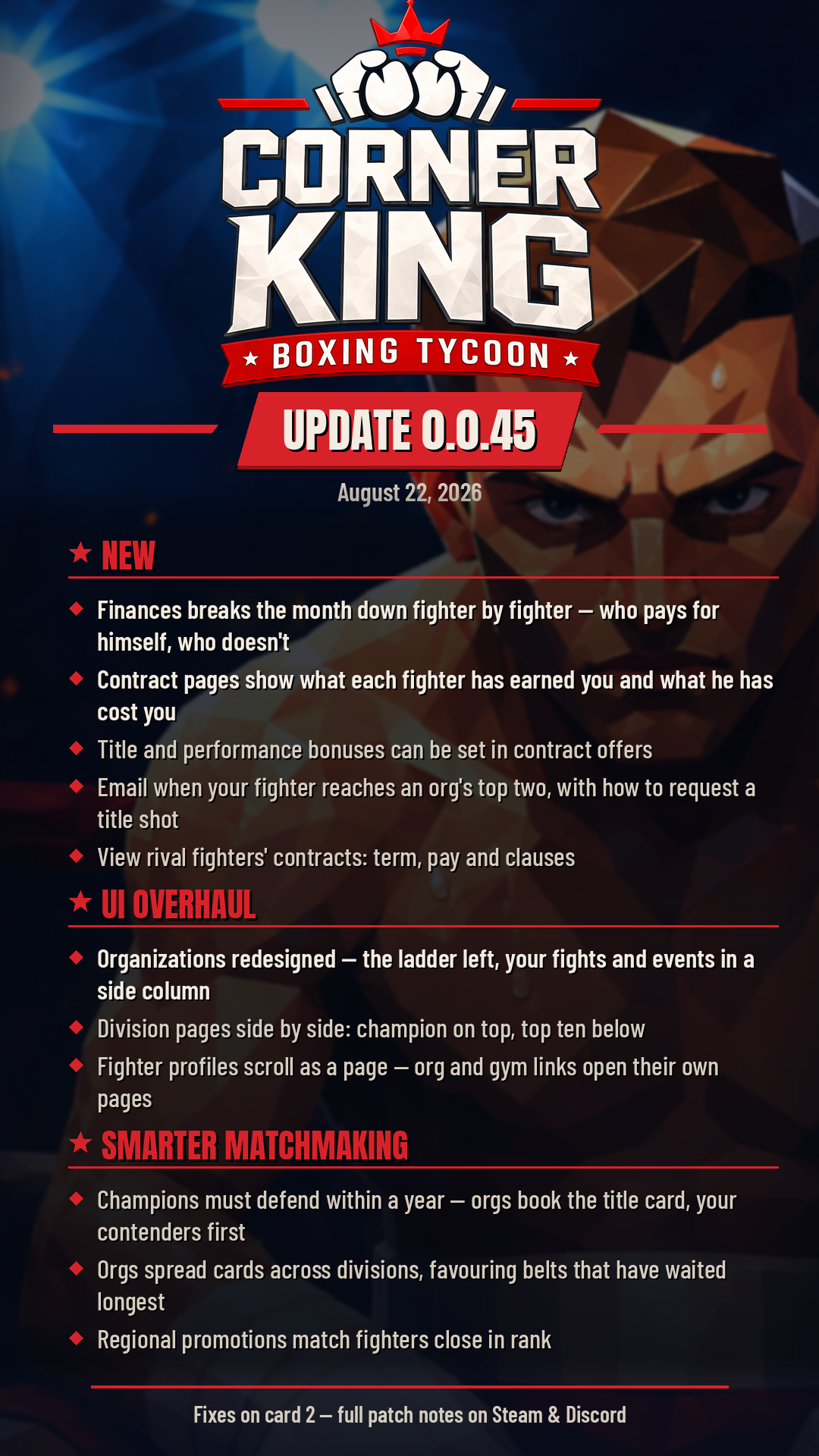
- An email arrives when one of your fighters reaches the top two of an organization's rankings, telling you he can be put forward for a title shot and how to request it.
- Title bonus and performance bonus can be set when you make a contract offer, alongside show money and the win bonus.
- The Finances screen breaks the month down fighter by fighter, so you can see who is paying for himself and who is not, and each name opens that fighter.
- A fighter's contract page shows what he has brought in, what he has cost you and where both came from, counting doctor's bills, gifts and purse advances against him.
- View Contract on a fighter signed to another gym shows his deal: term, pay, fight bonuses and clauses.
Changed
- The Organizations screen drops the background photo and lays out the ladder on the left with your booked fights and upcoming events in a side column.
- The Fighters table merges wins, losses and knockouts into one record column, moves the filter counts into the filter buttons and shows estimated ratings without the intel labels.
- Upcoming events on the Organizations screen show ten by default, with the rest behind a show-more toggle.
- An organization's page shows its divisions side by side, each with the champion on top and the top ten contenders below, with a show-more toggle for the rest.
- The fighter profile overview scrolls as a page instead of squeezing its panels into the window, and the organization and gym in the header open their own pages.
- A fighter's contract pages read like the contract itself: term, pay and fight bonuses listed line by line, with mood, earnings and the actions in a side column.
- A champion who goes around a year without a title fight is ordered to defend against the number one contender, and his organization books a title card in that division, starting with divisions where your fighter is the contender.
- Organizations spread their cards across divisions, favouring belts that have gone longest without being contested and divisions with enough fighters to fill a card.
- Regional promotions match their top-ranked fighters against opponents close to them in the rankings.
Fixed
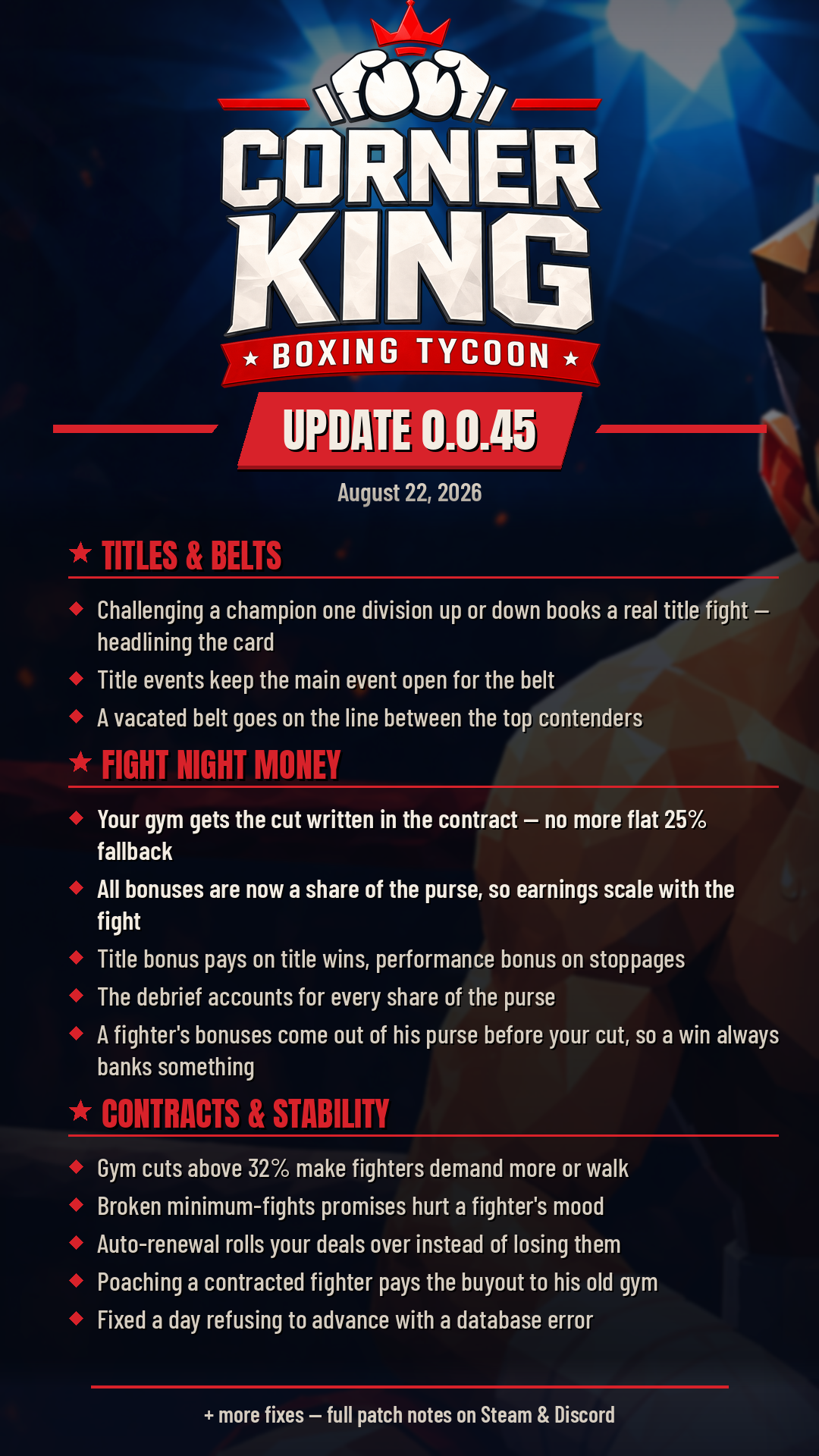
- A fighter ranked in the division above or below his own can challenge that division's champion for the belt, and the fight is booked as a title fight at the top of the card instead of a non-title bout on the undercard.
- A title event keeps its main event open for the belt instead of filling up with ordinary fights and going ahead without the champion.
- A belt left vacant when its champion retires is put on the line between the top contenders instead of going unclaimed.
- Fight night pays your gym the cut written in the fighter's contract instead of falling back to 25%.
- A gym cut above 32% costs a fighter real money in his eyes, so he asks for more to sign it and turns down the extremes outright.
- The fight night debrief says how much of the purse your fighter keeps, so the money that never reaches your account is accounted for.
- The title bonus in a fighter's contract is paid when he wins a title fight.
- The performance bonus in a fighter's contract is paid when he wins by stoppage.
- Show money, win bonus, title bonus and performance bonus are now a share of the purse instead of fixed sums, so what a fighter earns scales with the fight he is in.
- A fight offer keeps its accept, negotiate and decline buttons after the organization counters, so the second round of negotiation can be played out.
- A champion who defends his belt is labelled as a title defence in the fight night debrief instead of a new champion.
- The Fighters screen shows overall ratings out of 100 instead of out of 20.
- Everything a fighter is owed on fight night comes out of his purse before your gym takes its cut, so your gym always banks something from a win.
- The extra money a win pays your gym is shown as the promotion's win incentive rather than being folded into your cut, so the purse adds up between you and your fighter.
- Fights on the opening calendar and your first card pay what the promotion can actually afford instead of a flat minimum.
- Fighters already under contract in an existing save are moved onto the new bonus terms when the save loads, so the change reaches campaigns in progress.
- A fighter who was promised a minimum number of fights a year and did not get them says so, and takes it out on his mood.
- The auto-renewal clause on your own contracts rolls the deal over instead of letting the fighter or trainer walk.
- Signing a fighter who is still under contract elsewhere costs you the buyout the offer screen quoted, and that money goes to his old gym.
- A fighter's bonuses can no longer add up to more of the purse than your gym could ever take a cut of; the offer screen shows how much of it you have promised away.
- Fixed a day sometimes refusing to advance with a database transaction error, most often early in a new game.