Patch 0.12: 4 New Provinces, Heresies, Tolerance, and Ecumenical Councils
Restitutor Demo · build 24601138 · published
I am pleased to present Patch 0.12, expanding Restitutor into Germania and Hispania while bringing the religious disputes of Late Antiquity into the game. Germania, Tarraconensis, Lusitania, and Baetica are now playable, each with unique Provincial Spirits and dedicated events. Christian provinces must now contend with heresies, doctrinal conflict, and seven Ecumenical Councils stretching from Nicaea in 325 A.D. to Nicaea in 787 A.D. This update also reworks Cultural and Religious Cohesion, introduces tolerated cultures and religions.
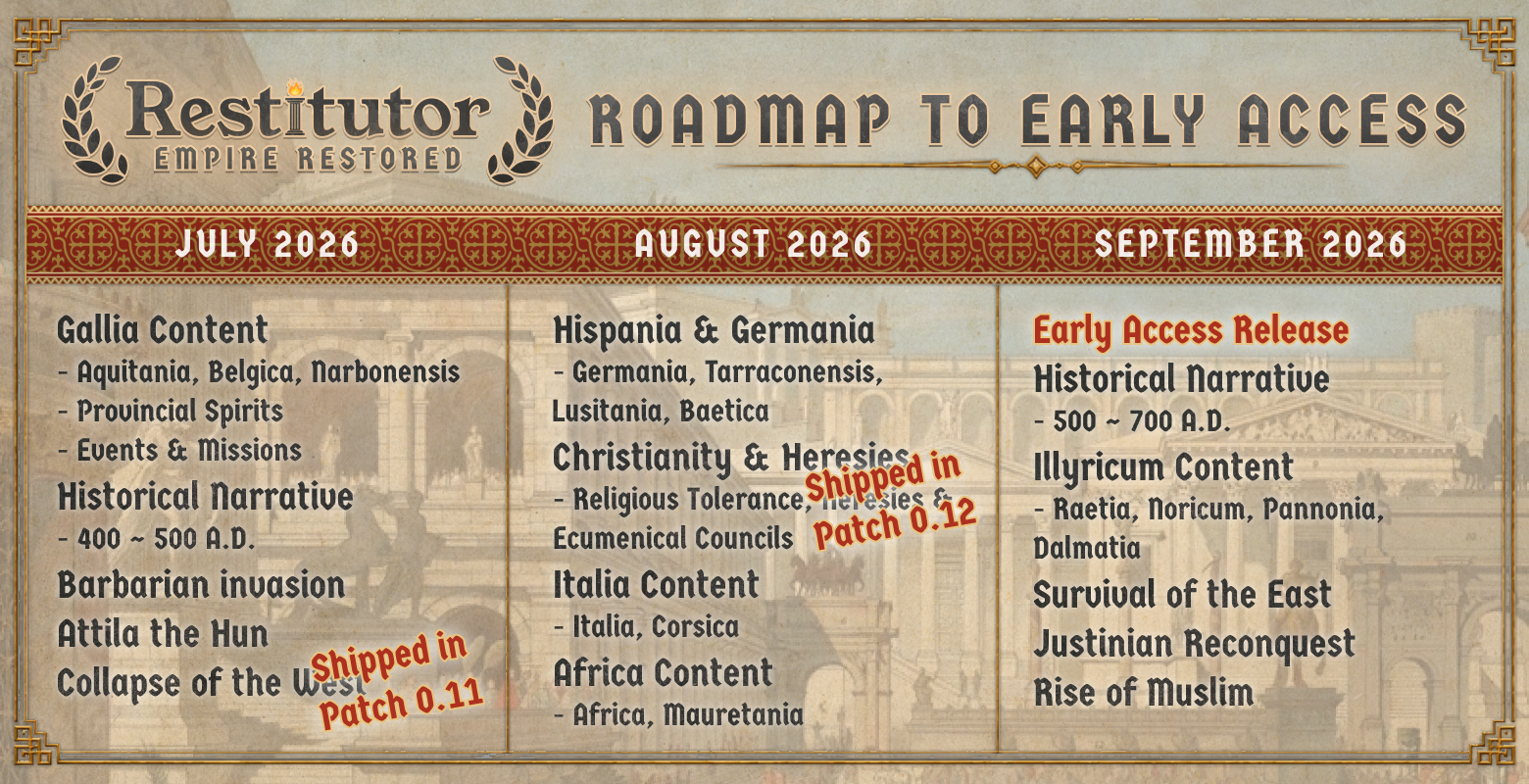
Here's an updated roadmap. As we are approaching Early Access release date, I will be sharing an exact release date and pricing soon.
Four New Playable Provinces
Germania, Tarraconensis, Lusitania, and Baetica are now available for new runs and Rebirth, replacing Aquitania, Narbonensis and Belgica in the current free demo province rota. Each new province has three unique Provincial Spirits, ten historical events, and five campaign events built around its geography, neighbors, and long-term ambitions.
Germania: The Rhine Frontier
Germania begins as a contested frontier of fortified cities, veteran armies, and uneasy neighbors along the Rhine. Its historical events follow the kilns of Rheinzabern, the Rhine fleet, the rise of Postumus, Constantine's campaigns, the victory at Argentoratum, Valentinian's forts, and the great crossing of the Rhine.
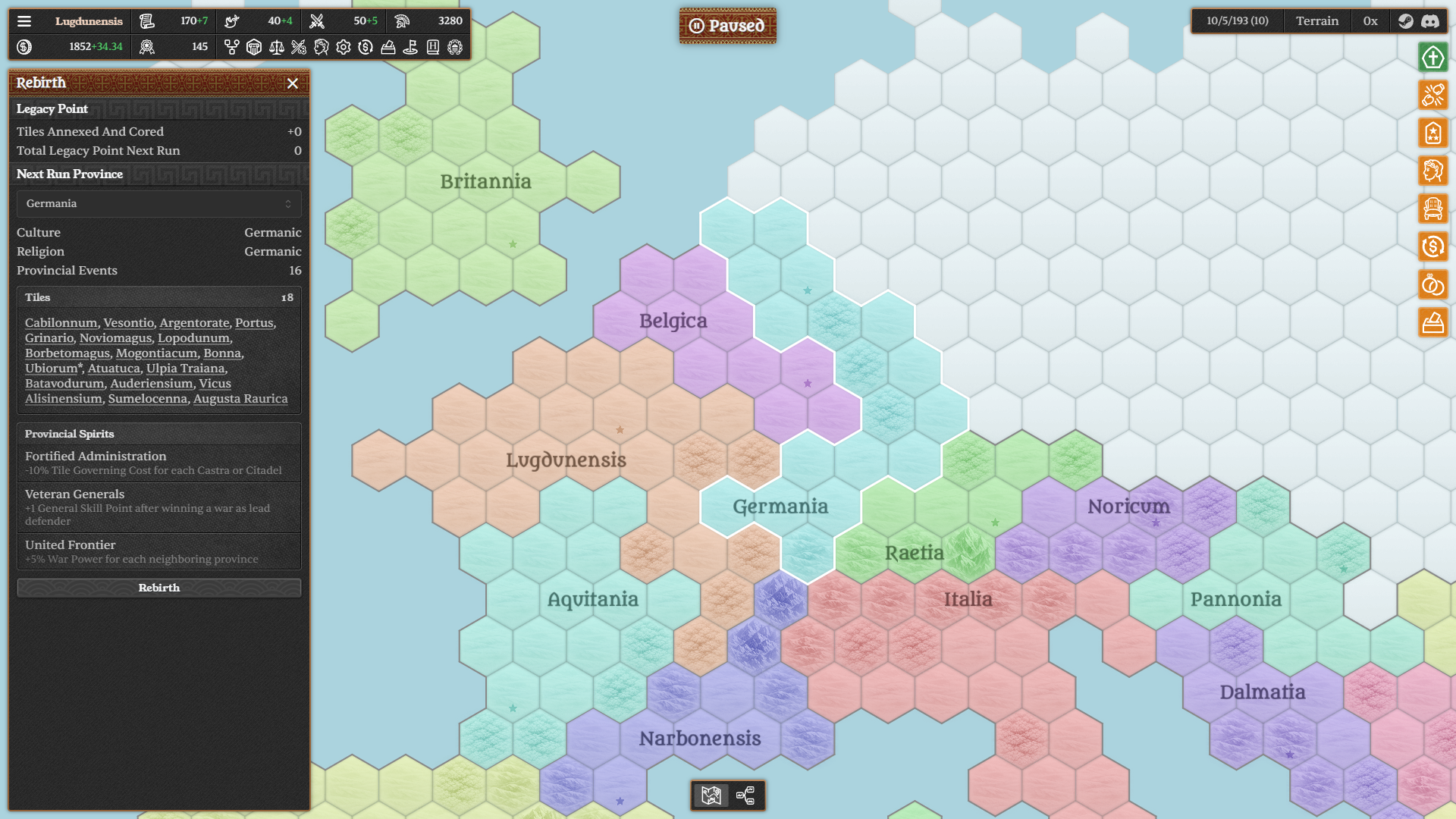
Germania's campaign can turn west into Belgica or Lugdunensis, advance into Raetia, bring weakened neighbors under its protection, cross the Alpine passes into Narbonensis or Italia, and finally choose the institution upon which an ascendant Germania will rest.
- Fortified Administration - Each Castra or Citadel reduces its tile's Governing Cost by 10%.
- Veteran Generals - Gain 1 General Skill Point after winning a war as the lead defender.
- United Frontier - Gain +5% War Power for each neighboring province.
Tarraconensis: The Last Roman Province in Hispania
Tarraconensis combines the mines of Carthago Nova, the games of Tarraco, the walls of Barcino, the irrigated Ebro valley, and a strong Christian tradition. Its historical narrative follows the province through imperial reforms, usurpation, the Bagaudae, and the final fragmentation of Roman Hispania.
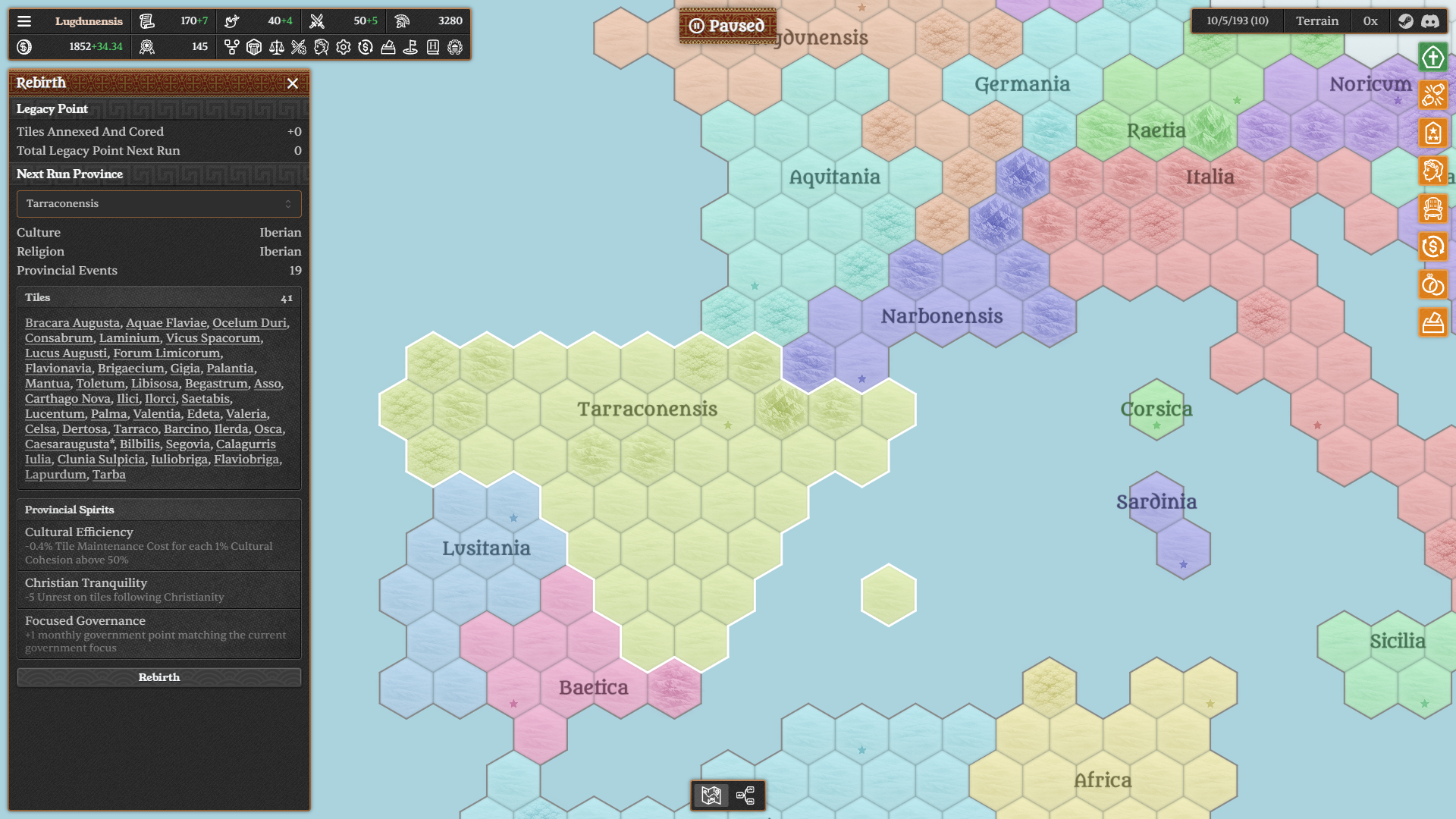
Its campaign turns south into Baetica and west toward Lusitania. Tarraconensis can undermine a weakened Baetica, forge an accord with Lusitania, purchase disputed borderlands, and ultimately receive Lusitania as a client. A successful Iberian power can then take the roads across the Pyrenees into Gaul.
- Cultural Efficiency - Reduce Tile Maintenance by 0.4% for every 1% Cultural Cohesion above 50%.
- Christian Tranquility - Tiles following any Christian denomination receive -5 Unrest.
- Focused Governance - Gain +1 monthly Government Point matching the province's current focus.
Lusitania: Wealth of the Atlantic West
Lusitania's events draw on the aqueducts of Augusta Emerita, the horses of the western plains, the fish-salting houses of Olisipo, the villas of the Alentejo, the rise of its Christian communities,
and the arrival of the Alans.
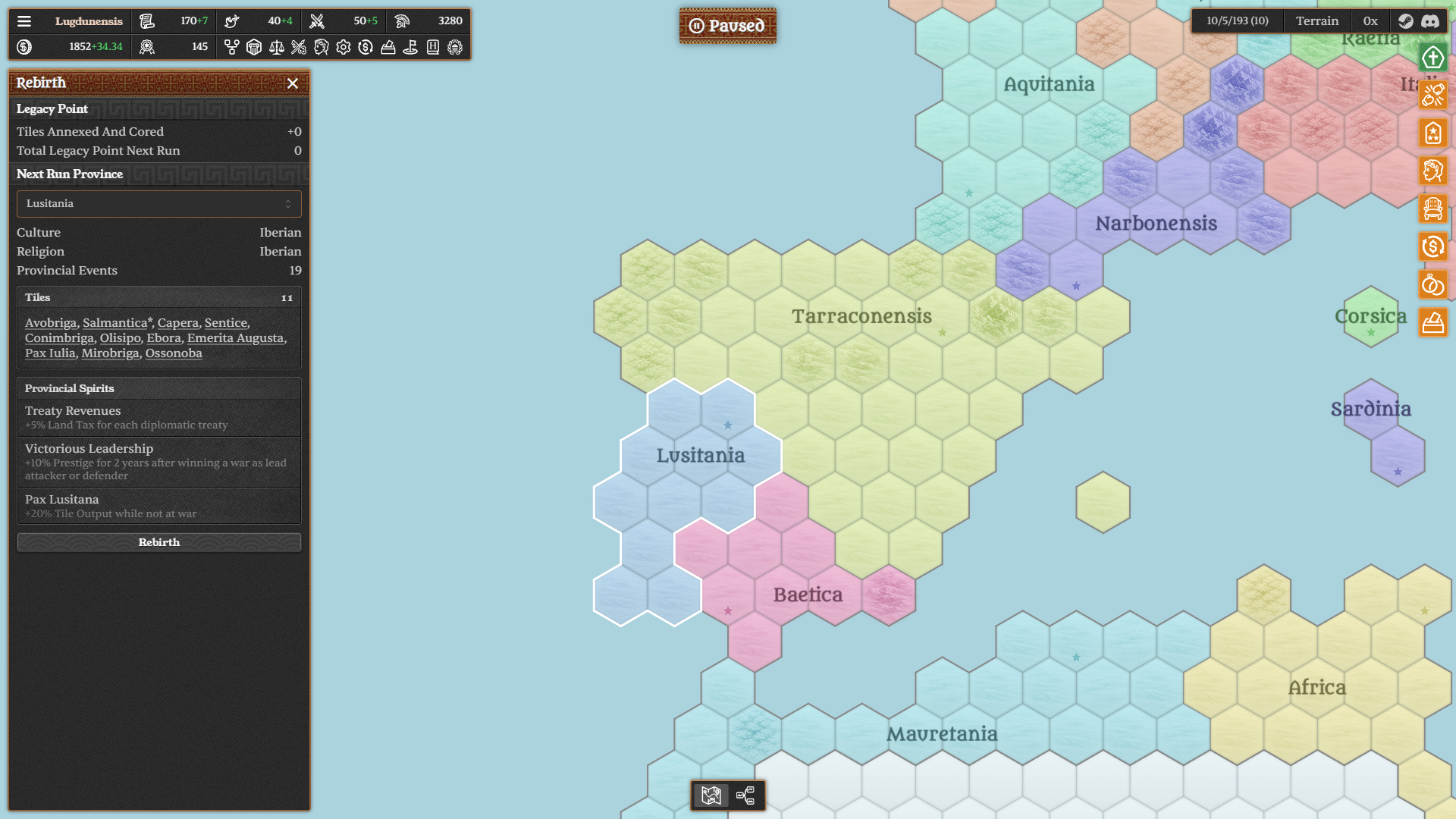
Its campaign rewards friendship with Tarraconensis, expansion into Baetica, the purchase of Tarraconensian borderlands, and the accumulation of wealth in Emerita. A prosperous Lusitania can invest its revenues in trade, estates, or a new generation of provincial officials.
- Treaty Revenues - Gain +5% Land Tax for each diplomatic treaty.
- Victorious Leadership - Gain +10% Prestige for 2 years after winning a war as the lead attacker or defender.
- Pax Lusitana - Gain +20% Tile Output while not at war.
Baetica: Workshop of the West
Baetica's fertile estates, mines, workshops, and Atlantic ports made it one of the wealthiest provinces in the western Empire. Its historical events feature Baetican olive oil and garum, the mines of the Sierra Morena, the ancestral prestige of Italica, the Council of Elvira, Hosius of Corduba, the Vandals' settlement, and their later crossing into Africa.
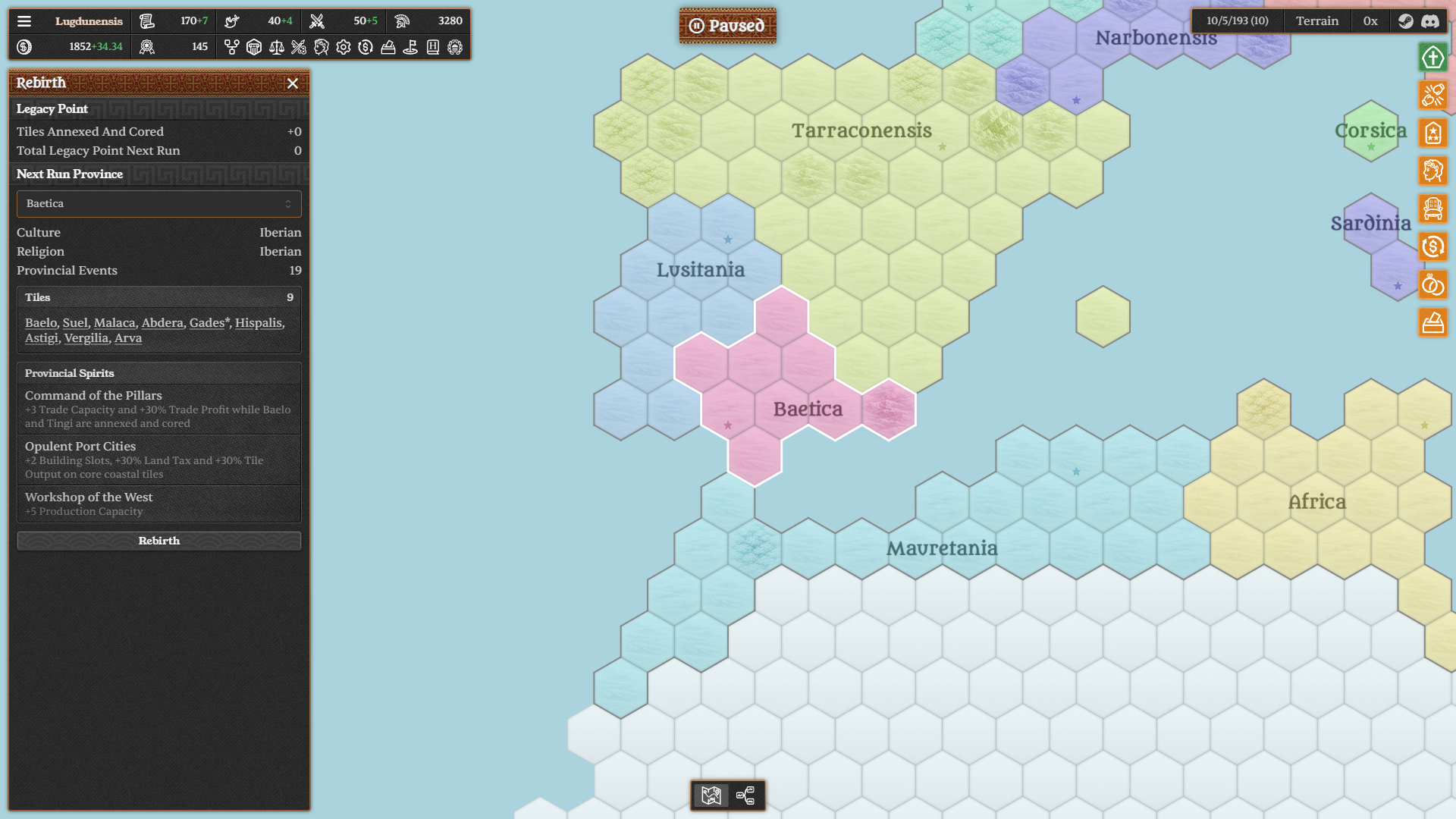
Baetica's campaign builds ties with Lusitania, contests Tarraconensis' power, secures both sides of the Strait of Gibraltar, reaches toward Palma, and can turn a marriage alliance with a weakened Lusitania into clientage - or renew the union as a partnership between equals.
- Command of the Pillars - Gain +3 Trade Capacity and +30% Trade Profit while Baelo and Tingi are annexed and cored.
- Opulent Port Cities - Core coastal tiles gain +2 Building Slots, +30% Land Tax, and +30% Tile Output.
- Workshop of the West - Gain +5 Production Capacity.
Hispania Campaigns
Four new regional events are available to the provinces of Hispania (Tarraconensis, Lusitania, Baetica). An expanding Iberian power can open the roads into Gaul, cross the Strait of Gibraltar into Mauretania, drive out the Suebi after their initial invasion bonuses expire, and establish a permanent foothold in Africa. These events provide new Casus Belli, campaign bonuses, and choices between military pressure and administrative preparation.
Heresies and Christian Denominations
Christianity is no longer represented by a single universal religion. Eight historical denominations can now emerge through dated narrative events and spread among Christian tiles in the regions where they were historically influential:
- Donatism
- Arianism
- Macedonianism
- Pelagianism
- Nestorianism
- Miaphysitism
- Monothelitism
- Iconoclasm
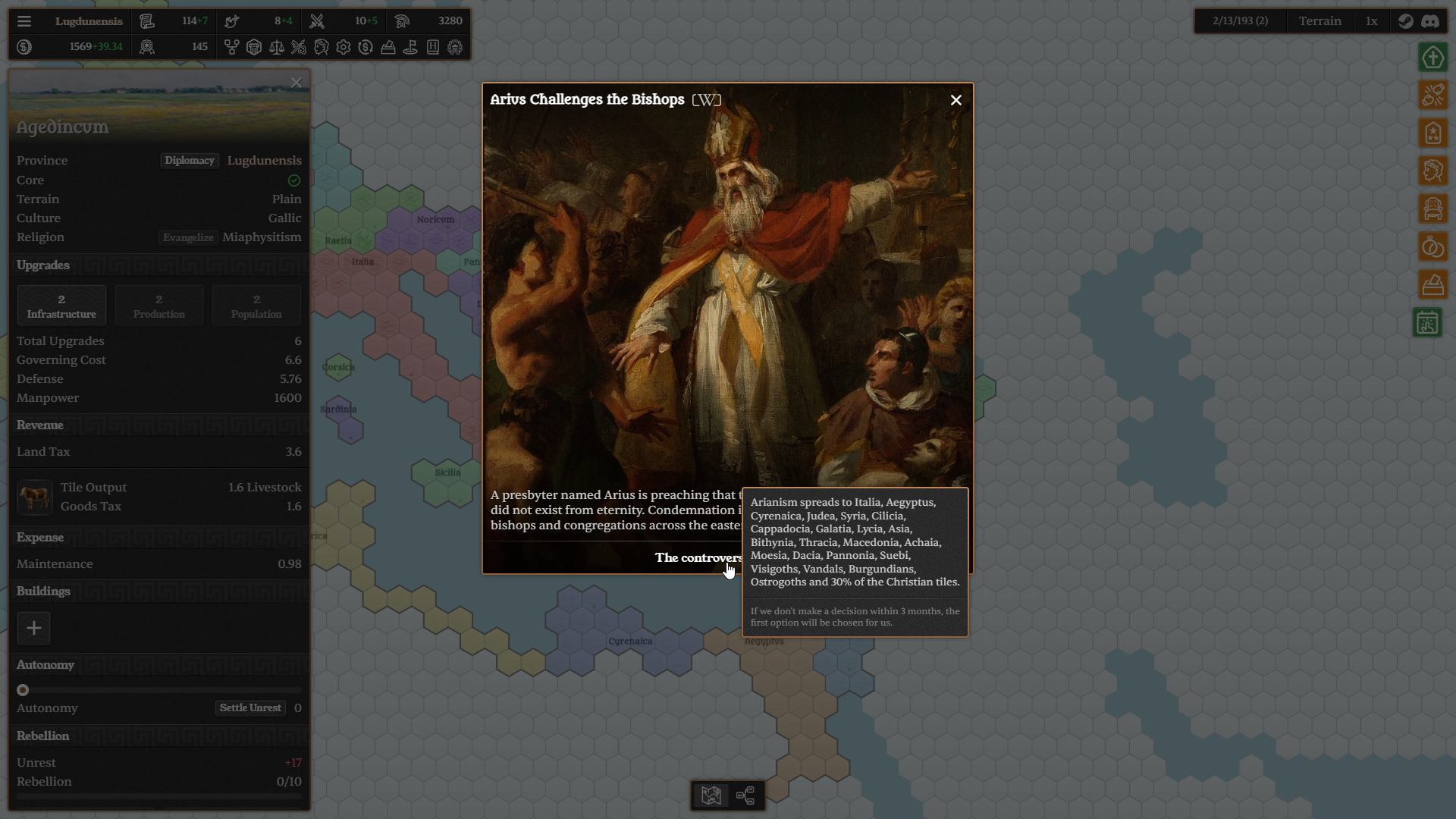
All of these denominations remain Christian for mechanics such as Christian Influence, Christian event conditions, evangelization, and crusade eligibility. Evangelizing a tile now converts it to your province's own Christian denomination rather than always converting it to generic Christianity.
Religious War now reduces required War Score when the attacker and defender follow different religions, including wars between competing Christian denominations. Proclaim Crusade now costs 25 Diplomatic Points, correctly grants a five-year Religious War Casus Belli, and can only target non-Christian provinces.
The Seven Ecumenical Councils
Christian provinces can now participate in seven historical councils:
- The First Council of Nicaea - 325 A.D.
- The First Council of Constantinople - 381 A.D.
- The Council of Ephesus - 431 A.D.
- The Council of Chalcedon - 451 A.D.
- The Second Council of Constantinople - 553 A.D.
- The Third Council of Constantinople - 680 A.D.
- The Second Council of Nicaea - 787 A.D.
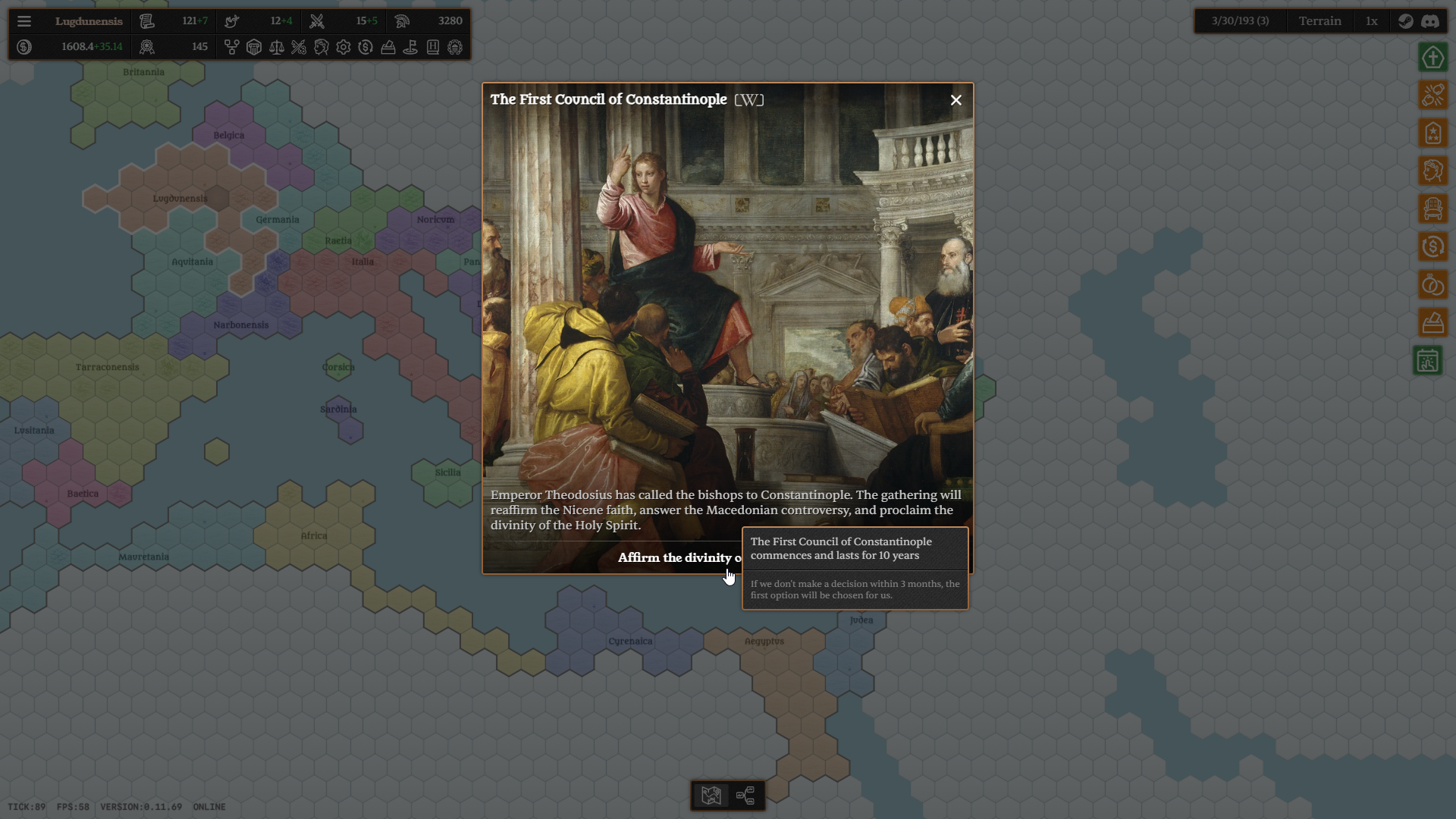
Each council lasts for 10 years and doubles the province's yearly Christian Influence while it is active. Every six months, governors can sponsor a delegate with Gold, draft an agenda with Administrative Points, lobby bishops with Diplomatic Points, or pressure bishops with Military Points. Each action grants Christian Influence.
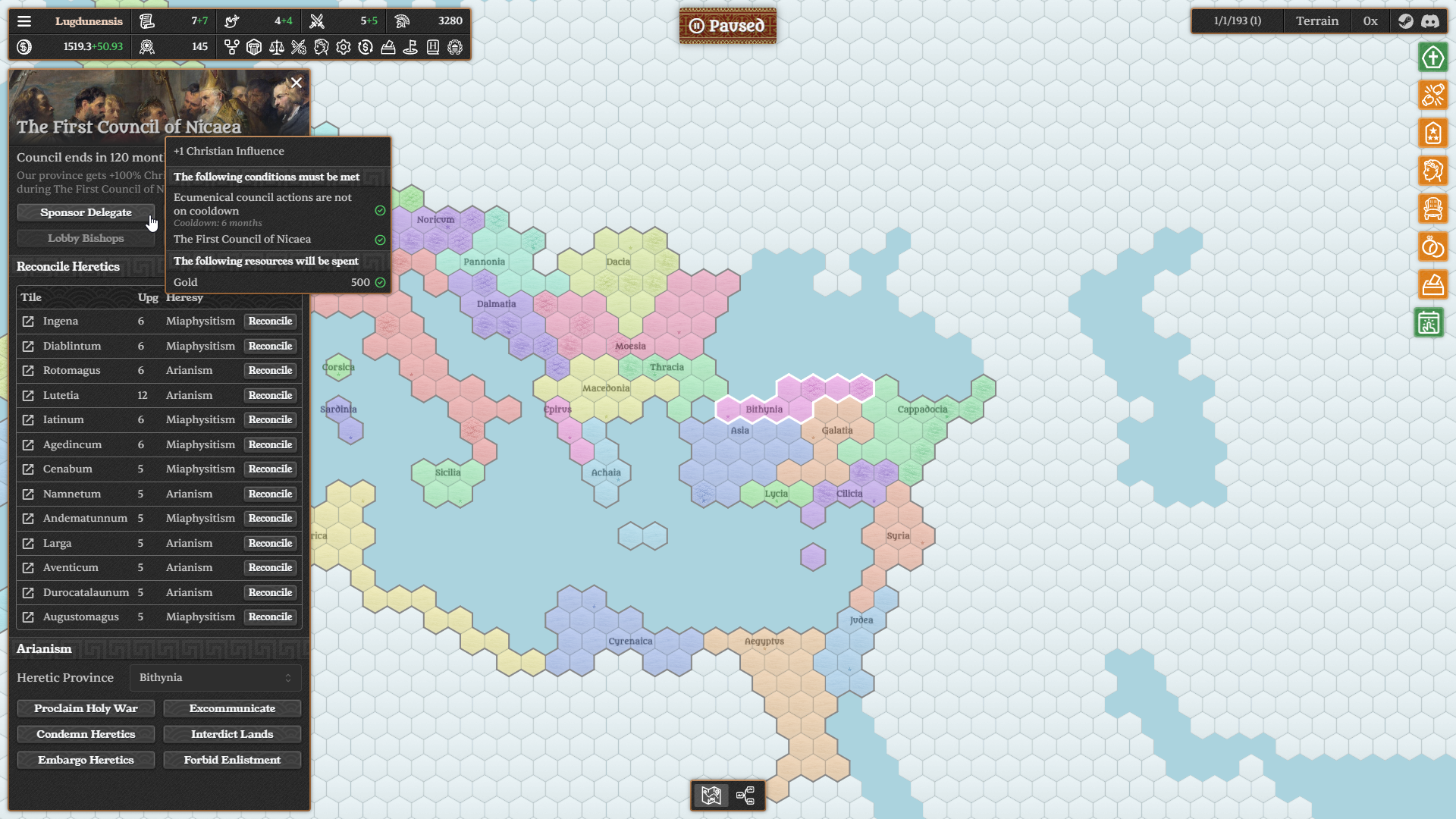
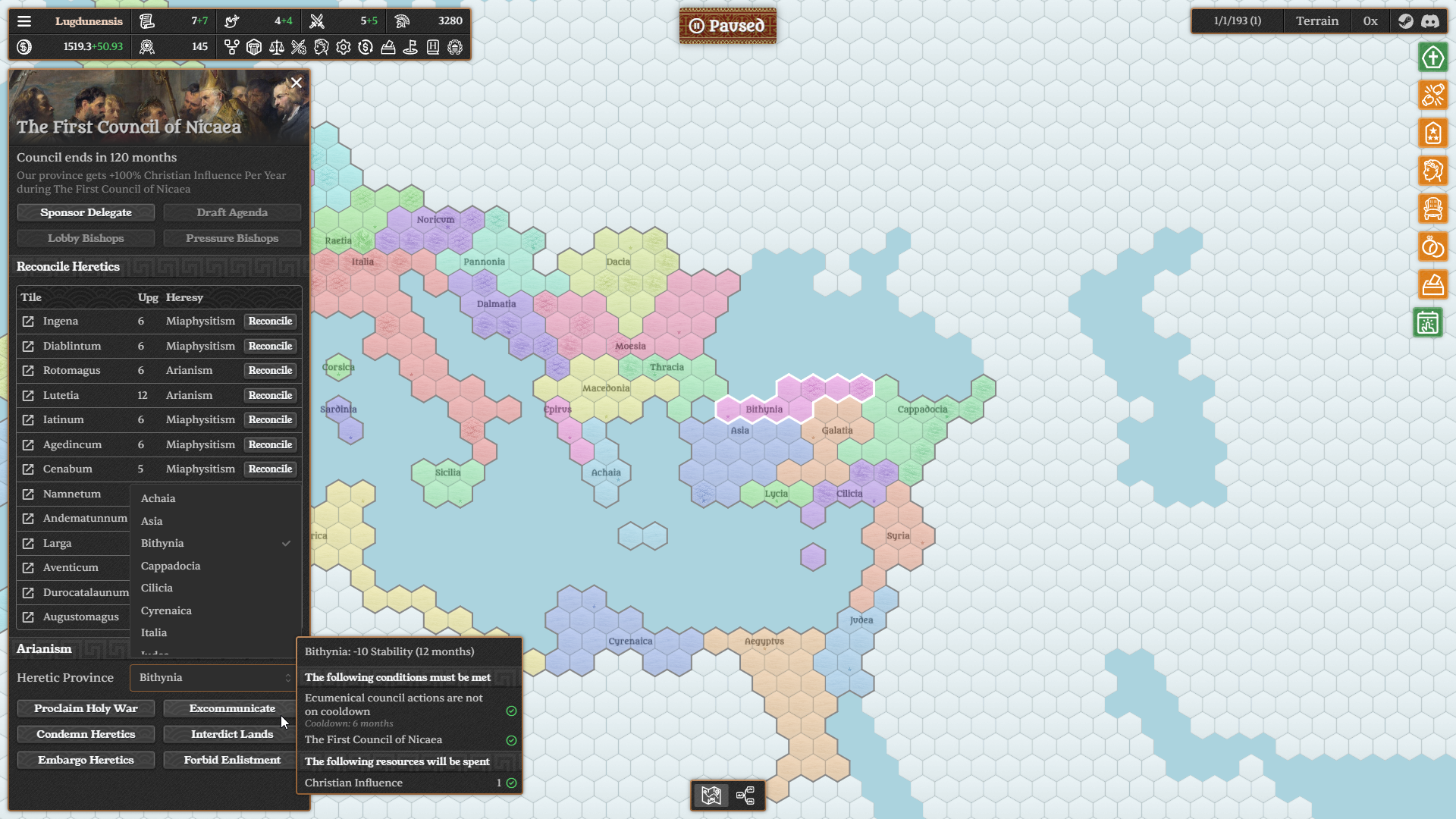
During a council, Christian Influence can be spent to reconcile heretical core tiles with the provincial denomination. The cost is based on the tile's total upgrades. It can also be used against provinces following a heresy under debate: proclaim a one-year Holy War, excommunicate their governors, condemn their prestige, interdict their tax revenues, embargo their output, or forbid enlistment to weaken their War Power.
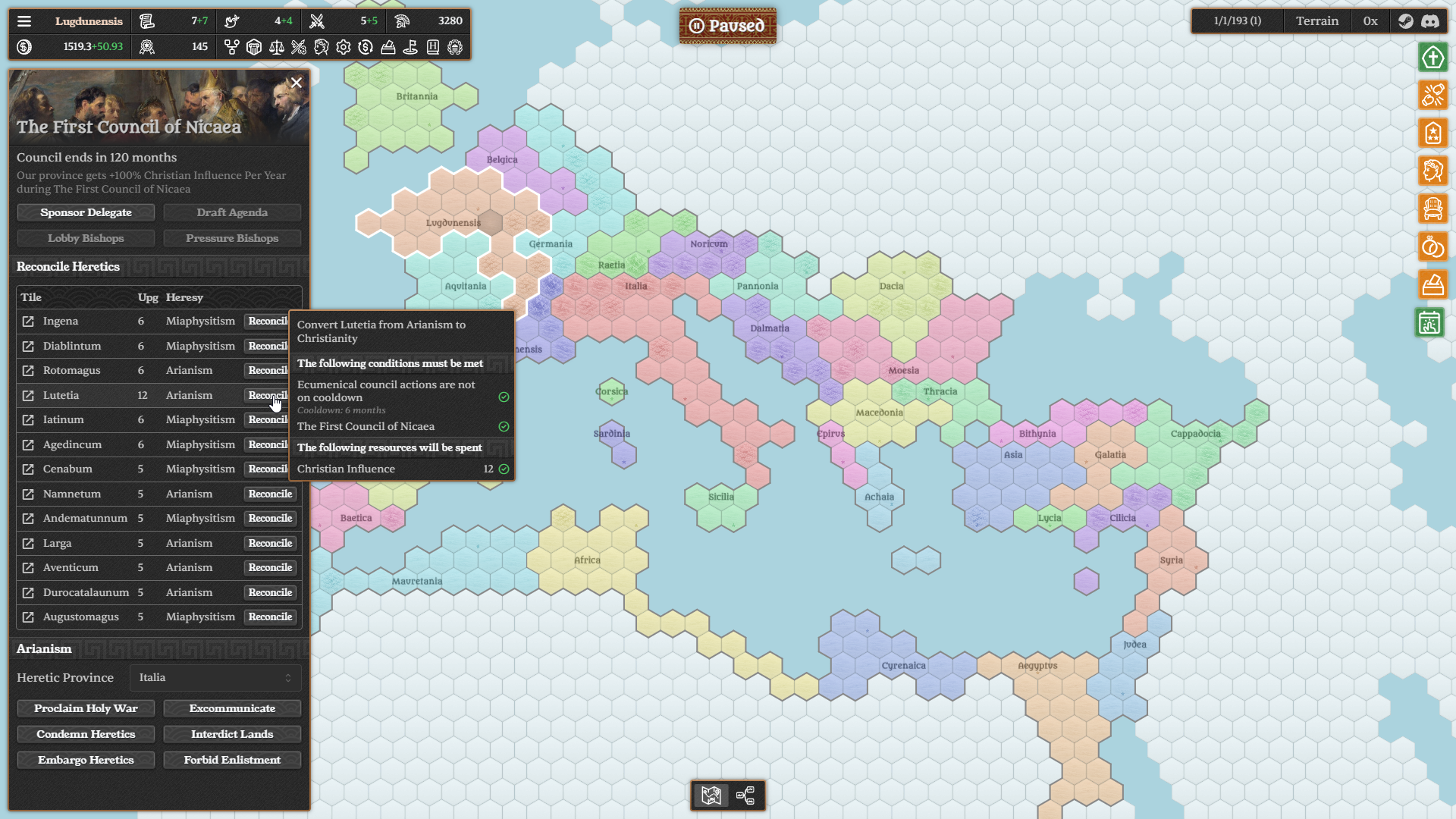
Tiles following a heresy condemned by the active council suffer -20% Defense and +20% Maintenance for the council's duration. A new notification appears whenever an Ecumenical Council is in progress and opens the council interface directly.
Cohesion and Tolerance Rework
Cultural and Religious Cohesion are now weighted by tile upgrades. Instead of every tile contributing equally, each tile contributes according to its total Infrastructure, Production, and Population upgrades. A highly upgraded minority region therefore matters more than a sparsely upgraded frontier.
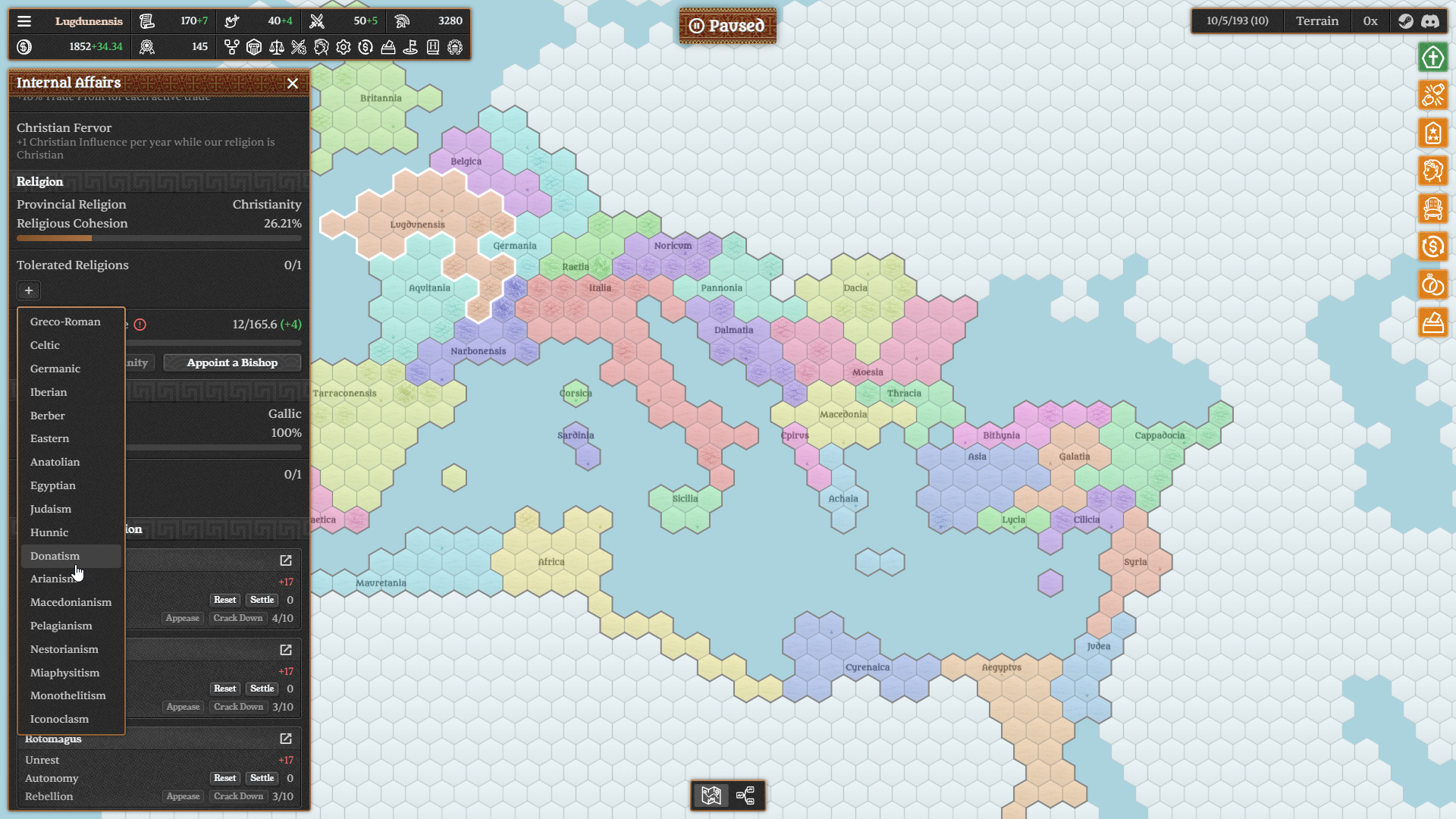
The game now supports permanent Tolerated Culture and Tolerated Religion slots. Tolerated populations count fully toward Cohesion and no longer receive the penalties applied to a minor culture or religion, including additional Unrest, Maintenance, Core Cost, and Tile Upgrade Cost. They remain neutral rather than receiving the bonuses of the dominant culture or religion. Tolerance choices cannot be changed once selected.
The Edict of Milan has been updated for this system. Granting religious freedom now provides one Tolerated Religion slot instead of removing the penalties from every minority religion at once.
Other Gameplay Changes, Bugfixes and QoLs
- When a barbarian polity is created, every province that loses owned or core territory to it now receives a 20-year Reconquista Casus Belli.
- Starting tile development has been redistributed. Every provincial capital now begins at Infrastructure 2, Production 2, and Population 2, with remaining starting upgrades spread more evenly across the province.
- Mauretania's capital has been corrected from Tingi to Caesarea.
- Rebirth now opens as a full sidebar page and previews the selected province's culture, religion, starting tiles, capital, Provincial Spirits, and number of provincial events before a new run begins.
- The Senate now opens as a sidebar with a new illustrated header and a more compact two-column layout.
- Senate elections now offer 10 candidates, increased from 9.
- The Senate and its warnings now display the correct next election year and the correct number of months until Consul Points expire.
- Consul Points are now cleared correctly for every province at an election, including provinces that did not pledge support to a candidate.
- Chronicle, Barbarian Raid, Ecumenical Council, Senate, and tile interfaces have received more consistent sidebar presentation and new illustrated headers.
- Historical, provincial, and religious events now include more direct Wikipedia links for players who want to explore their real-world background.