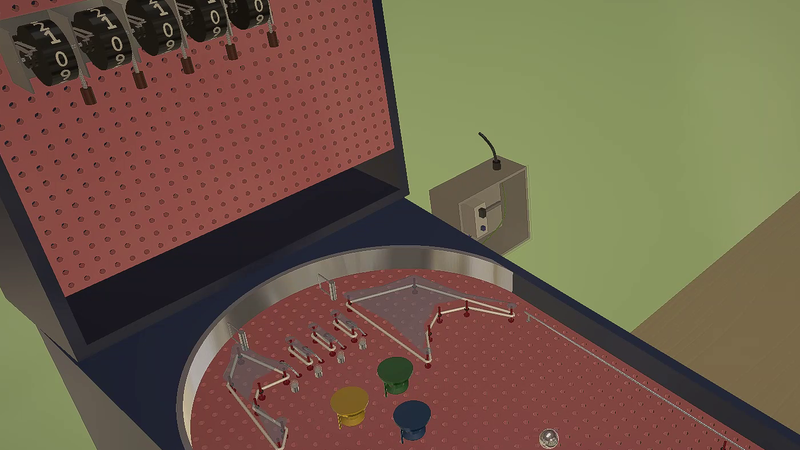
A second bench: the pinball machine
After the twelve vacuum-robot missions, the workshop opens a pinball cabinet — the drilled playfield, the backbox, and the same kit of parts to screw onto them. You trace your walls, you wire your flippers, you arm the transformer, and you shoot the ball. Five new missions, and the table stays playable at every step.
Score reels that count
The backbox is a mounting surface like the playfield, linked to it by a fifty-five-column ribbon. A score reel steps once per coil stroke, and its two contacts are the whole puzzle: the carry, closed at 9 only, and the reset, closed everywhere but at 0. Two reels and three wires, and you count to 99. Nobody will tell you how.
Twenty encyclopedia pages
Nine parts with their history, four drawn plates, and four ideas — starting with this one: your table is a 1970s electromechanical machine without a single chip, and one page explains what that means.
Faster, and fixed
On a loaded table the game draws sixteen times less: from eighty to nearly four hundred frames per second. Flippers, plunger and kicker now hit as hard at sixteen frames per second as at three hundred. The ball no longer jumps over thin walls. And the robot missions were gone through one by one.
Coming with early access: the relay, the contactor and its contact blocks, the score motor, the bumper, the drop target, the insert — already visible in the drawer, under a padlock.
Where to play it
All of the above is in the demo, and the demo is free: the Download Demo button on the game's page, or the direct download on angelostudio.fr. The full game is not out yet.