Ver 1.46 — Quick Scout, and personalities for your players
Hakoniwa Base Ball · published · build 24688864
Version 1.46 is out.
The headline this time is Quick Scout. Players now have personalities, and how well they match your coaching staff changes how they grow. The match simulation has also been rebuilt, bringing pitch counts, defense, batted balls and errors up to real-world levels.
Quick Scout
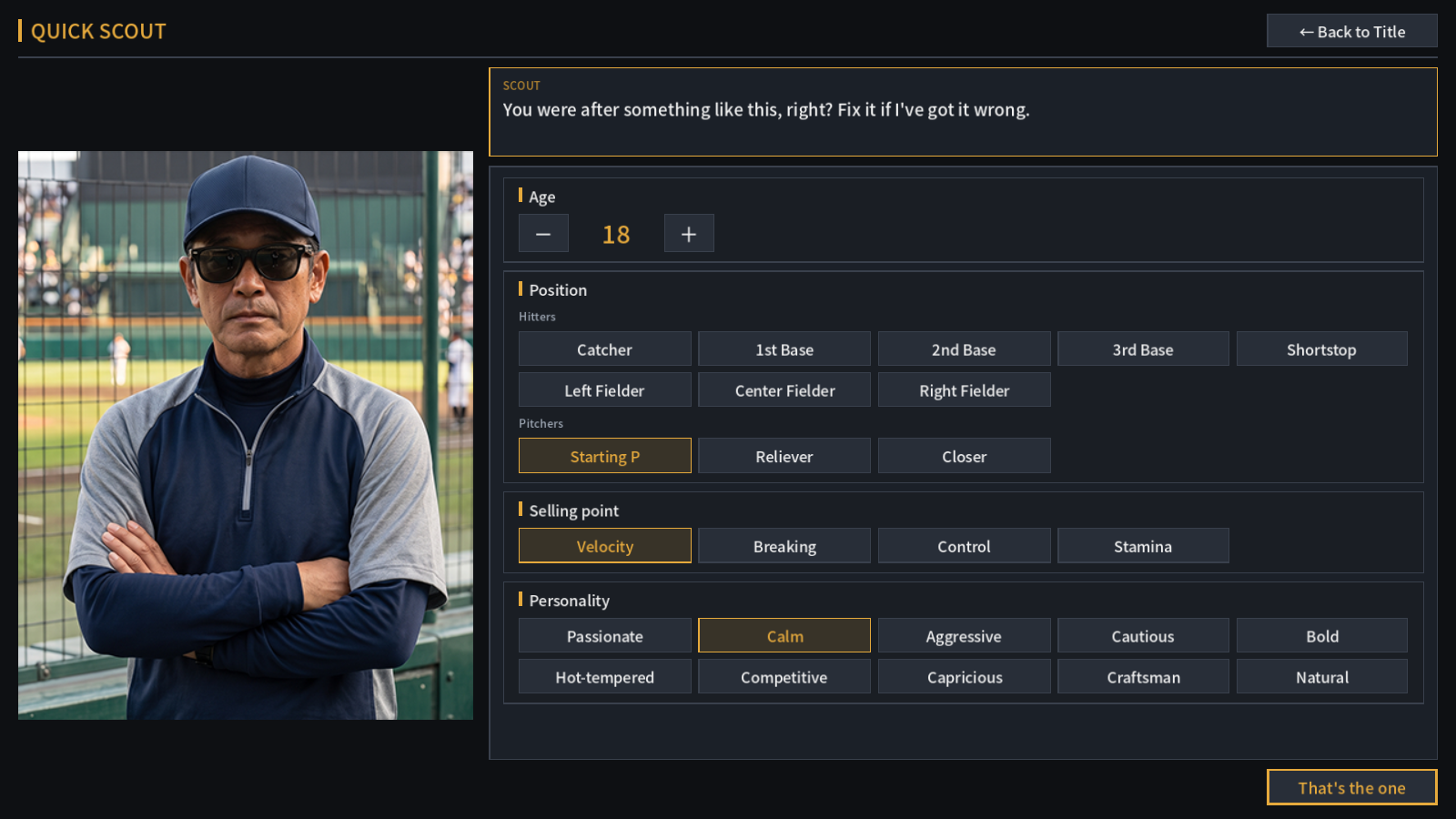
- A Quick Scout entry has been added to the title menu. You can put together the player you want in no time.
- Tell the scout an age, a position, a selling point and a personality, and he will bring back someone who fits. Ability is decided on S to E slots.
- Check his amateur record and ratings, and if you like him, sign him. He is added straight to your editable player data.
- Use it to fill a hole ("I need a pinch hitter I can count on", "a young starter for the minors"), or simply to build the player you feel like playing with.
Players now have personalities
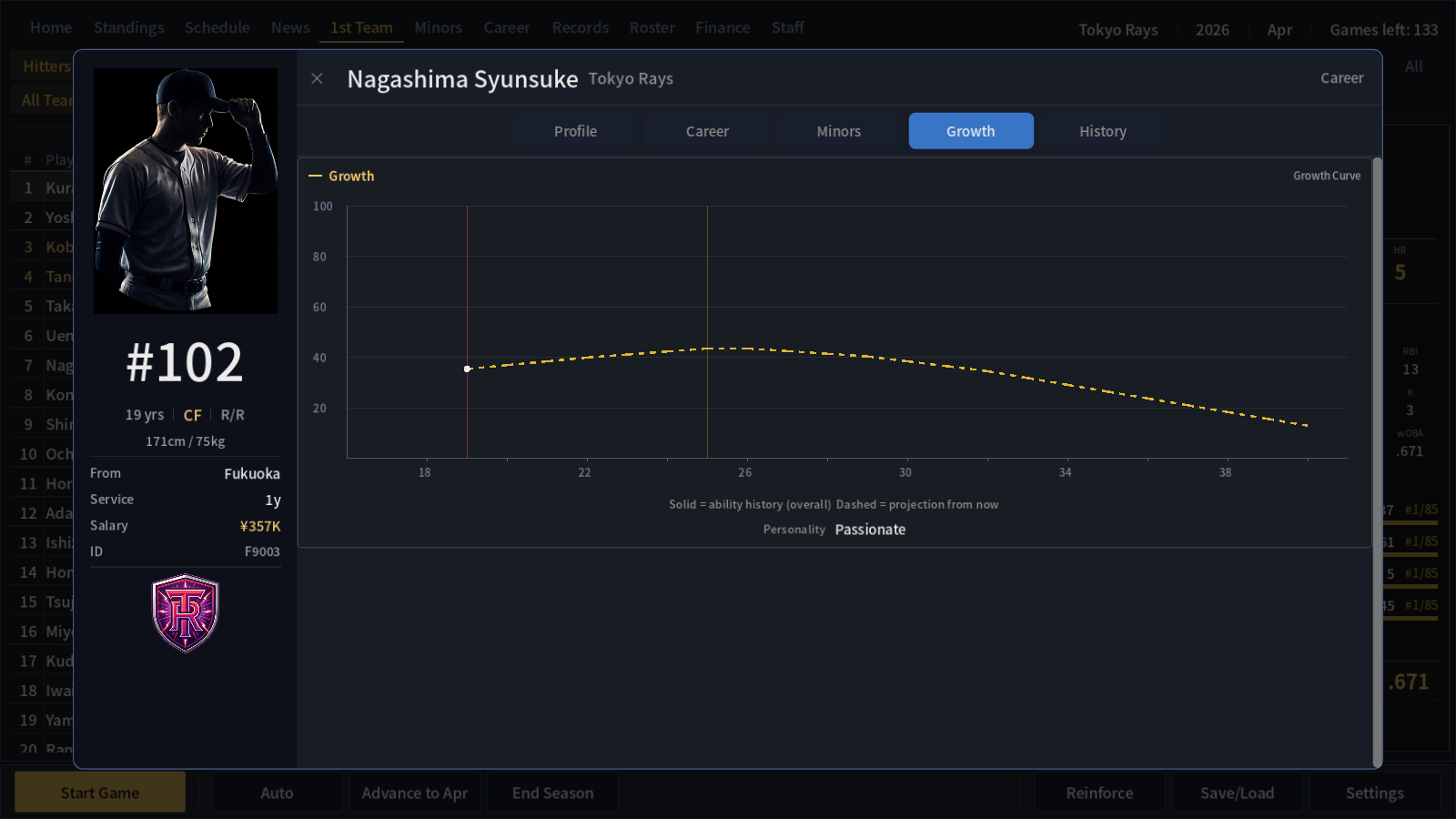
- Ten of them: Passionate, Calm, Aggressive, Cautious, Bold, Hot-tempered, Competitive, Capricious, Craftsman and Natural.
- How he behaves over contracts and negotiations, when he decides to retire, how attached he is to the club. Those traits used to be scattered; now they add up to one recognisable character. You can see it on the Growth tab of the player window.
- It can also be set from the player editor and from CSV.
You can now see your managers' and coaches' personalities
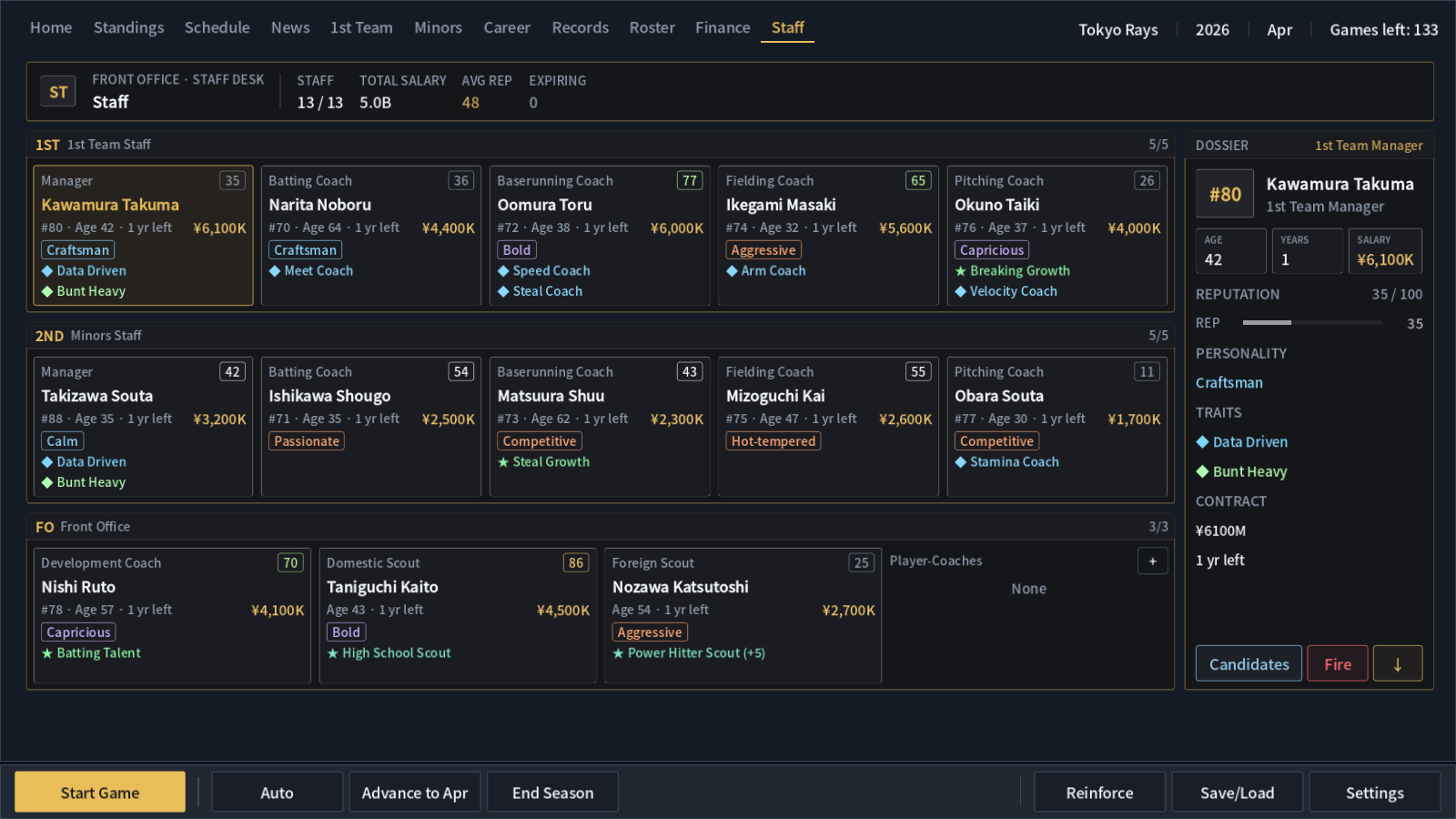
- The character your staff already showed through their in-game decisions is now spelled out as one of the same ten personalities. You can see it on the staff screen and the contract renewal screen.
- The staff screen has been regrouped into "1st Team Staff / Minors Staff / Front Office". Which players are in whose hands is now obvious at a glance.
The right fit changes how a player grows
- Put him with a coach he gets along with and he grows a little faster; leave him with someone he clashes with and he stalls. Over one season the difference is noise, but leave him there for five or ten years and it shows.
- Personality changes how much that matters. A Calm player is unshaken by anyone and simply grows along his training focus. A Passionate player leans toward power and velocity.
- You can now build a coaching staff around the question of who should be entrusted with whom.
A manager's personality shows in his decisions
- A Hot-tempered manager misjudges the moment when his team is behind.
- A Calm manager keeps his head even when losing. A Capricious manager is hard to read whatever the score.
Every pitch has been rebuilt
- Pitches per plate appearance are now at real-world levels (roughly 3.5 to 3.9). Batters foul more pitches off, and pitch counts climb accordingly.
- Walking a batter who has fouled off pitch after pitch, or pulling a starter early because his count is up: consequences that start from the pitch count now actually happen.
- Pitchers now change their control by the count. Ahead of the batter they work the edges; behind in the count they come after the zone.
- Pitchers will also pitch around a dangerous hitter.
- Injuries from overwork now happen in proportion to the pitches actually thrown.
Defense now decides games
- The fielder who actually handles each batted ball is now tracked properly. Whether it becomes a hit or an out depends on that individual's defense.
- Outfield defense, which barely touched the outcome before, now tells.
- Errors are at real-world levels (around 80 per team per season). Dropped flies and line drives are recorded as errors too.
- Passed balls are in. A catcher with weak defense lets one get by and the runners move up.
Batted balls, and three new ratings
- Batted balls are now described by exit velocity and launch angle. The mix of ground balls, line drives, fly balls and pop-ups sits almost exactly where real baseball does.
- Home runs come from a hard ball hit in the air. Only when contact and angle line up does it reach the seats.
- Three new ratings: Trajectory (low liners or balls in the air), Ground-ball rate (a pitcher who keeps it down or one who works up), and Recovery (a player who needs rest or one who can go every day).
- All three can be set from the player editor and from CSV.
New metrics
- UZR (how many runs a fielder saved) has been added to the batter tables.
- xFIP and GB% / LD% / FB% have been added to the pitcher tables.
- The CSV export carries the new records too (passed balls, the UZR breakdown, batted-ball types). Past seasons are calculated on the same basis.
Aces now reach the qualifying innings
- CPU clubs were rotating their starters far too often, so hardly anyone in the league reached the qualifying innings. Their core starters are now protected, and the number of qualifiers has gone from about 1.5 to around 2.4 per team.
- The races for wins and ERA now look much closer to real baseball.
DH lineups and fielding positions
- In interleague and preseason games, a minor-league player no longer ends up dropped into the ninth spot.
- Putting a player in a slot he is not suited for no longer overwrites his real position. This fixes players being treated as DH-only from then on (existing saves are repaired on load).
- Team defense is now calculated more accurately from the position a player is actually playing. Play someone out of position and it costs you.
Fixes
- Fixed the layout breaking when you selected a player already under contract in Overseas Scouting.
- Fixed column widths shifting slightly whenever you selected someone on the scouting screens.
- Reworded the notice for a manager or coach stepping down at the age limit.
In closing
This update joins up "find the player you want" with "decide who to entrust him to". Bring in the player you had in mind through Quick Scout, and where you place him changes what he looks like a few years from now. Take your time with him.
The match itself has also been rebuilt fairly deep down, from each pitch to where the ball lands to every play in the field. It is not only the numbers on the page that have changed, but the feel underneath them.
Thank you as always for your feedback. We will keep working through it, so please do let us know anything you notice or anything giving you trouble.