Hi, and welcome to Dev Diary 5. In this post, we’re going to talk about a couple of smaller features we’ve recently implemented in Substructure to add a little bit more variety to the way machines and recipes work, and the sorts of setups players will need to build.
Belt Converters
The first feature is something we call “belt converters”. These are machines that perform recipes to transform one item into another, but rather than coming with input and output slots, they are placed near a belt and directly process items on the belt as they come past.
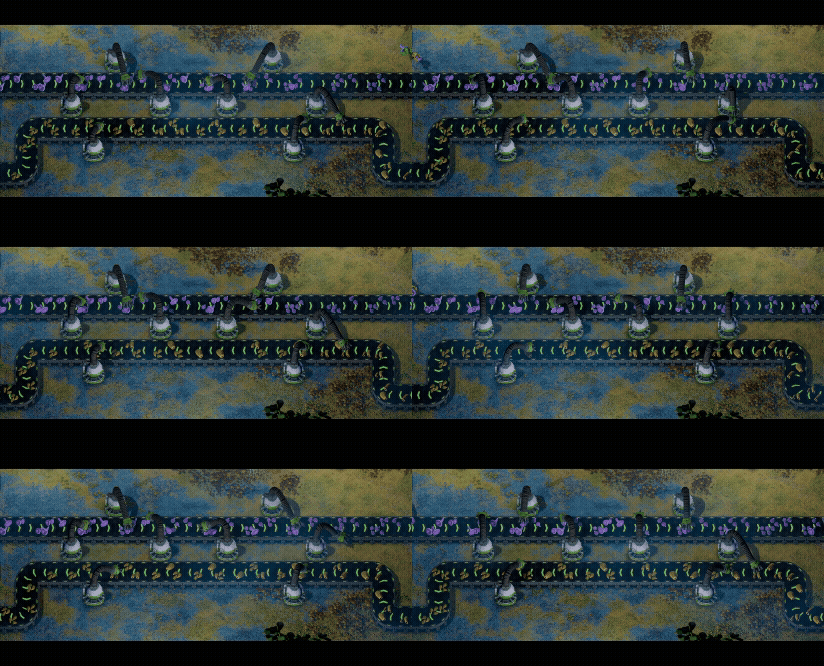
We’re using the same system we have in place already to render other mechanical arms, which gives this neat visual result that feels similar to a car assembly line.
This mechanic is first introduced in the form of the seed pickers that can be seen in the video above. These contraptions convert harvested crops back into seeds to be replanted, as part of the core farming loop. However, you can expect the general concept to be expanded upon and play a role in some other processes later on, too.
Since belt converters don’t prevent the flow of items on the belt, ensuring items can be processed in time as they move past presents an additional wrinkle. Players might consider a looped system that filters out processed items, or splitting a faster belt out into multiple slower lanes.
Belt converters may be compatible with multiple recipes, and will automatically select the matching recipe for the item they’re targeting. The recipes they perform are allowed to have random results, as long as they never result in more than one output item.
Variable-Input Recipes
The second feature is quite simple: recipes are now able to require either of two (or more) items as input.
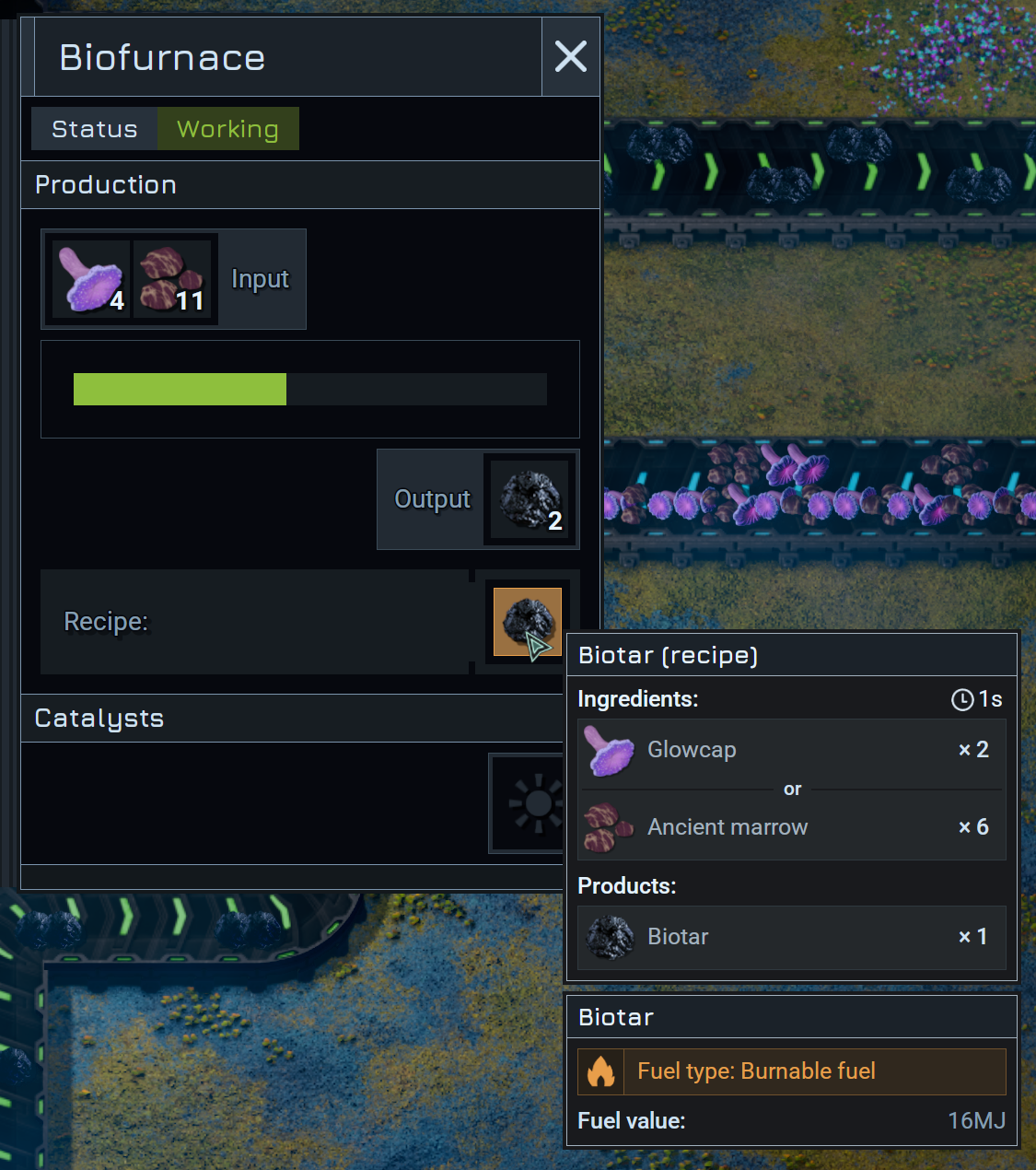
The recipe shown above can be crafted in the biofurnace. Either 2 glowcaps or 6 ancient marrow will do. Since the biofurnace gets input slots for both items, you can freely send in a mixed input belt, and it won’t ever get stuck or clogged.
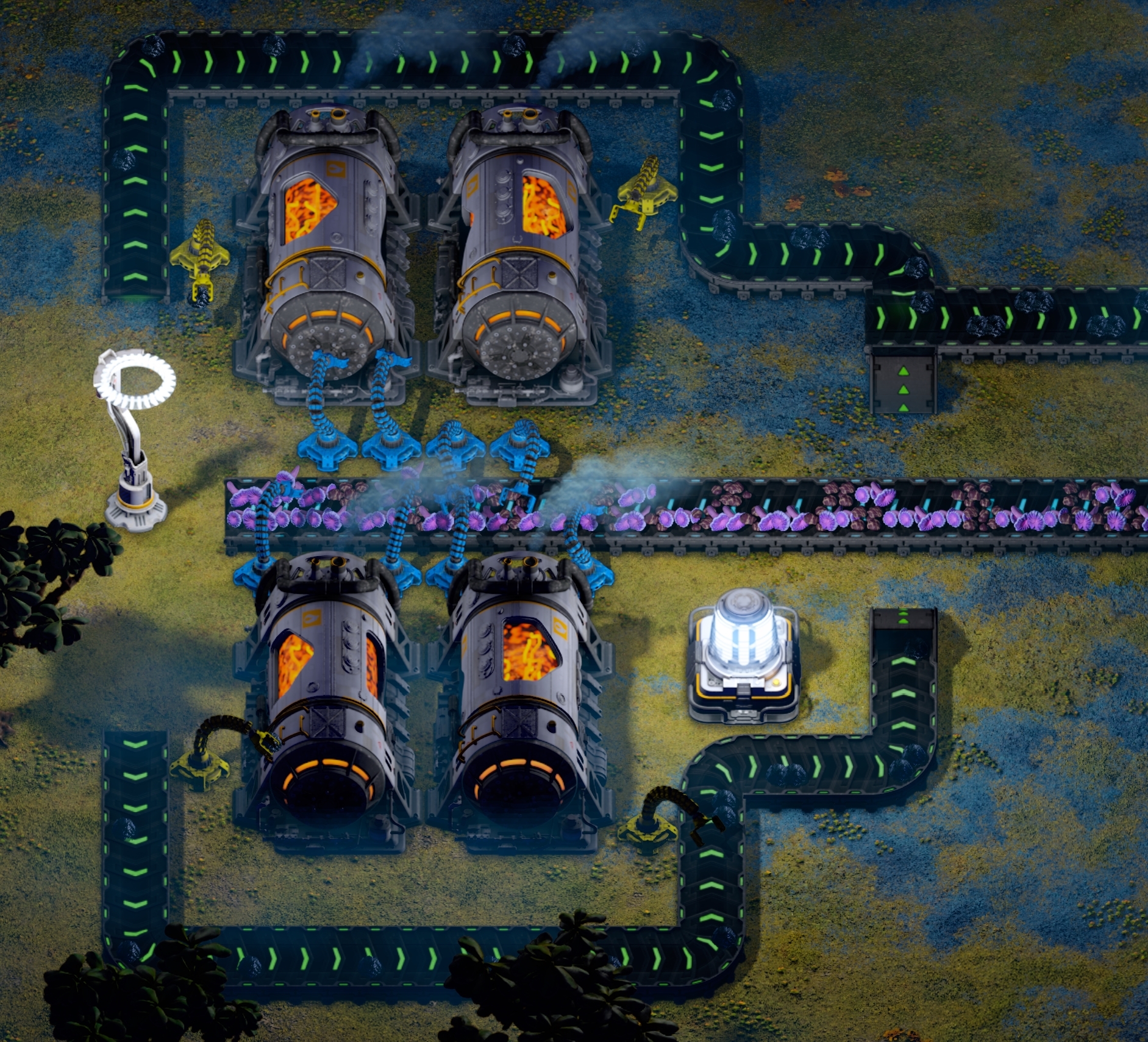
A recipe with variable inputs can also require other input items (or fluids) that are always needed.
This feature isn’t the most radical thing ever - of course, a recipe with variable inputs could always be emulated by replacing it with multiple recipes (a different one for each possible variable input). However, there are clear advantages in terms of UI simplicity, reducing recipe clutter, and making it easy for a single factory block to handle the different inputs simultaneously.
Additionally, the feature helps solve a design obstacle. Since we plan for the player to explore a number of different layers underneath the planet – and each layer should have its own unique resources available – it previously was not easy to come up with enough interesting uses for each resource.
Variable-input recipes allow us to expand on the applications of particular resources by presenting alternative options for existing production chains, with their own trade-offs, without overloading the player with the complexity of too many distinct recipes. We think this will provide for an interesting and slightly less proscriptive experience: some options might be better or easier than others based on which layer you’re on, or choices you have made previously. Different players won’t necessarily all make the same products in the same ways.
Thank you very much for reading!
Join the Substructure Community
If you’d like to follow along with development, ask questions, or just chat with us about the game, you can find us on our socials and Discord.
Discord | Reddit | Twitter | BlueSky | Website
https://store.steampowered.com/app/3012600/Substructure/