FROM THE TEAM 237 ARCHIVE
Originally published on 22 January 2026
Brais Calado
When we first examined the surviving Project Spooky builds, the word “error” seemed to offer a reassuring distinction. An error was something that did not belong. It interrupted the intended work and could therefore be removed without altering that work.
The distinction did not survive contact with the project.
Some failures are unambiguous. A door that prevents the player from continuing, a subtitle that disappears before it can be read, or a dependency that makes a scene impossible to load must be addressed. Preserving an unfinished game does not mean preserving every obstruction encountered while running it.
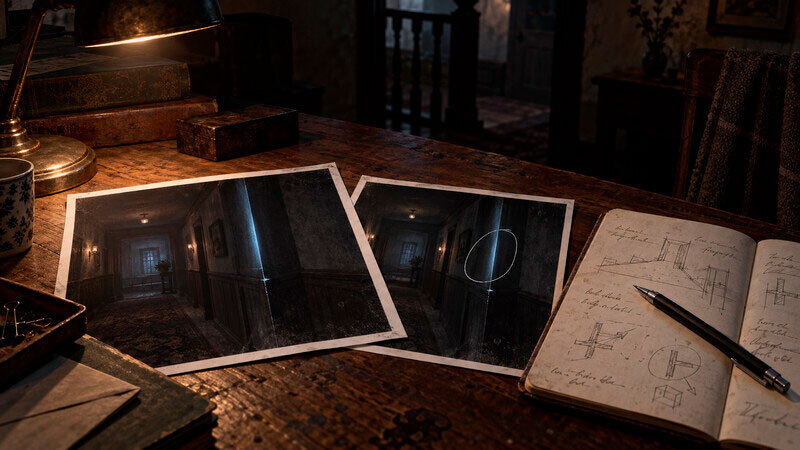
Other irregularities are harder to classify. A light enters through the seam between two walls. A sound continues after the object apparently producing it has stopped. A corridor takes slightly longer to cross than its dimensions seem to permit. Correcting these details may make the build cleaner, but cleanliness is not the same as fidelity.
An error can reveal the system that produced it. It can show where two versions were joined, which assumptions were built into a scene or what Álvaro had begun to change before the surviving files separated into incompatible branches. Removing it before documenting it would also remove evidence.
Keeping every defect would be equally irresponsible. A reconstruction cannot turn technical failure into mystery simply because the project is a horror game. If every collision problem, lighting seam or confusing interaction is defended as intentional, preservation becomes a way of avoiding decisions.
We therefore use three questions. Does the irregularity prevent someone from playing? Does it contradict an intention supported by the surviving material? Does it produce an effect that has already become part of how the work is experienced?
The first puzzle in the public demo provides a useful example. Its solution depends on recognising an order rather than testing every possible combination. The interaction itself works, but some players have not understood that the mark on the door is a clue rather than decoration. Changing the combination would repair nothing. Adding a more legible indication may help without replacing the logic of the puzzle.
This is the distinction we are trying to maintain: preserve the rule, improve the conditions under which the player can perceive it.
The point is not to make Álvaro’s decisions untouchable. Nor is it to use his absence as an authority for choices we cannot verify. Reconstruction means intervening while keeping the intervention visible to ourselves.
The complete original note remains in the Team 237 journal: https://team237.es
When you played the demo, did anything initially look like a technical mistake and later reveal itself as part of the game’s logic? Tell us below, or open a discussion: https://steamcommunity.com/app/4712780/discussions/
— Brais Calado
Team 237
Investigate · Document · Recover