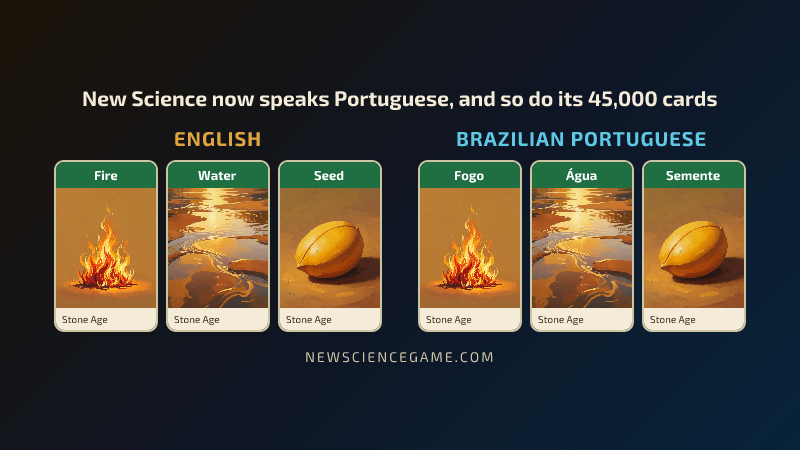
New Science is now playable in Brazilian Portuguese. It is the seventh language, alongside English, French, Spanish, Russian, Chinese and Japanese.
Brazil was the obvious gap. Portuguese speakers are 4.03 percent of Steam clients on the August 2026 hardware survey, which makes them the largest language group New Science had not translated for, ahead of German at 2.72 percent. They are also, by reputation and by our own experience of them, among the most enthusiastic communities in games.
Translating this game is not like translating a game
Most games have a script. It is long, but it is finished: somebody writes it, somebody translates it, and the job is done.
New Science does not have a script. It has a catalogue of more than 45,000 cards, every one of them invented by a player rather than written by a designer, and it grows by around five hundred cards a day. Each card carries a name and a short definition, so translating the game means translating a dictionary that nobody has finished writing.
So the game translates each card at the moment it is invented. When a player combines two cards and makes something nobody has made before, the card is named, defined, illustrated and translated in one go. A Brazilian player who invents something tomorrow gets it in Portuguese immediately, and so does everyone else who finds it afterwards.
The back catalogue is done too
Translating new cards as they arrive still leaves the 45,000 that already existed, and those were the harder half. That backfill finished overnight. Portuguese now sits level with all six other languages, and at any moment the only cards without a Portuguese name are the handful invented in the last few minutes, which get theirs as the queue catches up.
What this means if you play in Portuguese
Everything. The interface, the sixteen ages, the card names, the definitions, the wiki. You can play the whole game without meeting English.
You can also do the thing the game is really for, which is to make something nobody has made before and put your name on it permanently. Nothing about that is reserved for English speakers, and now nothing about it requires reading English either.
About New Science
New Science is a game about discovery through combination. You start with five cards, put two or three together, and the game engine works out on the spot whether they make something. If they do, and nobody has ever made it before, the card is created and illustrated there and then, and your name goes on it permanently.
Progress runs through sixteen historical ages, from the Stone Age to the Age of Intelligence. Seasons run for several weeks, and each one carries leaderboards, per-season goals, trading between players, and clans.
The demo is available and the full Windows release follows in March 2027. The game is playable in seven languages.