Greetings, comrades!Today, we have another comparison in store. But this time, rather than comparing two specific aircraft, we are comparing fundamentally different types of planes.
The Korean War of 1950−1953 was not merely the first clash between two worlds — West and East — but also a full-scale confrontation between two eras of aviation engineering: the piston-engine age and the jet age. It marked that boundary in aviation history where the direction of engineering thought was ultimately set for two generations ahead. And it should be noted that these are fine, but still rather general, points. As true enthusiasts of combat aviation history, both you and we would like to get into the specifics: what exactly was the fundamental difference between conducting air combat in a piston fighter and in a jet fighter? Where exactly did the distinctions lie, and why did jet aviation triumph over piston-engine aviation? Let’s find out today.
Conducting air combat in first- and second-generation jet fighters has very significant specific characteristics. True, these aircraft — especially the MiG and the Sabre — possessed outstanding performance in speed, rate of climb, flight altitude, and firepower during the Korean War. At the same time, however, they also had a great many specific handling limitations. Unlike piston fighters, whose engine-propeller groups are highly responsive to control inputs and whose thrust can be changed abruptly and across a wide range, jet aircraft had a very inert response of engine thrust to changes in throttle position. At the same time, a jet engine cannot perform a braking function in the way it can be achieved on a piston aircraft by cutting the throttle and reducing propeller pitch. This affected not only air combat, but even landing approach maneuvers.
Please note that all jet aircraft in our game are equipped with special airbrakes, whereas in piston-engine aviation practice, airbrakes were generally installed only on dive bombers. This is because, during a glide-slope descent, if there is a need to rapidly increase speed, a jet aircraft will not be able to do so, since its engine takes a long time to spool up. Therefore, the approach is flown with airbrakes deployed and, accordingly, with higher engine RPM and thrust. When it becomes necessary to increase speed sharply, the pilot retracts the airbrakes, and this happens much faster than the engine can spool up.The second crucial difference between a jet aircraft and a piston aircraft lies in the absence of propeller wash flowing over the tail surfaces. This is a vital factor in the controllability of piston aircraft, especially at low speeds. Notably, it was precisely for this reason that, with the advent of jet aviation, starting from the second generation, steerable nose gear began to see widespread use. This is due to the fact that, without propeller wash flowing over the aircraft’s vertical stabilizer, the only way to control the direction of taxiing at low speed is through the use of differential braking on the landing gear wheels. In this respect, the difference in taxiing control between the Sabre, which uses this technology, and the other aircraft, on which this technology had not yet been implemented, is clearly noticeable in our game.But this is important not only while taxiing. In aerial combat, if a piston aircraft loses speed, it retains controllability thanks to propeller wash over the tail surfaces. This makes it possible to perform maneuvers such as the Hammerhead, simplifies recovery from certain critical flight regimes, and allows the pilot — albeit with difficulty — to point the aircraft’s nose in the desired direction even at very low speeds.Jet aircraft do not have this capability, and the "aerial circus" with "pivoting on a dime" and the like — which was highly characteristic of the First World War and, to some extent, could still be present during the Second World War — disappeared completely in the conditions of jet aviation combat. Its revival has only become possible now, with the advent of super-maneuverability technologies in 4th-plus and 5th-generation jet combat aircraft.The third characteristic of first-, second-, and, to some extent, third-generation jet aircraft is the propulsion system’s particular sensitivity to the airflow conditions around the aircraft caused by the oncoming stream. Reaching extremely high angles of attack, entering negative angles of attack, and, for some aircraft, reaching high sideslip angles, all very often led to disruption of the airflow conditions inside the engine intake duct. At the same time, the entire "magic" of an air-breathing jet engine lies precisely in the coordination of gas-flow parameters in the intake, combustion chamber, and engine nozzle. When this balance is disrupted, oscillations and pulsations of the gas flow occur, better known as "engine surge" or "compressor stall." Once these oscillations begin, they lead to a complete disruption of the engine’s gas cycle. And even if fortune is on your side and they do not cause damage to engine components — which happens often — an in-flight engine restart will, at minimum, be required. At the same time, restarts on a number of aircraft also have their own limitations: often, they can only be performed below a certain altitude and flight speed.Thus, when fighting in a jet fighter, you possess high speed, a high rate of climb, and high flight altitude. At the same time, you cannot rapidly change your speed; you must ensure that you do not lose that speed, and you must avoid putting the aircraft into flight regimes where the propulsion system will operate unstably. The concept of the "Stall Fight" receded into the background for a time, until more advanced engines appeared.In other words, the jet fighter in aerial combat is a powerful and, at the same time, very precise instrument that must be controlled with absolute clarity, carefully calculating maneuvering trajectories and planning your actions in advance. At the same time, for the reasons described above, jet aircraft combat was conducted at higher speeds, which means that maneuvering at those speeds involved, on average, significantly higher G-loads. Where piston aircraft only occasionally reached high G-loads, jet fighter maneuvers are prolonged and squeeze everything out of the participating pilots in terms of physical conditioning.In group aerial combat, a jet aircraft has far greater capability to deliver a swift dagger-like attack against the main target in an enemy formation, since in order to pursue it after the attack, the enemy fighters covering the target would have to break away significantly from their formation. At the same time, however, group combat is also more difficult for it, because high speeds mean great distances: maintaining visual contact with targets and with your comrades becomes significantly harder. Here it is extremely important to keep the picture of the battle in your head, to understand exactly which direction you are currently moving in, and to have a clear idea of what your allies are doing. At the same time, you must remain constantly alert, because the enemy jet fighter has the same capabilities, and if it had a sufficiently advantageous starting position and you failed to spot it in time, it can rapidly close the distance and strike.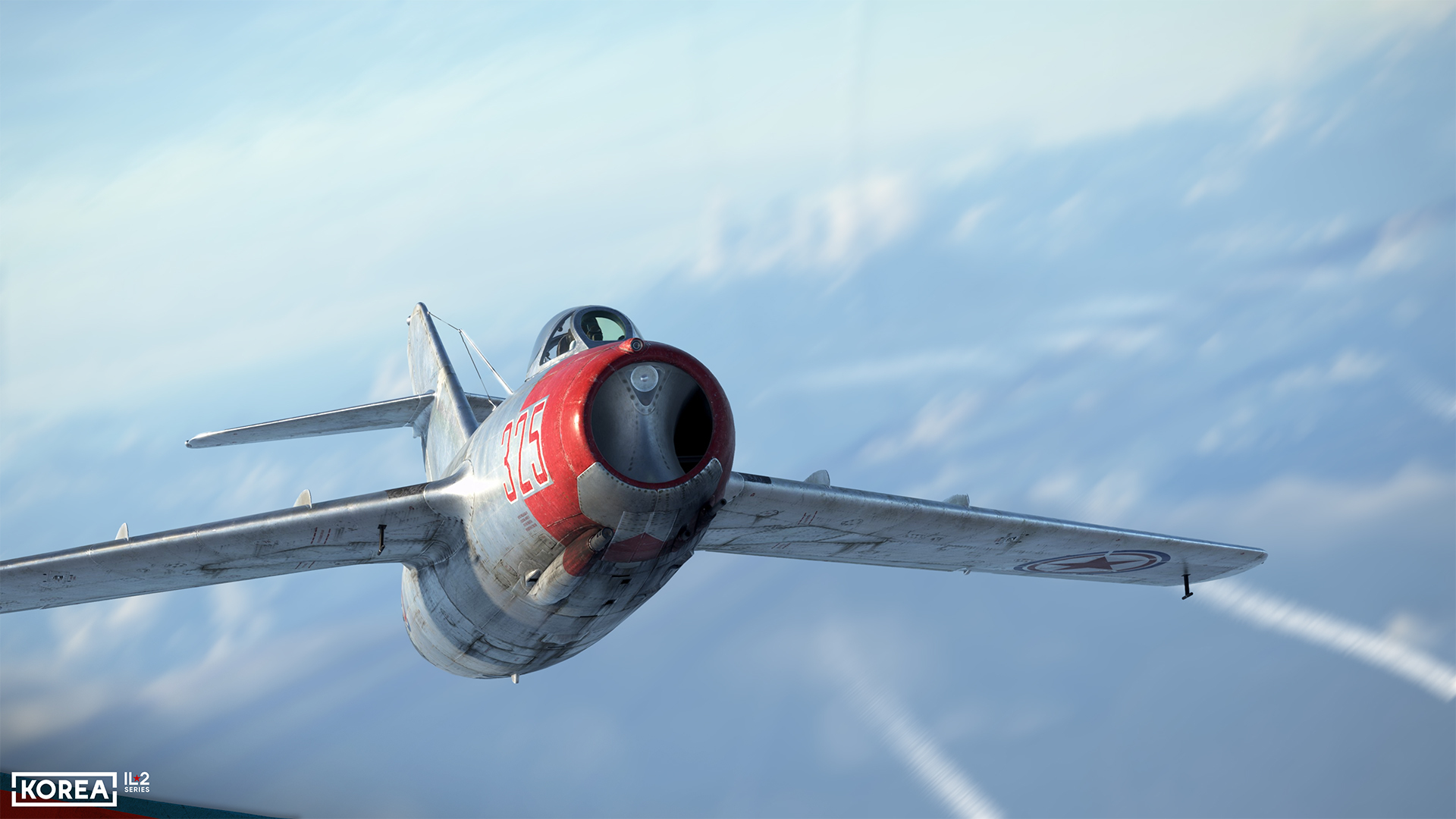 All these factors fundamentally change the nature of aerial combat. At first glance, it may seem: so many limitations, so many problems! But if these factors had been decisive, jets would never have triumphed over piston aircraft. The opportunities that jet aircraft provide in combat outweigh all the problems outlined above many times over.The beauty of combat in jet aircraft lies not in an abundance of maneuvers, but in an incredible concentration on the remaining essence of flight. The slightest error, the smallest inaccuracy — and all your advantages become useless. You must think ahead, know the limits of your machine better than ever, and shoot more accurately than ever before. But if you master yourself, if you master this speed, your jet-powered machine will give you an incredible feeling of power.And what about combat in piston fighters under the conditions of the Korean War? When facing an opponent of the same type, the combat picture, maneuvers, techniques, and key factors are, in general, analogous to those of the final period of the Second World War. Yes, the Yak-9P and La-11 are post-war aircraft, with a number of characteristics noticeably better than those of their Soviet wartime predecessors. But this does not make them significantly superior to American propeller-driven combat machines; rather, it reduces the gap that existed as of 1945 and levels the odds. Aerial combat between these Soviet aircraft and the American piston fighters represented in the game — and with the DLC taken into account, there will be several of them — the best aircraft of the US Air Force and US Navy from the previous era, is an extremely captivating spectacle. The fight is still compact, as befits piston aviation, but it is already much faster and more energetic.But what should the pilot of a piston fighter do when encountering a jet opponent? The most important thing is that your task is to spot them in time. Your aircraft is capable of changing flight direction much faster than an opponent diving at you at enormous speed, and you can and must take up a position where it will be difficult for them to aim effectively at you. The second point, and an equally important one, is to constantly keep in mind the characteristics of jet fighters described above. If you can force the opponent into making a mistake and drag them into a low-speed fight — they are yours.Your opponent cannot shake you off their tail with a sharp maneuver. "Scissors," "barrel rolls," "spins" — all of this is contraindicated for them. If the opponent is experienced and does not allow their speed to drop, attacking you with Boom and Zoom tactics, the situation becomes more difficult. A good solution is to descend to low altitudes, where it will be extremely difficult for them to pull the aircraft out of a high-speed dive, and the likelihood of error increases. If you are not alone, work as a pair: while the opponent attacks you, you, by taking the correct position on each of their attacks, prevent a situation in which they can aim at you, while your wingman at the same time takes up a firing position. There are always chances, but the initiative in such a fight will belong to the jet aircraft. The initiative in when and how to begin the aerial battle, and at what moment to end it — and this is, of course, incredibly important.It was precisely the ability to hold the initiative in aerial combat that became the defining factor that determined the transition from piston to jet aviation. Despite all the difficulties and new demands placed on the pilot by controlling these machines, a new era in aviation had arrived.
All of this can be experienced for yourself in Korea. IL-2 Series. Those who have pre-ordered on our website will be able to do so as early as June 25th. We have also prepared something else for you.
To make sure you do not miss it, as well as various other important news and future diaries in which we talk in detail about our projects, subscribe to our social media channels YouTube, Facebook, Reddit, X, and Discord and follow the news.
Stay tuned!