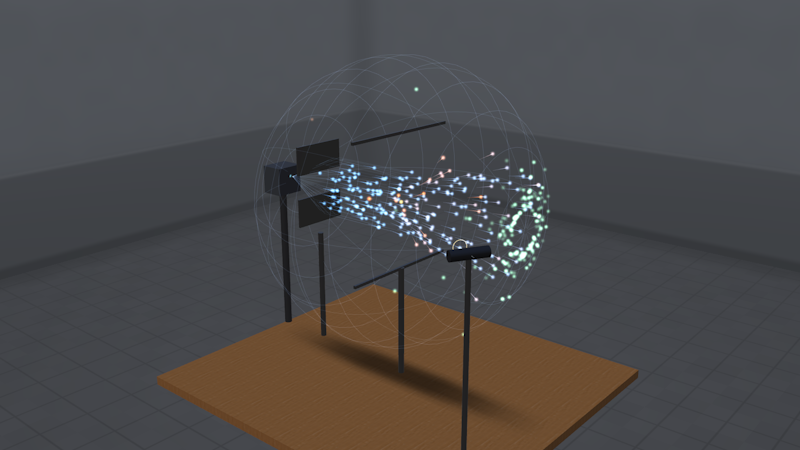
In 1909, Geiger and Marsden fired alpha particles at a gold foil a few thousand atoms thick. Thomson's model said the positive charge was spread across the whole atom, so everything should pass through with a slight nudge.
Most did. About one in eight thousand bounced straight back.
Rutherford compared it to a 15-inch shell rebounding off tissue paper. His 1911 answer: nearly all the mass and all the positive charge sit in a nucleus tens of thousands of times smaller than the atom. Scale the atom to a stadium and the nucleus is a fly on the centre spot.
It wasn't a hunch. He derived the scattering law - the fraction deflected by angle θ falls as 1/sin⁴(θ/2) - and Geiger and Marsden checked it against angle, foil thickness, particle energy, and four different metals. It held.
Half a century later, SLAC used the same trick at higher energy and found quarks inside the proton. The LHC still runs on that logic.
Want to know what's inside something? Throw something at it and watch how it comes back.