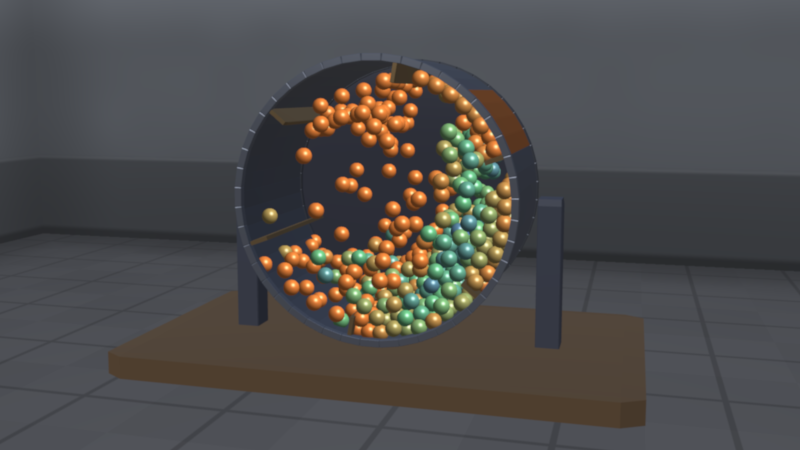
A rotating drum with a few hundred balls in it. There is one knob that matters, the spin, and one number that decides everything: √(g/R). For a half-metre drum that is 4.43 rad/s. Below it gravity wins and the bed falls back. Above it the wall holds a grain even at the top of the circle. Four videos, one per regime, in order of speed.
The bed is dragged up a grain at a time until the whole face lets go at once. Not a flow: a series of separate collapses. 8 % of the grains get above the axis.
The collapses merge. The lower half travels with the wall as a solid, a thin layer runs back down its face, and all the mixing happens in that layer. 18 %.
Grains stop rolling back and start falling across the cavity onto the far side of the bed. 31 %, fastest grain 4.17 m/s.
The bed sticks to the wall as a ring and mixing stops. 59 %.
Nothing here is scripted. Every grain is a body, contacts are a spring and a dashpot with Coulomb-capped friction, and the wall, the end caps and the lifter plates are a moving boundary carrying ω×r. The regimes are not modes you switch between - they are what falls out of one speed knob.
One thing the videos would hide if I let them: the fourth regime needs the lifters. Set them to zero and at the same 9 rad/s a smooth wall slips under the bed, which stays at the bottom - 3 % above the axis instead of 59 %. √(g/R) says whether a grain stays up there. It says nothing about getting it up there.
Granular tumbler is one of 132 modules in Makarov Physics Suite.