A battle used to begin with a loading screen: a column marching under a studio logo while the arena was generated somewhere out of sight. Now the field builds itself where you can watch it. Roads paint in, scenery drops onto its spots, the commanders take their ground, and the interface slides in from the edges. The wait is the same length. It just stopped being a wait.
The battle assembles itself
- The loading screen is gone from solo battles. The map fades through black while the arena generates, then the stage builds on camera: roads paint in left to right, scenery lands in a travelling wave, terrain bands bloom from their centres, muster tiles pop, and the commanders take the field before the HUD slides in from its edges.
- Any click or key skips straight to the finished field, and reduce-motion gets plain fades instead.
- The studio logo plays at boot only. Branding in the middle of a run reads as an ad break. A battle load gets its own picture now: your host crossing the region ridges toward the field, under a horizon tinted for the act you are in.
Fights open at speed
- The speed dial defaults to 2x. A round measures 6.6 seconds against the old 12.6. It was already the biggest pacing lever in the game and it opened on its slowest notch for everyone who never went looking for it. If you have picked a speed yourself, you keep it.
- The boss tax came down. Three bosses were taking 37% of a run's fight time across 3 of its 15 fights. Every boss bar comes down, weighted by how often that boss is actually beaten, the Swamp Treant hardest.
- Act 1 was the slowest act, which is the opposite of how it feels: 3.6 rounds a fight against Act 3's 2.0. A starter deck is the weakest thing that ever fights, so the grind sat in the run's first twenty minutes. Act 1's bars come down to meet its decks.
- The boss fly-over is half the length it was. The finishing blow is not scaled at all, because a lord's arrival and its death are the moments the fight is for.
Three events you play instead of read
- The Charmwright designs a relic to your order. She replaces the Whispering Grove, and she does not sell what she has: you tell her what the charm should do, what it should take, and how you are paying. Eighty gold, fifteen percent of your health into the quench, or a flask on the coals. Then two strikes, one of three boons and one of three flaws. Every pairing is a real relic with a real name, and nothing on that anvil is free.
- The Travelling Medic bottles a card. Her third row is the only place in the run that turns a card into a flask. Pick anything playable out of your deck; it leaves the deck for good and you walk away carrying a Potion of it. Uncorking that flask plays the card three times over, free, one copy after another.
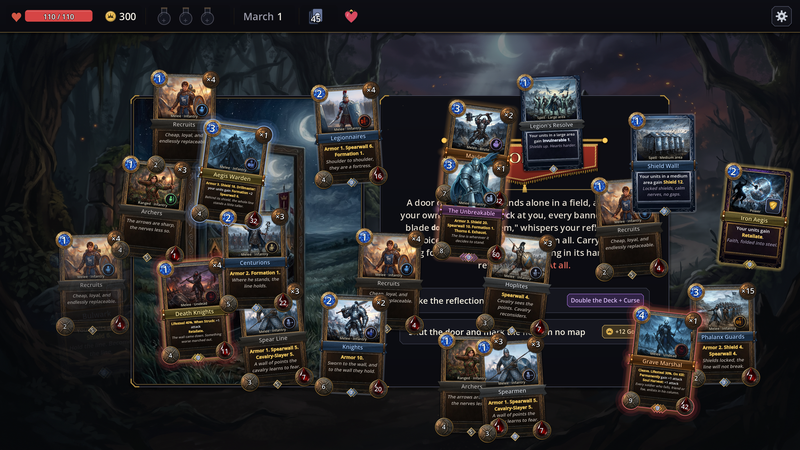
- The Mirror Vault's twins arrive on screen. Doubling your deck used to be a line of text. Now a copy of every card you carry fades up somewhere on the page, one after another, until the pile has buried the screen, and only then does it drain into the deck a card at a time. Its curse has a name now: Mirror's Due.
Forbidden Lore learns to burn
- Erasure spends as many pages as you choose. It was a flat blast that took one page afterwards. Now the pages are the spell: aim the circle, burn any number of cards out of your hand, and the whole total lands as one blow on everything inside it.
- Speak the Name replaces Angle Hounds. It lands one Charm per page burned this battle, counting the page it burns to be spoken, so it can never resolve on nothing.
- The Congregation musters the pages you burned, one Thrall per card exhausted this battle, and exhausts itself.
- Read Aloud replaces Initiates, Thrall Call is what the pack runs on, and Eyeless Scribes costs 1.
- Loose Page says it plainly instead of leaning on a keyword, and the Hungering Sigils print Trap first, because on a body that is nothing but a spring, the spring is the card.
Cards that print the truth
- Wild Die adds its roll instead of replacing the attack. The Dice Golem's printed 4 was a number it never dealt. A 1-attack golem with Wild Die 6 now lands for 2 to 7, and his upgrade hands him a second die rather than a bigger one, both thrown side by side on the same swing.
- The Wildcard Egg hatches anything in your card pool. It advertised "any pack" and then rolled off the same hard-coded sixteen bodies every run. It is now every summon your drafted packs can field: if you could have drawn it, it can crack out of the shell.
- The Gunslinger's guns are printed at the half his rule doubles. Deputy 1, Rifleman 3, Deadeye 5, which is what 2, 6 and 10 look like before the warlord touches them. Six Chambers doubles the number and says so, in green.
- Armor, not Armored. The keyword printed three different ways depending on where you read it. It says "Armor 3" everywhere now, the way Shield has said "Shield 12" for months.
- Grand Gesture does not sway a lord. Charm cannot buy a commander's allegiance, so it was being billed straight out of the lord's health instead: half a boss's healthbar for two energy, at any range, on the turn of your choosing.
- Spearmen answer cavalry. Cavalry-Slayer 5, so the brace lesson the starter deck teaches has teeth against the charge lords it is aimed at.
- A wave you can spend. Every lane front carries a finite charge now. Six bodies and it peters out mid-lane, so units standing in the lane are the answer to a wave instead of a reason to hold your hand until it has gone by. A lane left empty still delivers the whole front to your throne.
- The Eternal always opens holding his relic and two cards, whether or not your profile has a winning run for it to read.
- Every card that stuns says how long it stuns, Hurled Log included. Seismic Steps says "nearby enemies" like every other card. Twenty keyword definitions now say the rule in one line and stop.
- The Serpent of Gold, and the chain it was the head of, are gone.
Screens and sound
- Cards lean under the pointer everywhere but the hand, tipping away from the cursor the way a card lying on a table tips under a finger, with a glint that follows the pointer across the face.
- Screen washes bloom instead of flashbanging. Ten separate beats each blew the frame to near-white in four frames, on their own numbers, over a screen that is near-black everywhere else. For a photosensitive player that is a hazard rather than juice. There is one ramped wash now instead of ten.
- The road ahead is dark again. Naming the commander on every reachable node turned the march into a menu you priced and shopped. The sheet still names the fight you are standing in and the ones you have already won, and the act boss keeps his tableau at the head of it.
- Uncle Jim has a theme, with an instrumental twin for vocals-off, and it remembers where it stopped.
- The menu theme plays once and hands off to the jukebox, which on the title screen draws on all 73 songs, shuffled so that nothing repeats until the library has cycled. The music also stops swapping every time you pick a pack.
- No lord ends up smaller than its own soldier, B backs out of the pack draft, and nothing pops over the finishing blow any more.
What's next
The clock was the thing this update went after: a shorter boss, a faster round, and a battle that shows you a field instead of a progress bar. If a run still overstays its welcome, or if Act 1 still reads as the wall it used to be, the in-game feedback button is the fastest way to tell me. Most of the list above started as a report from someone playing.
More from Cardboard Conquest
Other announcements
0.7.9: the moon comes up red and never setsWally has always been the boss who turns into something else. Until now he only turned once. This build gives him the ending the whole fight was walking toward: at nought health the sky is dragged round a second time, the moon comes back up red, a black wood grows in around the board, and what stands up in that light is not Wally and does not answer to the name. The blood moon Every other act b…0.7.7: a lair for every lord, and the box gets its depth backEvery enemy lord has a lair now: forty-two of them, cut from paper and taped to the back wall of the box, where before a lord stood in front of whatever its theme's wall was. The box itself went through a round of changes meant to give it its depth back, and half of them came back with a line each. Around those: a boss stands a cast of curios that are its own, the battlefield moves when you dra…0.7.5: a new title theme, and Uncle Jim cut from paperThe menu has a new song, and it is the game's name. Uncle Jim, who walks you through the first act, was the last drawn face on a desk made of cut paper, and he is cut from paper now too. Around those: the relic pool's best card stops being free, Ascension 9 stops taking ten health off you quietly and starts putting two commanders on one mat, and every taunt in the game is written on its own sta…