0.7.7: a lair for every lord, and the box gets its depth back
Cardboard Conquest · published
Every enemy lord has a lair now: forty-two of them, cut from paper and taped to the back wall of the box, where before a lord stood in front of whatever its theme's wall was. The box itself went through a round of changes meant to give it its depth back, and half of them came back with a line each. Around those: a boss stands a cast of curios that are its own, the battlefield moves when you drag it, the spells are cut paper, and so is the Path chooser. This post also covers 0.7.6, which went to the Steam playtest branch without a post.
Every lord has a lair, cut from paper
A lord's back wall was its theme's back wall, and a theme is shared. Two things fixed that, in order.
First, what stands in front of the wall. Thirty-nine lords got thirty-nine kits of cut pieces, where the main piece is one commander's signature and never another's, the second piece is unique across the roster too, and two lords who share a theme now share its floor and its sky and nothing on its wall.
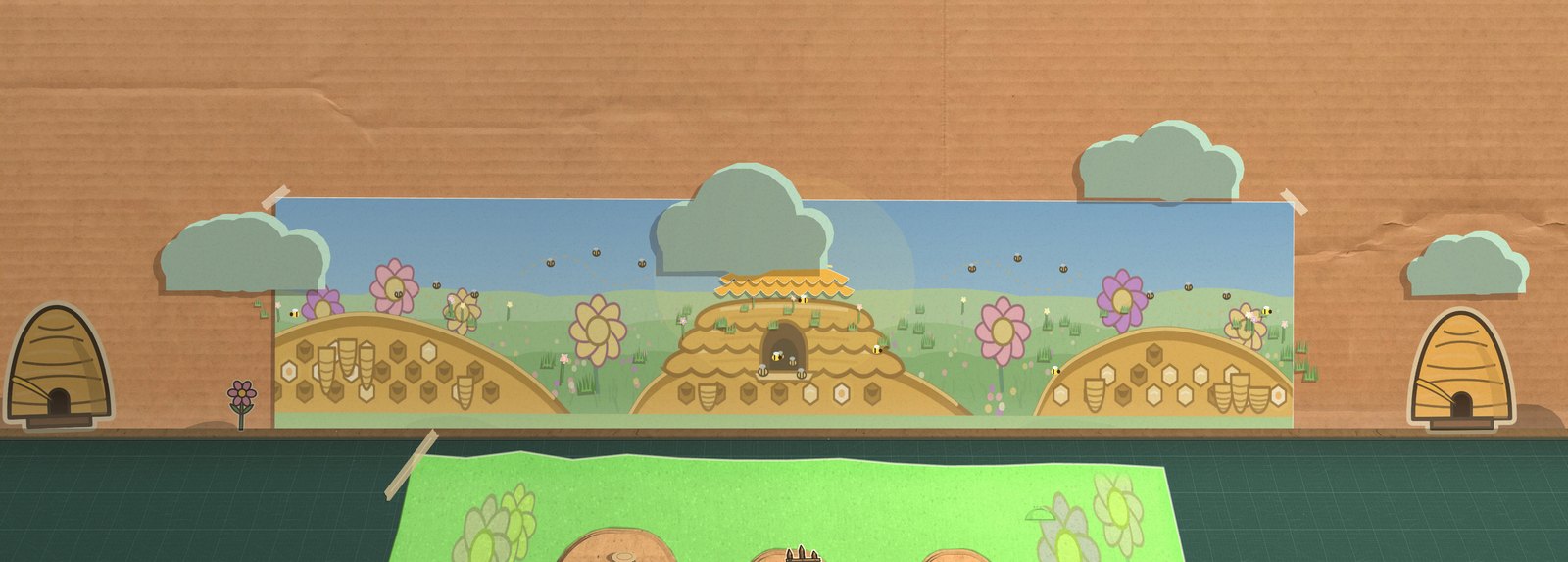
Then the wall. Forty-two backdrops, one per lord, cut one at a time, each an authored scene. Verdy B. Queen's Hive Garden is a loam bank cut open on tongues of wild comb, with queen cells and honey strings, her hive over its guarded mouth, a punched sun, a bee route, and the beekeeper's box and frame at the floor edge.
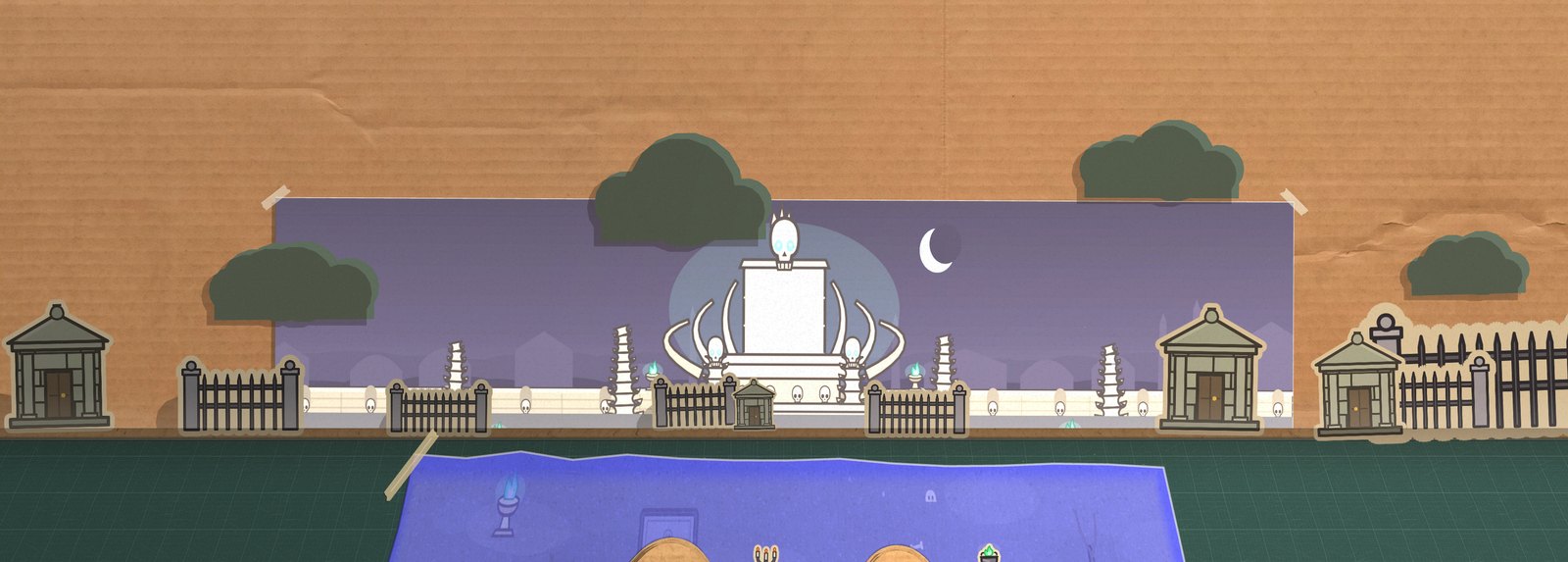
Rex Mortifer's Bone Throne is a colossal chair of femur stiles and a ribcage back under a skull-crested arch, ghostfire braziers throwing mint light on the flags, and a crypt heaved open with a skeletal arm climbing out. The Elder Treant's Rootheart is a mother-log across the top of the sheet with its splayed root flare, sawn face and bark curl, moss curtains, a forked sapling, a dead snag, and ferns, roots and toadstools on a litter floor.
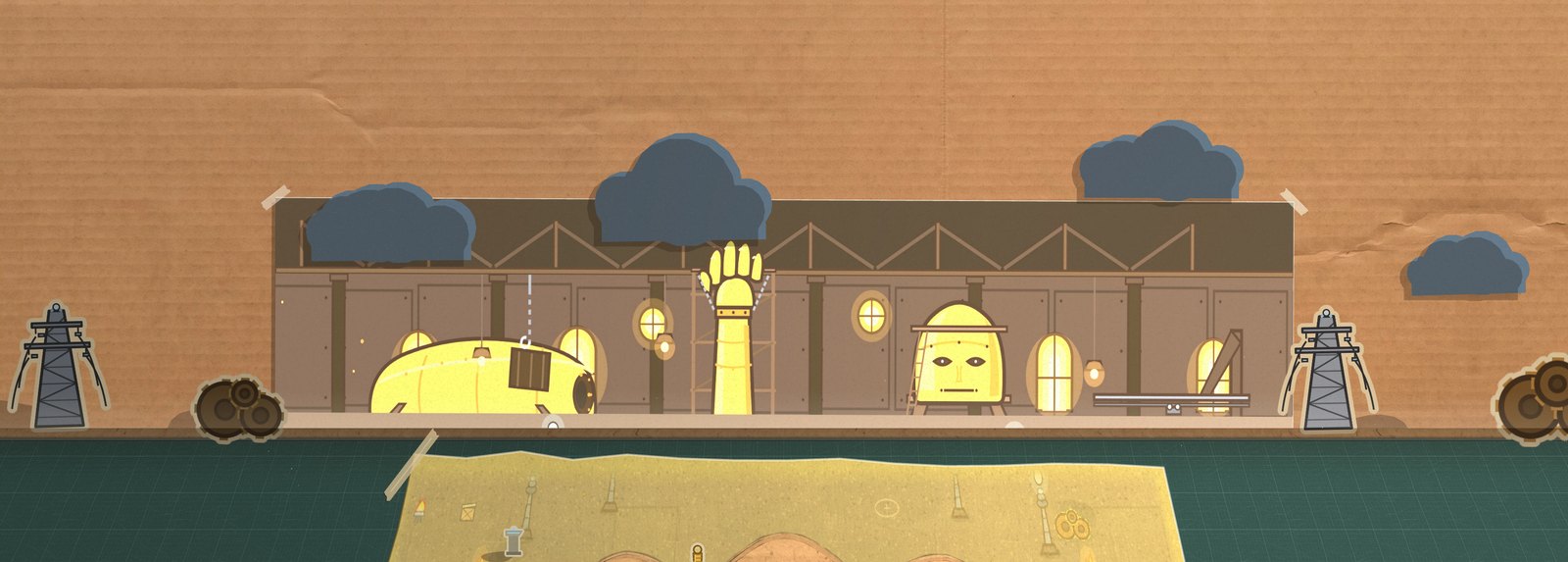
The Brass Colossus's Assembly Hall is him in pieces: a branching bolt jumping torus to torus under the roof truss and striking at his shoulder, his arm hung on hook and spreader with its claw open, a shin and boot in a wheeled cradle, a rack of cast fingers and the great hand on its pallet.
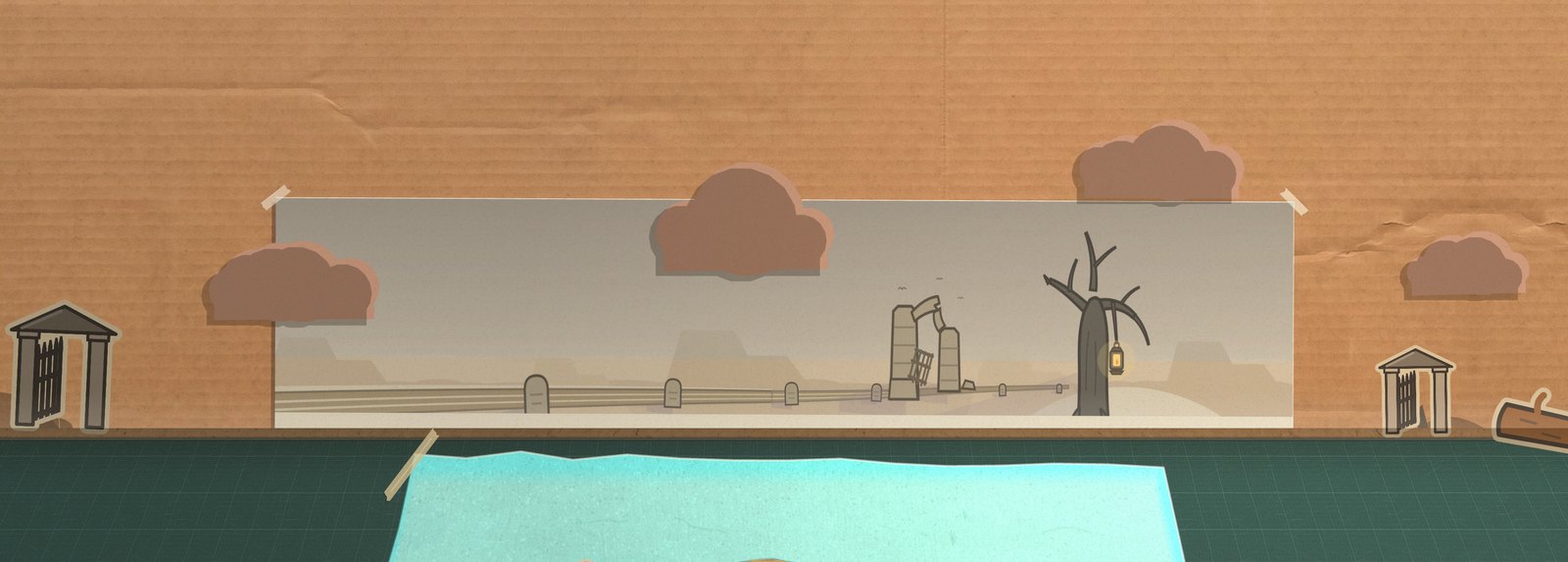
The Pale Rider's Last Road paces gable-capped milestones along the verge, the crow reading the number on the nearest, the dead tree carrying its one lit lantern, a horse's skull and ribs in the bone tumbleweed, and every shadow raking the same way off a low moon. Wally's village square has a punched moon rising behind the cottage row, a villager howling on the ridge, the well with its cat, a tipped barrow, a dropped lantern and clawed prints crossing the green.
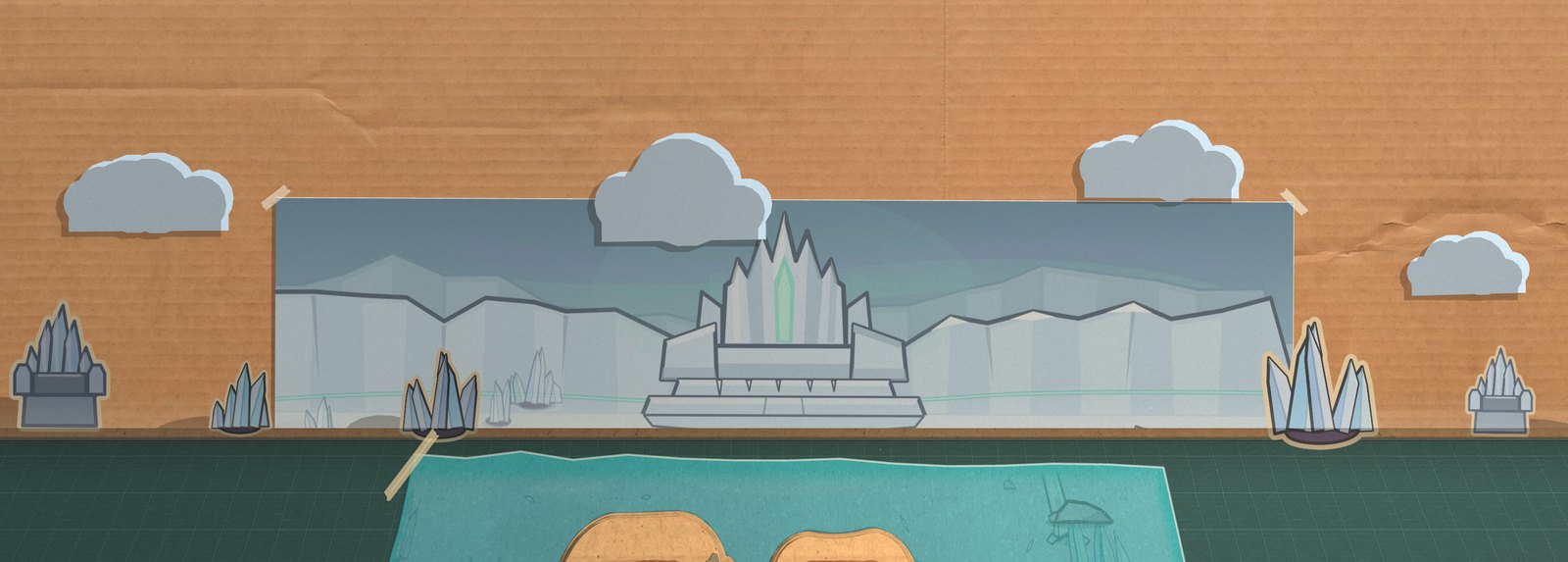
The Avatar of Winter's Frozen Throne is a fluted ice back crested with icicles on a three-step dais, two fractured armrest blocks on their brackets, aurora curtains torn along the hem and mirror shards raking their shadows over the crust. Haft and Hew's Divided Camp is one scene split on the diagonal and mirrored: his stake line runs from the near floor edge back to the horizon, hers runs out of the opposite corner, his sister's tent is alight under a banner torn to match his own, and on her half their father's point is reforged and driven into the earth.
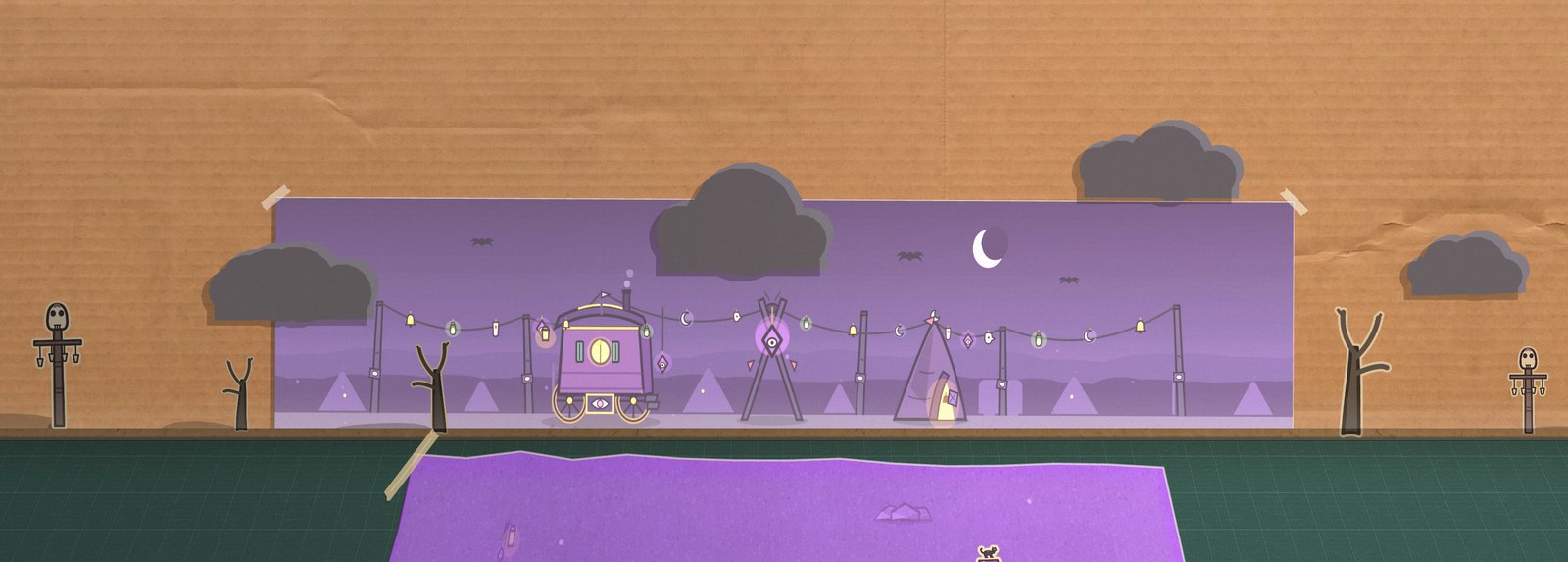
The Cursemonger's Charm Bazaar hangs three charm lines between crooked posts, a lit hand of glory among the bottles and bones, her stall of remedies and wax dolls, a lantern-lit counter with its rigged scale, and the black cat crossing with the light in its eyes.
The bestiary and the hover card on the battlefield show the paper lair too, where they were still showing the older drawn one.
A fused fight's back wall wears both commanders' scenery now. The mat was already torn per commander and the card printed per commander, but everything standing in front of the card came from the first commander's theme alone, so a Frost Yeti drawn first stood snowdrifts and arctic clouds along the foot of a Fire Devil's volcano. The scenery splits on the tear the mat is taped along. The mat under each half is that commander's own paper as well, rather than the theme's ground: Grix and Sift both hold the Middens, and their tear used to be the same brown on either side.
The box gets its depth back
Screenshots of the game read as an illustrated map with a cardboard flavour. The picture it is meant to be is a box of paper on a desk. A round of changes went in to close that gap, each on its own knob so it could be turned back to where it was. Three came back within the hour. The rest went to an approval page that showed the same frame with each piece on and off, and it split them four and four. What went is out of the code, not switched off.
Then the polygons went too. The mat had been dressed with code-cut paper: tufts and mounds along the road shoulders, offcuts, a loose disc, a piece in the lord's corner. The note on one of them, beside a drawn curio: "these don't fit together ... just some rough polygons with a white angular border ... a shortcut representing something like a trash bag. remove these again from all the arenas." Every one is gone. What stands in front of the back wall is a rank of drawn pieces, about eighty-five of them, including one for every wall kind a lord names (the goblin's shanty tower, the yeti's serac, the lich's mausoleum, the queen's skep), each pressed out of card with a rim, an easel tab and one cast shadow, which is the footing the pokeable curios already stood on. And the theme's own picture is printed into the pockets the lanes leave in the mat, which used to be bare sheet.
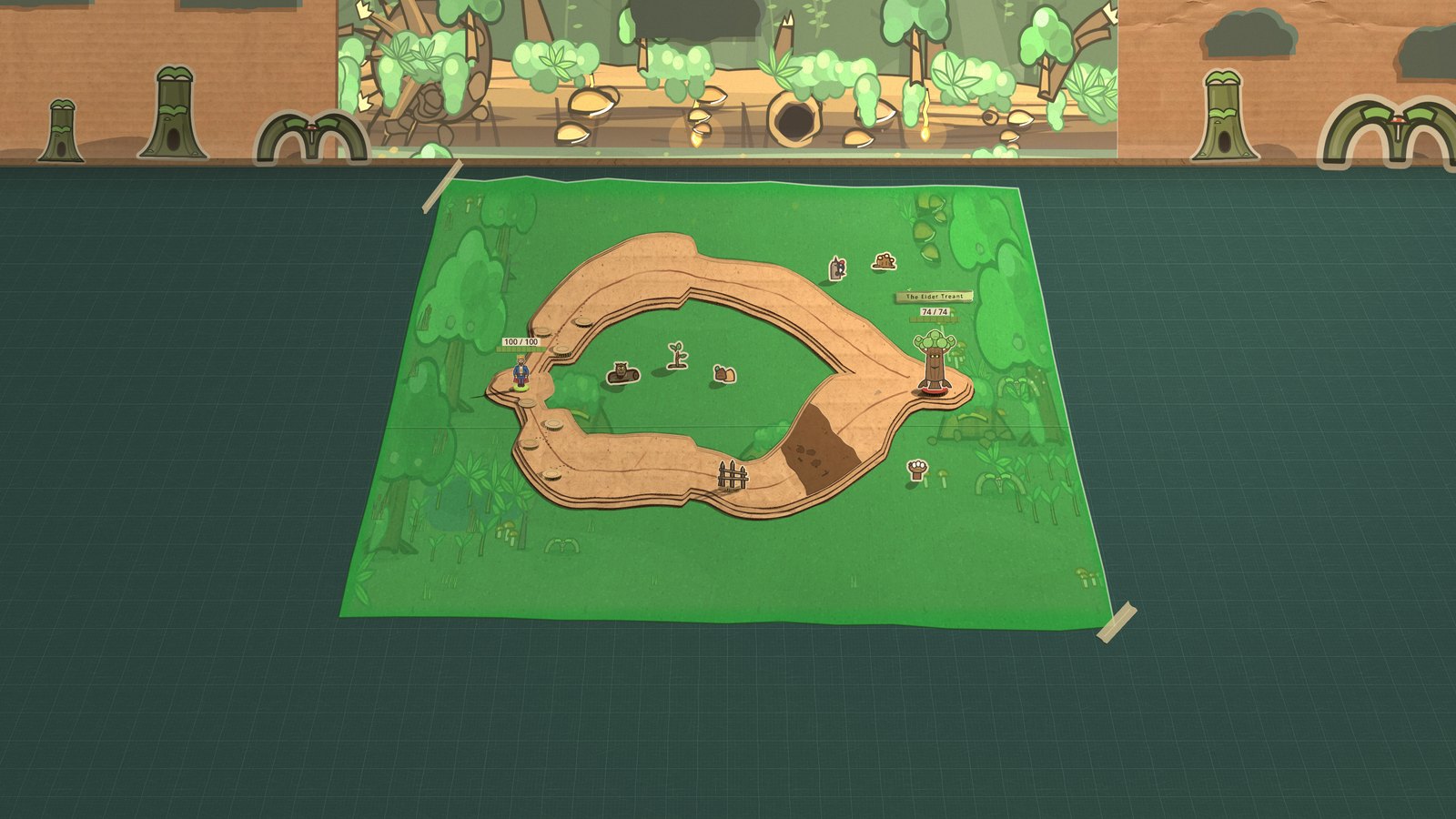
What stayed: standing scenery on the skirt below the lanes, two to four standees tall and clear of every corridor by its whole height, with the lamp's shadow; standees 1.3 times bigger, visually only, with footprint, spacing and hit radius untouched; a denser, taller rank in the midground that no longer stands aside for a busy card; and more of the sheet's pulp tooth, with a whiter core on its cut edges. The skirt got one note of its own: "I don't understand these green blobs. the shadow makes it look like they are floating." They were the meadow's bushes, a low dome cut for tiny warren dressing, stood at ten times that size under a cast shadow. Anything that lies on the ground (bushes, mounds, drifts, pools, rubble) never stands on the skirt now. A meadow's skirt is blossoms.
What went:
- The five-ply lane stack. "adding extra layers messed up a bunch of effects, like the lane effects like spaceman, the commanders, maybe enemy unit spawns, tons of stuff." Five plies put the top of the stack 30 px above the lane path where two put it at 12, and the path is where every unit, spawn tile, lane effect and commander's court is placed. One bug fix from it holds at any ply count: the hand that assembles the stage lays as many tiers as the stack has, instead of folding the fourth and fifth into the third.
- The back wall cut into a sky sheet and a skyline sheet that leaned with the camera by different shares. "in the world, the backwall is one wall with that backdrop taped to it, it shouldn't be cut and have different effects on different pieces." The back wall is one wall.
- The mat print's contrast change. "i don't like the mat contrast change."
- The saturation cap and the fold toward bare paper. "i want this game to be more colorful not less."
- A denser lamp, a strip of wall reserved in every framing, and a dodge that pushed any sheet dyed near kraft to bone or terracotta.
A boss stands a cast of its own
The brief for it: "boss battles in particular (should) be awesome and special ... don't repeat any interactable and make sure each one has a healthy roster of unique, bespoke interactables." A boss's field now stands its whole cast, more pieces than an ordinary field and standing closer together, with nothing from the shared theme pool. Twenty curios were drawn for it.
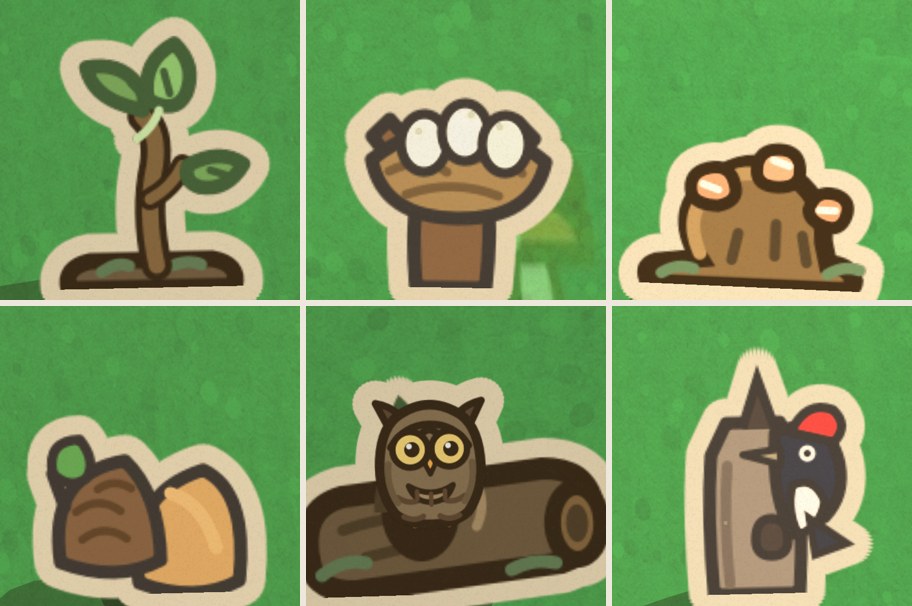
- The Elder Treant: a woodpecker that drums, a nest that hatches, acorns that sprout.
- Verdy B. Queen: a watering can that grows a flower, a bush whose butterflies take off, a birdbath with a bird that bathes, sings and laps the garden.
- The Magma Magnate: a geyser, a volcanic bomb, a salamander on a hot rock.
- The Brass Colossus: a bulb that pops and mends itself, a dynamo that arcs, a tin soldier that marches, falls and springs back.
- Rex Mortifer: a coffin with a hand in it, an hourglass that turns itself, a pile of skulls, a candelabra that burns green.
- The Avatar of Winter: a snowman that sneezes, an ice lantern, a fox that pounces, a sled that runs.
The ones that move stand on their own base, and the props are drawn at one unit to the pixel, so a poke lands on the drawing: the beak on the bark, the flame on the wick.
Grab the ground and pull
Left-drag pans the battlefield. WASD, the arrows and the right mouse button all moved the camera before this, and none of them is what a player reaches for first. Nobody should have to hold a key down to look at the rest of their own battlefield.
The press is never consumed. It only arms the grab, and travel past a slop threshold promotes it to a pan, so every click that does not travel still reaches the card in the fan, the button on the HUD and the commander it landed on. The promotion is what calls the other readings of that press off. Touch and the pad sit this out; each already has a pan of its own. Thirty-three checks drive it through real synthetic input on a real battle, including a drag whose release never arrived.
The spells are cut paper now
The spell effects were still drawn as if on a screen: translucent shapes, line-stroke ropes, and one cardboard grade laid over the lot that turned fire mud-brown and gold the board's own khaki. Every piece of a spell now throws the lamp's shadow, fills as opaque stock, and wears the pale scissor line inside its ink contour. Alpha runs through a paper curve, so nothing solid arrives translucent. The single grade is replaced by construction-paper grading per slot, which keeps each family its colour.
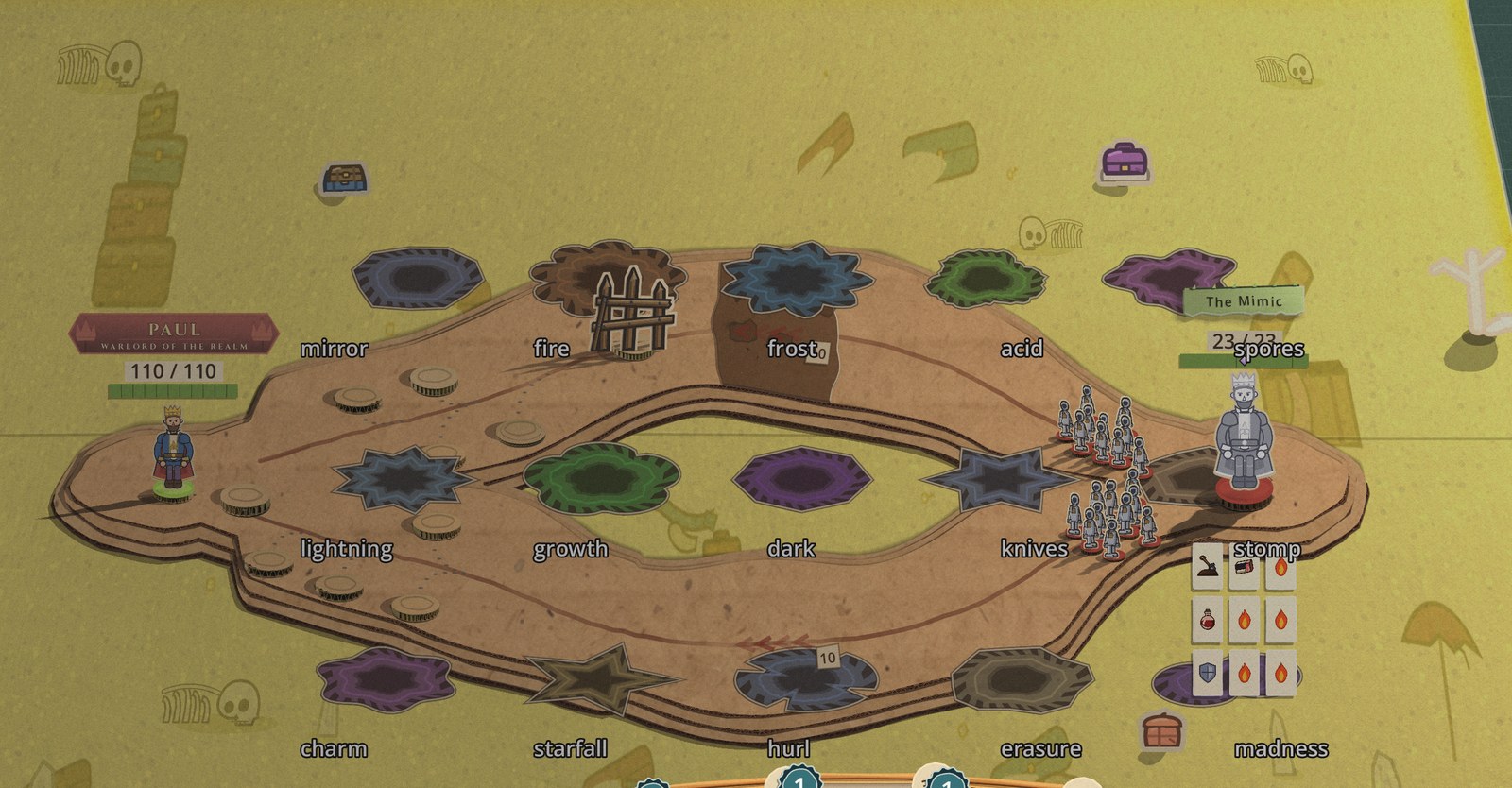
That picture is a test sheet, not a battle: fifteen rings, one per spell family, laid across a mat so the grading could be checked in one frame. It is the whole point of the change, though. Under the one grade, fire came out mud and gold came out board; here each family keeps its own paper.
Three of the drawings changed with it. The smoke silhouette, which the review called "badly drawn rocks that are semi transparent", is a layered two-tone bank of cut-paper clouds. Fire is a fuse of scissor flames, orange stock with a cream heart, instead of a line-stroke rope the diorama read as a muddy branch. Lightning is one kinked paper ribbon widening toward a cut-star strike, built panel by panel. Starfall's tail is a piece of gold stock instead of a 60 percent wash that matched the board.
The Path chooser goes papercraft
The doctrine titles were the path's hue lightened onto cream, which was unreadable. They are swallowtail nameplates now, cut from the path's own stock, in the chooser and in the Compendium's Paths ledger both.
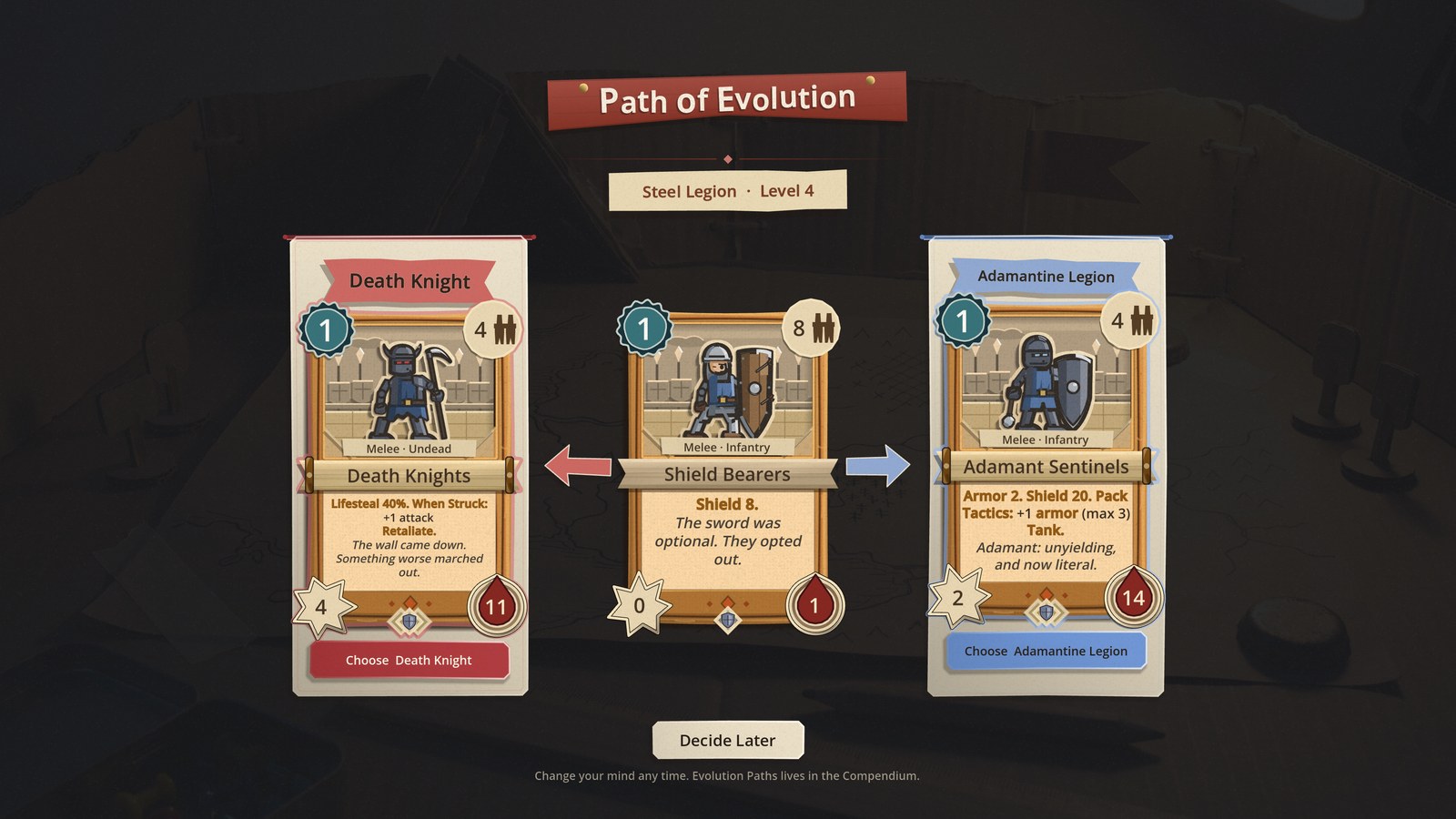
The base card stands once, in the middle, with a cut-paper arrow to each payoff, so the same face is never printed twice. The blurbs and the "Choose a doctrine" line are gone; the name alone says it. The "CURRENT" chip is a sticky note slapped on at an angle, and committing peels it off the old plate and rolls it onto the new one.
In the same room, a landed pack pick was the one thing still made of screen: the pack's colour darkened to lacquer, a lit border, the name floating in a black halo, beside empty slots that had long since become penciled frames on kraft. A filled slot is a piece of the pack's own stock now, with the name written on it in the pack's ink.
Smaller things
- Uncle Jim names the number on the road. The head-count tag beside a lane the enemy is filling is the only thing on the board that says how many bodies are marching at you, and nothing ever said so; on a first fight it read as decoration. The march's lane beat now frames each tag with its own ring, and Jim says what the number is and which one to answer first. His note about the speed row waits for a turn you can read it on, instead of arriving on top of the battle it was describing.
- A held key no longer skips Jim's lore. His walk-up was the one dialogue view in the game without the guard against key repeat, so a key still held from the fight that just ended filled the plate and took it away a few frames later. A playtester diagnosed it himself. A key repeat is not a decision.
- The daily briefing is inked for the card it is printed on. Every colour on it was chosen against the old dark panel; on kraft the pack names measured close to invisible, and a playtester said so: "I could barely read Pandemonium and not read Primordial Growth at all."
- A boss's beat-walk captions arrive as slips of the motif's own stock, settled over the lord and taken back up by the hand, instead of white type in a glowing halo drifting off like a ghost.
- The boss arrival camera holds one lane. It followed the closest pair of bodies, which flips lane to lane as they close and die.
- Grix's telegraph. The cast clock was printing across his nameplate and under his crown; it clears the sign now. The clock itself was the last HUD widget in the diorama, a rounded black panel over a lord whose sign, health ticket and body are all card; it is a slot cut in board with a strip of red paper sliding through it and the time in chalk. And his cutthroats' card says "Summon 2 Warren Shivs." and stops, because where they land is something you see a beat later. Where they land changed too: just behind one of your own bodies, the way a Backstabber's would.
- Both Masked Challengers take a turn, every round they are both alive. A pair's budget was billed as two halves but spent as one purse in one order, so the commander at the front took its whole script and the one behind lived on the change. Grix & Sift is where it showed: Grix bought goblins with three of the four points and Sift stood in the other corner with a full roster and put down two rats. Each buys its own half of the row now. The total does not move.
- Hew's plays stop being filed over Haft's empty ground. Kill Haft first and the strip of the survivor's last plays stayed parked over his patch of bare dirt.
- A tooltip answers in a third of a second, not two thirds.
- A fresh install gets XInput's deadzone, and the dice cup reads the drift-corrected stick.
- The Rapt-Boar, Gorehoof's boar that calls another out of the brush every time it kills, drops from 10 health to 5 and keeps its 3 attack. The swarm was always meant to be the threat and the single body cheap to clear; at 10 it was neither.
- Pyromancy's card backdrops are a place now. Every pack's were the same template in a recolour: a banner on a pole for the powers, a chevron ridge for the spells, two flat bands and a motif for the summons. Pyromancy's summon scene is the Burning Ward itself, with its tiered brazier, its pyre and its cauldron boiling over; the power is the same yard at its altar; the spell is the yard mid-surge. The fire is cut paper throughout, every tongue a flat ink with a hard edge and its own pale core.