0.5.64: what the enemy pays, and four versions of catching up
Cardboard Conquest · published
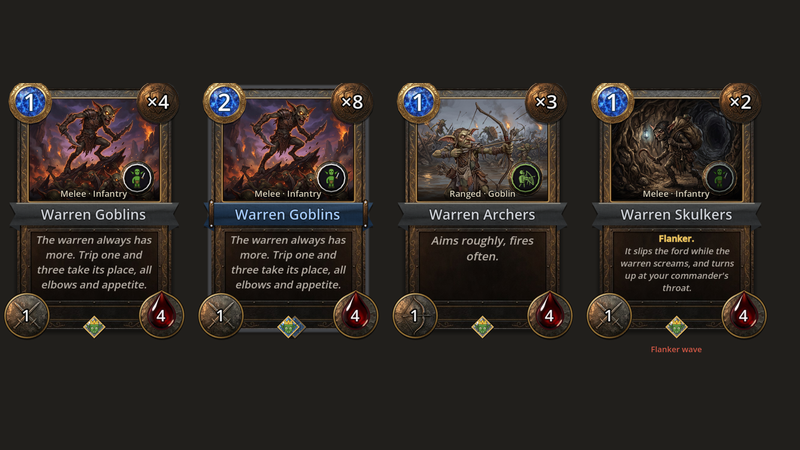
This one covers more than a single version. Steam saw the 0.5.58 notes and then the 0.5.63 notes, and four versions in between never got written up here. So this is 0.5.59 through 0.5.64 in one place, and most of what follows has been live for a while.
The short version: Act 1 stopped being a wall, the fight explains itself while it happens, the game runs on a phone, and every enemy card now prints what its lord paid for it.
You can read the enemy's budget
- Every enemy card shows its energy cost on the card's own gem. An enemy lord spends a purse each round exactly like you do. That number was always there and you could never see it, so a fight that felt arbitrary was often just a lord spending three energy on eight bodies. Now the Bestiary prints it.
- A summon card is named in the number it arrives in. Warren Goblins times four is a different card from Warren Goblins times eight, and they no longer look identical.
- The Bestiary roster stands on three grounds: Normal, Elite and Boss, so you can see which shelf a thing you just lost to came off.
Enemy powers say what they do
- Open the Graves buys ten seconds of ground that is yours alone, and says so.
- The Green Tide throws a d20 you can watch land. It was always a roll. Now it is a roll you see.
- The foundry's Overload is the Lightning Storm, and it prints how long the Stun holds. It also aims its barrage at the front rank instead of going straight for your crown.
- Mob Rule pays out on the crowd rather than a flat point, and Contagion admits it catches its own strain.
- Shields say Shield 8 instead of describing an eight-point shield, which is the same rule in the same words the rest of the game uses.
Act 1 stopped being a wall
This was the 0.5.59 and 0.5.60 work, and it is the biggest balance change the game has had.
- Every enemy body is priced against a flat energy budget. The enemy lord gets a purse the same size as yours and has to buy its army out of it. There is no hidden multiplier anywhere any more, and no difficulty dial: the roster is the difficulty.
- The run-killers came down to something a first clear can answer. The Swamp Treant thins out and drops its plate, the Hulking Troll is a troll you can actually kill, and the lords that used to crest out of reach now crest at a height a starter line can wade.
- Three summoning spots, minimum, in every fight. Losing because there was nowhere to stand was never a decision you made.
- Act 1 loses gracefully. The on-ramp hits softer rather than thinner, so the early fights are still fights, they just stop ending runs before they start.
- Seven things the fight was doing without telling you now tell you. The three switches people kept hunting for came out of Advanced and into the open.
The fight explains itself while it happens
- A telegraph tells you how long you have, not just that something is coming. The boss spell says whose head it is coming for, and the blast that killed you has a name on the defeat screen.
- Bosses wear boss bars, and a growing boss states its rate.
- Keyword definitions say the rule and stop. No preamble, no flavour, no tips. Card faces stopped re-explaining keywords they had already named, which is where most of the crowding on a card came from.
- Every upgrade that rewords a card says so in green, so you can see what you bought.
- A cast spell stands over your lord until you have answered it, and every enemy spell telegraphs in its own language.
It runs on a phone, and it can play itself
- A full touch pass. Every commit is a tap, every screen fits a thumb, the interface fills to a phone's shape instead of an ultrawide's, and a cast lands where your finger is rather than where it used to be.
- Auto-play. Settings, Advanced, off by default. It plays your hand and you watch it decide. It was built for testing and turned out to be the best way to watch what a deck actually does.
- Your opening hand belongs to the run, not to the reload. Quitting and continuing no longer re-deals it.
- The Compendium's sections are tabs that wrap in even ranks, and the map road has a far end you can see.
Cards, relics and renames
- Chain hits full damage on every jump, and you can watch it travel. Counterattack split into Retaliate and Thorns, which were always two rules wearing one name.
- Coup de Grace sweeps the line instead of duelling one body. The medic's tonic is a choice of three, dealt one at a time. The Wildcard Egg's upgrade lays a second egg.
- Jim mends three quarters of your wounds rather than filling you to three quarters full, which is a much better deal when you are nearly dead and a much worse one when you are nearly whole.
- Deathly Pall withers on a ten second clock and never touches a commander. Blinding Sheen answers a crowd instead of a coin flip. Wolfsblood Vial also grants movement.
- Free Placement is Free Deploy. Ritual is Spectral Call. Cloak and Dagger is Rogue's Gambit, with a new crest. Day is March.
- The King stopped being immortal.
If you missed the 0.5.63 notes
They are the post below this one and worth the two minutes: the Infernal Legion was replaced by Forbidden Lore, a nineteen-card pack about reading things you should not, the whole interface was rebuilt into one design language, the killing blow became a finishing move, and each of the four other warlords stopped being a costume and started rewriting a rule.
What's next
The Bestiary now shows the enemy's economy, which means for the first time you can argue with it. If a fight still reads as unfair with the numbers visible, that is worth telling me, and the in-game feedback button is the fastest way. Most of the list above started as a report from someone playing.