Slot Theory 1.5.3 - Update Notes
A new modifier that does not care how big the health bar is, a faster fast-forward, an Anomaly Feed that finally trusts you with tradeoffs, two more bans, a light touch on deep endless, a smarter auto-pick, and a batch of fixes for things that quietly did not work.
New modifier: Corrosion
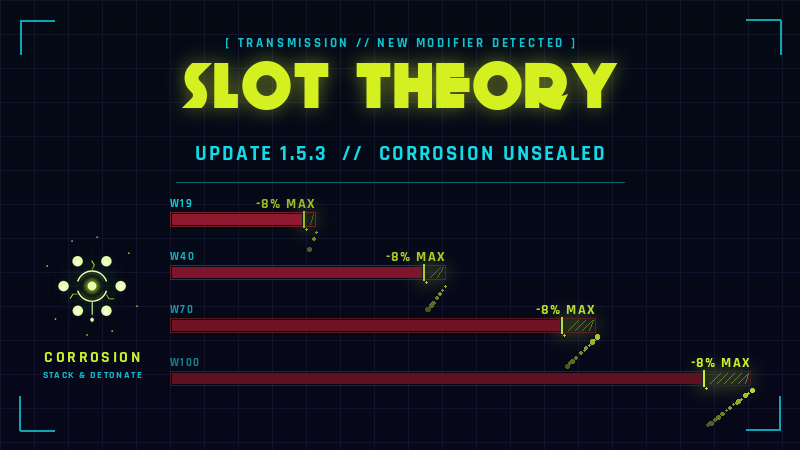
Every damage card in the game so far multiplies flat damage, and endless waves grow faster than any multiplier. Corrosion is the first card that sidesteps that arms race: primary hits apply a Corrosion stack, and at 4 stacks the enemy loses 8% of its maximum health and the stacks clear. Fifty primary hits kill anything. Not anything at your wave, anything: the card removes the same fraction of a health bar at wave 100 as it does at wave 30, which makes it the first tool in the game whose value goes up the deeper you get.
The price is the mirror image. Where flat damage is still plenty, fifty hits is slow, so Corrosion is a poor pick in the mid game and a strong one exactly where everything else stops working. Extra copies on the same tower each apply their own stack per hit, so stacking three copies detonates three times as fast. Bosses resist it heavily, because a boss that loses 8% of its bar fifty hits at a time would not be a boss for long.
It is easy to track in the moment, too. Stacks build as a rim on the enemy itself, readable even when a deep endless swarm blurs everything else together, and a detonation gets its own beat: falling acid residue, a second damage number for the health that just vanished, and a sound that tells you it landed while you were looking somewhere else.
It only appears in drafts from wave 19 onward, arriving just in time for the finale and really built for what comes after it. And it has to be unsealed first: beat Warp on any difficulty to earn the new Corrosion Unsealed achievement. Warp is the map whose gimmick sends enemies back through the central diagonal for a second pass, and Corrosion stacks per hit, so a map that routes every enemy past your towers twice is the card's natural home.
Game speed now goes to 10x
The speed button ran 1x, 2x, 3x, 4x, 5x. Five rungs, and each one felt like the last one: nobody sits at 2x deciding whether 3x is worth it, and the top of the ladder was not fast enough for the part of a run where you already know how the wave ends.
The ladder is now 1x, 3x, 5x and 10x. Four rungs with real distance between them.
The simulation keeps up with it. The game does not simply run its physics over a bigger step at higher speeds, it splits every frame into fixed slices so a run plays out identically at 1x and at 10x. That slice budget was sized for a 5x ceiling; it has been doubled so 10x stays honest all the way down to 25 frames per second, rather than quietly running short of the speed on the button in exactly the heavy late waves you want to fast-forward through.
The Anomaly Feed now draws from the whole common pool
The feed shipped drawing from a two-card allowlist, the harmless fillers, on the reasoning that a randomly placed tradeoff would feel like griefing. That was backwards. Less say over what lands is the price of running the Anomaly Feed, not a defect in it, so every common card is now drawable, tradeoffs included.
Two things came with that or it would have been half a change. The feed now checks whether a tower can actually pay a card's cost before drawing it, so a card nothing on your board could take no longer silently eats the wave's feed and reads as the feed doing nothing. And a fed Overdrive Fuse now applies its upside as well as its downside; previously only the player pick path pushed the good half, so the feed would have handed you a strictly worse card than the one printed.
Five bans per run, up from three
A ban is permanent for the run, so every charge is a card removed from your offer stream for good. With the pool one card bigger, two more charges give a player who knows their board that much more say over what they get shown. This is a player-agency change, not a balance lever; it was measured, and it will not carry a bad draft on its own.
Deep endless, retuned slightly
The Accordion Engine's compression pulse pulls a little less hard per pulse, and the endless health curve was softened to match: per-wave growth eased from +4% to +3.85%, and the every-five-waves tier steps from +22% to +21%. The intent is to trim the deepest compounding of one specific build without raising the game's absolute difficulty, and the pairing was measured to exactly that standard: typical runs come out where they were, and the change was tuned in the easier direction on purpose, because all-time leaderboards mean a harder game strands old scores as unbeatable. Waves 1 through 20 are untouched; that was verified to the byte, not assumed.
Auto-pick drafts better
The brain behind the auto-pick button was replaced with the strongest drafting logic the playtest bots have. Measured head-to-head across four maps, it wins about twelve points more often than the old one. If you use auto-pick as a fallback when a draft has no obvious answer, the fallback got meaningfully less likely to cost you the run.
Fixes
- Bronze Field Mod cards are no longer locked out of a tower that can use them. Live Wire trades chain reach for chain damage, and it checked whether your tower could chain when you first placed it. A Voltspear starts with no chain, so a Voltspear that had since drafted Chain Reaction and was visibly bouncing shots off enemies still could not take the card. It now reads what the tower can do right now. A tower with no chain at all can take it too, since there is nothing there to trade away. This was the only card in the bronze tier that cared what kind of tower you pointed it at, and it is the one you were most likely to meet: the bronze cards only show up once your board is full, so finding the card you wanted and being told no was the last thing that happened in a lot of runs.
- Anomaly Feed no longer drops an invisible tower under Free Tower Placement. With the free placement rule on, a tower has no board position until something puts it somewhere. Every path did that except the Anomaly Feed's end-of-wave pick, so a fed tower was live, firing and even clickable, while drawing nothing at all. It also counted as sitting at the corner of the map, which blocked you from placing real towers there and teleported it to that corner if you resumed a saved run. The feed now picks a legal spot the same way your own cursor does, preferring somewhere near the path so the free tower actually covers something, and declines cleanly if the board has no room left.
- Banning a card no longer strands a controller player in the draft. A ban swaps that one card out in place, and the card you banned was almost always the one the pad had highlighted. When it went away it took the highlight with it, so the stick and d-pad had nothing to move from and the confirm button did nothing. The replacement card now takes the highlight, and only when the banned card had it, so a ban does not yank your cursor across the panel.
- The Leaderboards screen opens on the GLOBAL tab. Opening it from the main menu started you on your own local scores, which you have already seen. It now opens on the world board, and Local is one click away.
- Deep-run damage totals no longer freeze at 2.1 billion. The total-damage counter was a 32-bit number, and a deep endless run can genuinely deal more damage than a 32-bit number can hold. It is now wide enough that nobody will ever hit the ceiling honestly.
- Split Shot's extra projectiles now count as primary hits everywhere. One echo path treated them as chain bounces, which meant on-hit effects that skip chain targets, Corrosion among them, would silently not trigger from those hits. The game now agrees with itself about what a split projectile is.
Found a bug?
Tell us. The Steam discussions and Discord both reach us, and Discord is usually faster.