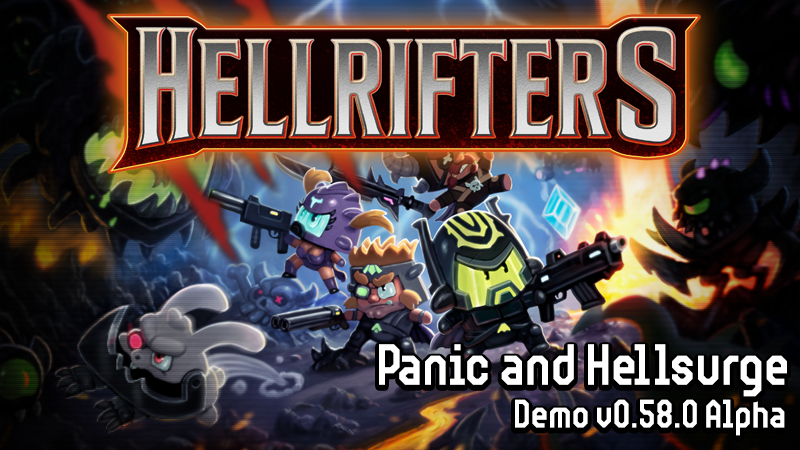
Panic and Hellsurge
Demo Update v0.58.0 Alpha
Three weeks since Seal the Rift. This update is about making combat more dynamic, so a fight feels varied instead of the same wall of bodies every minute of every run. Three things carry that: a new fodder enemy, the Hellbug, which dies to a single hit but never arrives alone; combos turned into a weapon, where every redeemed combo fires a shockwave and lights a Hellsurge of speed and firepower through the squad, bigger with every tier; and enemies that behave in more ways, losing their nerve, marching in formations, charging in close and rising again as zombies.The second theme is communication. The game now tells you where a run stands and what to do about it: you leave a raid by walking out through extraction, the mission tracker always points at the next open objective, and the phase menu says what is left to chase.Much of this came out of player data and the feedback panel, which is also why Rift 1's opening was retuned. And since a battlefield of panicking, exploding hogs costs more than one of walkers, the game got a serious performance pass.Here is everything new since v0.51.0.
A fresh start, and a question for you
Your old save still works. But the game has changed enough since v0.51.0, in how a raid flows, how it ends, how combos and enemies behave, that playing the demo again from a clean progression gives you a genuinely different experience than continuing where you left off. On your first launch after this update you will get a one time prompt offering that fresh start. Take it if you want to see the new Hellrifters the way a new player does. Keeping your save is always fine, and the reset stays available in Options either way.Whichever you choose, I would like to hear one thing: is the game going in the right direction? There is now a short survey on the quit confirmation screen, with star ratings and room for comments, and it goes straight to me. If you have played earlier versions, your view on where this one landed is the most useful feedback I can get right now.
Weaponized Combos
The combo meter is now a weapon. Chain kills fast enough to redeem a combo, Multislay up to Uberslay, and two things happen at the same moment.
A shockwave erupts from the center of your squad and physically bulldozes the horde back. The wave grows with the combo tier, up to a screen wide sweep at the top. The wave clears the space, and the surge is how you use it.
A Hellsurge lights up through the whole squad for ten seconds. Every combo speeds up firing, reloading and the squad's legs. Mid combos add weapon damage, dramatically bigger bullets and an extra spread of bullets per shot. A top tier combo puts everything on: up to triple bullet size, three extra multishot levels, longer reach and fully doubled movement speed. The bigger the combo, the bigger the surge.
For the surge's duration every weapon has a bottomless magazine, the same way bullet time works, so no gun spends its glory window reloading, not even the rocket launcher. A weapon caught mid reload when the surge hits is reloaded on the spot. Picked up special weapons are the exception: they fire with the surge's fury but burn through their ammo honestly.
Surge items drop on the field. The ammo pickups retired in the last update return reborn: a small surge item lights a level one surge or pumps an active one a level higher, a big one is worth three levels on the spot, enough to put the multishot fan on screen by itself. They drop sparingly from heavier enemies, Hellploders, bosses and site objectives, never from common fodder, and once your surge is maxed out they wait on the ground like a med kit at full health. The radar upgrade that used to sniff out ammo now boosts surge item drops.
You can see the surge on the squad. Every member's ground ring turns molten gold and grows and spins faster the bigger the combo, then settles back as the power fades. Every HUD slot shows the active surge level as a row of up to five icons. Squad members arriving mid surge get the full boost the moment they land.
Balance. Combo thresholds scale with the size of the living squad, from the third member up, so solo and duo play at baseline while a four strong squad that reaps at four times the pace pays a matching price, and a battered squad earns its surges more easily. Combos do not stack surge levels endlessly: a bigger combo takes over at full strength, an equal one restarts the clock, and only surge items build the level up piece by piece. And the peak burns down instead of burning forever: each further top level extension grants a shorter one, so a rolling squad cannot keep an Uberslay engine running as a permanent state.
The numbers are still being tuned, so expect them to move. The idea is staying.
Enemies that lose their nerve
Wounded enemies can now panic. When a basic drops below a quarter of its health there is a coin flip chance it turns tail with a burning shriek and sprints away. Get it far enough and it is gone for good, loot and all. But if a Hellploder is within reach, the coward runs to it instead and huddles by its healing pulse, returning to the fight only once healed. That hands you a choice: chase it down, or shoot the Hellploder it is hiding behind. Each enemy panics at most once in its life. Bosses, enraged enemies and risen zombies never flee.
Panic is contagious, and morale works like armor. Every enemy has a hidden reserve of nerve, and fear wears it down. When a neighbor breaks and runs, its panic eats at the nerve of everything nearby. One coward might not be enough to crack a steady enemy, but two breaking in quick succession can be, and when an enemy's nerve runs out it faces a nerve check and can bolt at full health.
Carnage spreads terror too. An enemy destroyed critically, kicked apart or blown up radiates dread into everything around it. Wade in with boots and explosives and the survivors around your kills start losing their nerve.
Fear respects the food chain. A small enemy's panic never rattles anything of a bigger class, while dread rolling downhill hits harder with every size step. When a boss falls, its death blasts out a terror wave that no small enemy can resist, so felling a Stomper reliably sends the field around it scattering.
Boosted enemies never lose their nerve while the boost rage burns, so the bounty a boosted kill carries cannot run off the map. Stompers have no patience for cowards: one within leaping range of a fleeing enemy slams down on it, once, before returning to business.
Bladers now charge. Get close enough and one breaks into a rush at 1.5x speed for two seconds, then falls back to a walk before it can rush again. Formation members do not rush, so the pattern stays readable. The proximity alert over an approaching enemy is back as a single flash at the exact distance a rush can begin, without the old screen wide clutter.
Enemies flinch when your bullets land. A hit knocks the body back along the line of fire, shakes it and lets it settle, on top of the existing hit flash. How hard they flinch depends on the size of the hit against their health and on the size of the enemy, and criticals visibly hit harder. Visual only: nothing moves an enemy off its path.
Skullcrawlers burn out after biting. Like the new Hellbug, a Skullcrawlers latches onto a squad member and is awkward to shake off, so it now dies on its own after landing three hits on a player, with full gore and drops.
Bladers cut the corner. They steer toward where you are going to be rather than where you are, and a charging basic aims its rush at your predicted position. Reinforcements also favor the direction you are traveling, so the open lane you are sprinting toward is where the next arrivals appear. Stand and carve, and none of this touches you.
Enemies march in formation
Until now the horde arrived as a loose, scattered mix, so there was never a readable battle plan on the field. Enemies can now arrive in formation: a wedge, a line, a column, a box, a ring, or a filled circle with a protected leader at its center.
A formation moves as a unit. It advances at the pace of its slowest member, holds its shape until it gets close, and then breaks into regular enemies. The ambient chaos stays; the formations punctuate it.
Kill the lead and the formation breaks early. A member that loses its nerve breaks out of the pattern, and if the lead panics, the whole formation falls apart on the spot.
Formations are budgeted. One arriving from a phase's pool shrinks to fit the enemy headroom the phase actually has left, and skips its turn entirely when even a small one would not fit, so they never stack on top of an already full field.
This is the first version, and it is the start of something rather than the finished thing. Right now a couple of formations are wired into Rift 1 as a proof of the idea. Where it is going is authored formations per phase, formation specific telegraphs when one arrives, and formations folded into the strikes and flavour waves so a push can open with a wall of shields or a column of Boomers marching straight at you. Spacing, break distance and turning speed will all move with playtests.
New enemy: the Hellbug
A hopping swarm bug that dies to a single hit but never arrives alone. Hellbugs are fast, relentless and dangerous only in numbers, which is exactly how they come: as a ring closing in around you when you grab the bait gem at a Hellpump site, and in packs through the regular waves. A Hellbug latches onto a squad member and is awkward to shake off or shoot at point blank, so it burns out on its own after landing three bites. Three bites is what the beast has in it.
The Stomper
It hunts now. Slip beyond its leaping range and it roars and breaks into a sprint, cutting the corner on your escape route until it is back within jumping distance. The sprint is a burst of at most three seconds, so outrunning or outturning it for that long earns a clean escape, and it catches its breath for fifteen seconds between sprints.
Every footstep thumps the camera and the gamepad. The tremor fades with distance, so a far off Stomper is a faint rumble on the horizon and a close one makes the whole screen pound in rhythm with its stride. During its sprint the steps come faster.
Its jump landing hits harder than anything else in the game. A new heavy impact channel lets it far exceed the camera's normal shake ceiling and deliver a full strength gamepad slam, followed by a short series of fading aftershocks, so the landing reads as one massive blow with the ground still settling.
It sounds as heavy as it feels. Its footsteps got their own, considerably louder sound that carries over a much wider radius, so you hear the thing coming long before it arrives.
Hellpumps wake the rift
Finding a Hellpump site, or destroying a Hellpump, triggers a one minute terror surge. The picture cools and hardens, the music tightens, the Devil laughs, and fallen enemies can rise again as zombies for the duration. The raid timer turns red and counts the surge down with a Terror bar, while the actual raid clock keeps running underneath. Finding another site while a surge is running adds a full surge to the time remaining.
The reward gem at a Hellpump site is now bait. Finding the site still counts for the objective by walking in, but grabbing the gem springs a telegraphed Hellbug ambush that closes in a ring around you, with a proper doom sting. Whether the reward is worth the swarm is your call.
The Hellpump's chant now carries across the map the way an occult engine should, holding full strength out to a hundred meters and staying audible from twice that, so you can hunt sites by ear.
Your squad no longer opens fire on Hellploders from across the field. They are engaged at a moderate approach distance on a clear field and only at close range in combat, so an intact Hellploder stays a tactical tool you can save and detonate when enemies crowd around it.
The shape of a raid
Pushes now ease off toward their end. Over the final third of every push the reinforcement stream thins out sharply, so the fight winds down into the valley, the valley's spawn pause gives you room to finish the leftovers, and the next push opens with an authored wave that surrounds you at once. The pressure breathes: peak in the middle of a push, taper at its tail, a short true lull, then the next surge.
Valleys are hands off. Enemies that drift off screen during a regroup are no longer teleported back at you; they walk back at their own pace. Between pushes, enemies that get left far behind come back as an arc closing around you rather than a tidy wall opposite you.
Peaks are up sharply across Rift 1, then the opening pulled back. The first phase used to be a stroll until its final stretch. Its pushes now run harder, but after playtests showed the first phase had become a brutal trial for a new player, its peaks now sit about halfway between the old tuning and the full raise, while later segments keep their full new pressure.
Phase 2 stopped being a wall. Player data showed runs consistently ending at Rift 1's second phase: finish the objective, get invited to chase shard goals in overtime, and walk straight into full terror pressure with a Stomper on the field. Phase 2 now asks for two Hellpump sites instead of three, Phase 3 drops to two Hellpumps to destroy, and overtime's Night Terror got the gentler ladder described below.
Rift 1's enemy order got fixed. Boomers, who approach and explode so you see it coming, now headline Sublevel 2, and the fast, erratic Zigzaggers debut in Sublevel 3, so each stage's new threat escalates in the intended order. The signature enemy strikes that punctuate each push were dialled down by about a third, and Hellshrine guardians on Sublevels 2 and 3 now summon the light tier only.
Longer raids no longer open like a rerun of the tutorial. Segments you have already cleared escalate when revisited on a longer run, with more enemies in their battle phases and strike assaults that fire with the best unlocked enemy type instead of silently vanishing. Valleys and breathers are untouched, and a first time Phase 1 run plays exactly as before.
Soldier difficulty actually presses harder now. It used to sit almost exactly on Recruit's enemy density, so the middle of the ladder played like a second easy mode. It now fields noticeably more enemies and refills the battlefield sooner. Recruit is untouched, Elite keeps its crown.
Climaxes no longer slam into the engine's hard enemy cap, so later phases keep a visible headcount difference and the heaviest moments stop riding the game's performance floor.
Extraction: you decide when the raid ends
A campaign raid no longer throws you out the second the clock fills. Surviving the raid clock banks the win on the spot: the clear, your Dominance stars and every point of XP earned so far are safe at that second. Then an extraction portal opens at the point where you dropped in, and the run goes on for as long as you want it to. Walk into the portal and you are out. Stay, and you can finish the dig you were halfway through, chase the shard goals you had not gotten to, or farm the horde with the strongest build of the run. Dying after the clock has filled is still a victory. The only thing you lose is the Extraction Bonus.
When the raid clock runs out, extraction is always open. No unfinished objective holds the door shut. The extraction notice is followed by "Still available:" and whatever you have not finished, with the count left and what it pays, so the door tells you the clock is done, not that you should go. The portal has its own arrow on the compass and above itself, distinct from an objective marker.
Walking out through the portal pays an Extraction Bonus of 2500 XP. The run summary itemises it, and dying in overtime forfeits it: the win itself is already banked when the clock fills, so the bonus is the only thing still on the table.
An unfinished objective completes normally in overtime. Eighty percent through an objective when the timer fills used to mean the game ended it for you. Now you finish it, the reward lands, and then you walk.
Finishing everything earns you a victory walk. When the clock runs out on a run where you completed every objective, overtime loses its teeth: no Night Terror, no new spawns, the stragglers slip away, and the walk to the portal becomes a calm lap where you gather what is still on the ground. This can happen mid overtime: finish your last objective under escalation and the world visibly relents on the spot, the lights recover, the music settles back down and a notice tells you the horde is breaking off. The walk no longer pays per second survival XP, since lingering in a level with nothing left to threaten you was free idle income.
Completing a phase's final collectable now earns a proper moment. When the last Rift Core or Shard goal falls into place, a "Congratulations, All Goals Completed" panel plays right after that goal's own reward, and only then does the extraction door announce itself. If dominance stars are still on offer, the Optional Challenge invitation follows straight after.
The raid clock tells one continuous story. On a phase without terror escalation it flips to "Overtime:" and counts up once the raid time is over, and when the victory walk begins the label turns into a golden "Victory!" and keeps counting from where it was. Victory also sounds like victory: the music crossfades from the late run pressure layer back down to the lighter mid run layer.
Overtime reminds you what is still unfinished, and finishing the phase objective during overtime brings the notice back for the shard goals you still have open.
Overtime and the Night Terror
The pressure does not stop when the clock fills. It tightens. If the horde simply stopped, the smart move would be to dodge until the timer ran out and do every objective in peace in an empty level, so the rift gets more unstable the longer you linger after the raid is won.
Overtime opens with a grace period. Thirty seconds of normal play, no effects, no extra pressure: time to wrap up what you were doing without dramatics.
Then the raid clock turns red and the Night Terror begins. Every time the clock fills, the Terror climbs a step, with a flash, a devil's laugh you have learned to associate with death, the world going darker around your squad and the music dropping in pitch. A Terror bar under the clock fills toward the next step so you always know how long you have before it gets worse.
Five steps instead of three. The ladder was reworked in this update after player data showed runs dying in Phase 2's overtime. The first two steps add no combat pressure at all: the world just turns wrong as the dead begin to rise as zombies. The Stomper herald arrives at step three. Steps four and five are the old hard pressure, with heavier enemies fed into the mix, a steady stream of Stompers and the dead rising every time.
Early phases cap the ladder low. Rift 1 Phase 1 has no terror at all, so your first overtime is nothing more than learning what the portal means. The next phases stop at step two, so a new player's overtime is eerie, not lethal, and chasing the last shard goals after the whistle is an invitation rather than a trap. Later phases climb all the way to step five, and difficulty stretches or compresses how fast the ladder climbs.
The battlefield thins during overtime, scaled by how dangerous the phase's terror is meant to be. The field used to keep refilling at the final push's full climax density on top of the escalation, which made even gentle early phases feel crushing. Now early phases clear out noticeably so the pressure comes from the dread, while late phases keep their density for veterans farming the tail.
A dominance sprint freezes the Night Terror at whatever step it was at for the length of the sprint. Finishing every objective during overtime ends the terror on the spot and starts the victory walk.
The dead do not stay down
Zombies were introduced with the Devil's Reanimator deal in the last update. Now they are everywhere the rift stirs.
What a zombie is. A fallen enemy dragged back to its feet: red glowing, half again as fast, on a fraction of its health. It lurches, it groans in a register no living hog can reach, and it leaves blood behind it as it comes. Kill it again and it can rise once more, faster still and frailer. No enemy rises a third time. Anything you blow to pieces stays down, and a body already dissolving out of the world stays gone, so a critical kill is a decision, not just a bonus.
Zombies are fearless. They never panic, never flee, and shrug off the terror waves that send living enemies scattering. A coward that died mid flight and got back up now turns around and comes for you, as a proper zombie should.
Where they come from. The Night Terror raises them in overtime, more with every step. A Hellpump terror surge raises intact corpses half the time for its full minute. The Reanimator deal raises them for the whole run, and the Devil's deal is never overridden downward by any of the others.
Hellploders now raise the dead too. The healing pulse that mends nearby enemies has learned a darker trick: every pulse washing over a fallen enemy drags it back up as a zombie, with the same limits as everywhere else. The ground around a living Hellploder gets worse the longer you leave it standing: the wounded heal, the fleeing recover, and the dead do not stay down. Kill it properly, and kill thoroughly around it.
Dominance: shorter deals, instant stars
Dominance deals are now a self-contained sprint, not a commitment for the rest of the level. Taking a deal used to mean surviving the whole raid under its pressure before the star was yours. Now it drives the current wave to its peak and asks you to hold out for a set time: a full minute at tier 1, plus 20 seconds per tier up to 140 seconds at tier 5. Survive the sprint and the star is banked on the spot, whether or not you make it out of the level afterwards. Then the world returns to normal and the raid picks up where it left off. Enemy variety comes from whichever wave you were in, so no two runs of the same challenge feel identical, and a completed sprint announces itself with a popup naming exactly the stars and tier you just earned.
Dominance sprints change how the world looks and sounds. Accepting a deal heats the picture up: colors get richer and harder, the fog glows golden orange, your lights pull in and pulse like a heartbeat, and the music tempo climbs with the tier. It is deliberately the opposite tone from overtime's cold Night Terror look, so you can always tell pressure you bought from pressure that is hunting you. The raid clock switches to "Dominance:" in the medal color of the star at stake.
Deals no longer cost you time. The raid clock used to freeze during a sprint, so a five star hunt stretched a run by over eight minutes. The clock now keeps running through it: you pay for the star in risk, not in playtime. If the timer runs out mid sprint, the sprint always finishes first.
Farm runs greet you with the challenge you came for. On a phase where everything is already earned, the first dominance item is waiting on the field 15 units ahead of your squad the moment the run begins, and the HUD tracker shows a progress bar and a star counter for the current difficulty. The extraction portal no longer stands open from the first second; it appears once you bank the fifth star, turn the Devil down until he stops asking, or the raid clock expires.
A dominance challenge accepted during a Hellpump terror surge freezes the surge for the length of the challenge, and one accepted during a victory walk fully wakes the field for the sprint, with the music ramping right back up. Kick highlight slow-mo stays out of the way while you are racing the Devil's clock.
Menus that tell you what to chase
The phase selection menu shows a completion percentage for the selected phase. It counts every objective the phase has plus a medal weighted dominance share: a full bronze star row counts for a third, silver two thirds, and only a full gold row brings a phase to 100 percent. The number always agrees with the dominance panel, and it points every completionist toward gold.
A new objective line tells you what to chase next. Complete the Main Survival Goal while it is open, then finish the remaining Rift Core and Shard goals, naming only what is actually left, then earn the full row of Dominance stars. A phase with five gold stars and everything else done crowns itself with a gold "All objectives completed!".
Completion marks now mean what they say. A difficulty button shows its mark only when that difficulty is closed, every objective plus all five stars at that level. A phase button lights up only when the whole phase is finished on every difficulty.
The HUD mission tracker never goes quiet. It always shows the run's next open objective: the core task while it is underway, then Survive the Raid, then remaining Shard goals, then Dominance. The Extraction Available state waits its turn until everything is collected, so the strongest guidance on screen no longer urges you to leave mid task.
Shard goals tag themselves. When the tracker lands on a passive objective, the game fills the free tag slots with the phase's unfinished shard goals, preferring the ones you have progressed furthest on. Your own tags always keep their slots, and a completed goal hands its slot to the next unfinished one a few seconds later.
A sealed Rift now looks sealed. Close Rift 1 for good and the Campaign menu boards the portal up with two planks, and General Bishop explains how the Order managed it: the Council took the Cores and would not say what for, the Quartermaster issued some timber and a handful of nails, and both requisitions cleared the same morning. You can still get back in. Just pull the nails. When Bishop finishes telling you about the next Rift, its steel doors grind open in the menu behind him. You still cannot deploy there yet.
The run summary's objective list covers only what was actually at stake this run, an empty gem haul says so instead of leaving a blank hole, and Survival Time shows how long you actually played, overtime and sprints included. Objectives now read "Locate Hellpump Sites x3" with the count at the end, so a one of objective no longer reads as "Locate 1 Hellpump Sites".
Level-up stat upgrades climb a ladder
Each stat category offers its level 1 card first, then level 2, then level 3, and once you take level 3 that category is done for the run. No more lower level cards of a stat you already upgraded, and no waiting on timers for the next level to appear. The card draw is now always three cards, so every pick counts.
Performance
A battlefield of panicking, exploding, rising hogs costs more than one of walkers, so this update spent real time under the hood. Nothing here changes how the game plays; it changes how often the frame stutters when it gets busy.
Distant enemies think less often. Beyond 30 meters an enemy runs its decision logic at a third of the usual rate, and beyond 60 meters a third of that again, while its movement still updates every frame. Anything that matters snaps it back to full attention instantly. Beyond 70 meters walk animations pause entirely.
Mass slaughter no longer stutters. Exploding body scenes are now pre built in the background during calm moments and picked up when a critical death happens, cutting roughly a third off the spike in a measured 16 death burst. Rock formations and Hellploders use the same treatment for their debris.
Every explosion, and the goal completion shockwave, now processes its kills over a few ticks riding the expanding front instead of paying for every funeral on one frame. Everyone caught in the blast still dies.
Blood dries on a budget. Splats are painted onto the ground in one pass ten times a second instead of up to 125 times a second, and the canvas no longer redraws itself every frame from boot until the first drop lands.
Loot storms queue at the door: when a bullet time surge wipes thirty enemies in a second, their drops enter over a few hundredths of a second nobody can perceive instead of piling onto single frames.
Resting gore sleeps properly. A settled piece switches its hit detection and per frame thinking off until something sets it moving again. Magnet charged pieces stay alert, and while a Magnifier orbits the squad no piece sleeps.
Most bullets now light the ground with an additive sprite instead of a real dynamic light, which side by side proved indistinguishable. The rocket launcher keeps its real light on purpose.
Feedback and session stats
The quit screen now offers an optional exit survey with star ratings and free comments, delivered straight to the same private channel as the in game feedback panel. The demo can also share an anonymous per session summary (runs, difficulty, results, session length) with that channel. No personal data is collected, the collection is disclosed, and you can turn it off in Main Menu. Every playtest now tells me where the frame drops happened and where runs end, which is exactly the data that shaped the Phase 2 changes above.
Smaller changes
Moving with the sidearm out grants a settled 25 percent walk speed bonus.
Mega XP gems now grant their XP right after pickup instead of after the entire collect sound finished playing, so level ups from big gems no longer fire seconds late.
The XP bar on the end screen can be sped up with the gamepad A button, Enter or Space as well as fire.
Tutorial prompts read SPACE while keyboard navigation is active and switch back to LMB the moment you move the mouse, and the menu tutorials can be completed without a mouse.
The bait ambush at a Hellpump site is a third smaller than it was on its first day.
Bug fixes
Fixed the game crashing with an access violation every time it shut down.
Fixed Quick Demo locking up when the final stage timer ran out, leaving the run stuck in an empty arena with no victory screen.
Fixed all story and lore dialogs, Bishop's campaign welcome, phase briefings and the Devil's mid level lore, silently missing from the demo build.
Fixed destroyed rocks and Hellploders dropping double loot. The authored drop rates are now the ones that actually apply, so if resource objects feel stingier than you remember, this is why.
Rare drops are rare again. Objects with a guaranteed minimum drop used to fill it with an equal chance pick, which quietly turned a 1 percent special weapon into a 20 percent one. The guaranteed drop now respects the same weights as the normal roll.
Restored the missing Hellshrine destruction goal in Rift 1 Phase 2. A leftover debug edit had removed it, so the shrines stood in the level with nothing asking you to break them.
Fixed shard goals stating targets that had drifted from the real requirement, including every Pillars of Destruction goal claiming 100 kills at every difficulty.
Fixed the run summary understating overtime runs, which left the survival objective unticked and the survival reward calculated from the wrong time. Walking out through the portal was the worst case.
Ending a run from the pause menu after the raid clock has run out now shows the victory screen instead of a failure.
Fixed a farming run that could refuse to end: a player who ignored every dominance offer never got a portal. The portal now always opens when the raid clock expires.
Fixed a new squad member occasionally spawning at the level's starting point instead of joining the squad. During overtime the extraction portal stands exactly there, so the lost newcomer wandered straight into it and ended the run on the spot.
Fixed enemies getting stuck walking in place, and fleeing enemies clogging the corridor by ramming into the oncoming wave. A fleer that makes no progress for a couple of seconds now returns to the fight, and cowards no longer camp a Hellploder for a full minute.
Fixed formation groups freezing mid run when a single member panicked out of the group, leaving the rest marching in place for the rest of the run.
Fixed enemy formations materializing in plain sight when you fight near the map's edge.
Panicking Shooters and Spitters no longer keep firing while they flee, and risen zombies no longer flee in panic. A zombie turns around and comes for you, as a proper zombie should.
Fixed the dominance item haunting the next run, staying on the field through a restart from the meta menu.
Fixed dominance challenges falling flat when taken during a victory walk, with the arena draining empty the moment you moved.
Fixed the music layers no longer blending smoothly, with an audible dip when a crossfade began.
Fixed the Stomper's jump attack occasionally playing out strangely fast when its sprint leaked into the jump.
Fixed the terror burst from the final Hellpump sitting on top of the "All Goals Completed" celebration.
Fixed Hellbugs soaking bullets with no hit reaction at all, distant enemies approaching while facing the wrong way, and fleeing enemies glancing over their shoulder every few steps.
Fixed notices landing on top of a reward that was still arriving.
Thanks for playing. The in-game feedback panel (F11) goes straight to me, and the Phase 2 retune in this update exists because of what came through it.Whether you survive or fall, Hell remembers.