Developer Diary #001: Creating the Characters of Crimson Frontier: Youth
Crimson Frontier: Youth · published
Hello everyone!
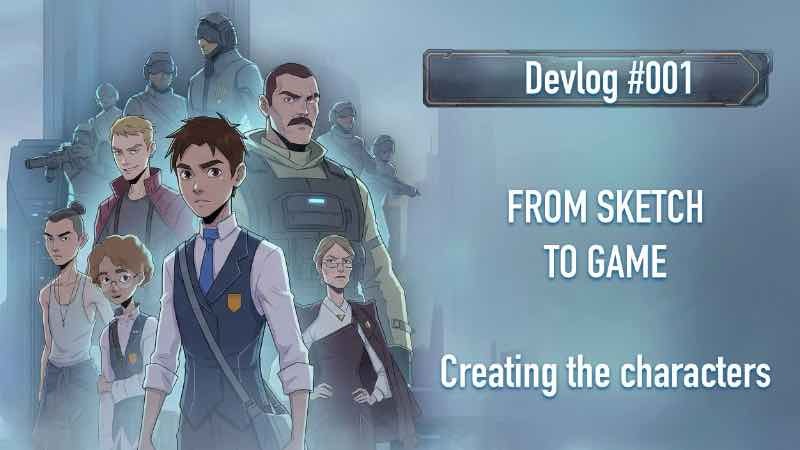
Today we’re kicking off a new series of development posts about Crimson Frontier: Youth.In these devlogs, we’ll take you behind the scenes of our audiovisual novel, introduce different members of the team, and show how the game evolves from ideas and sketches into the world you’ll eventually experience on screen.For our first devlog, we’re starting with one of the most important parts of that world: the characters.We sat down with our Lead Character Artist, Anastasia Shurkina, to talk about how a character goes from a few lines in the script to a complete visual design — and how personality, story, clothing, color, posture, and even tiny accessories can tell you something about who that person really is.
What comes first when creating a new character: their personality, their story, or their appearance?
There’s no single formula.
With some characters, their actions and dialogue are what define them first, so their story becomes the foundation of the design. With others, their appearance does most of the talking — a particular look in their eyes, a hairstyle, a pose — and the visual side becomes the starting point.Every character has something different at their core.That said, the story usually comes first, simply because the script exists long before we begin working on the visuals.
How do you turn a written character description into an actual character?
When I read a character description or some of their dialogue, I usually start seeing them in my head almost immediately. That first mental image becomes the foundation.
I begin with quick sketches of the face: the portrait, expressions, and especially the eyes. After that, I explore posture, body type, and hairstyle.Once the direction is approved, I move on to clothing and the overall color palette. That’s also when I start adding smaller details and accessories — the things that make the character feel like a specific person rather than just a design.
How important is personality when designing a character?
It’s essential.
Personality influences almost everything: the shape of the eyes, facial proportions, hair color, the overall palette, and the visual rhythm of the design.A cunning or confrontational character might have a stronger squint and sharper facial features, for example. Someone softer and more approachable will usually have gentler shapes and a calmer, softer palette.Even before a character says anything, we want the player to already feel something about them.
How do clothing, hairstyle, posture, and other details communicate personality?
You need to know two things: who the character appears to be when the player first meets them, and who they are going to become over the course of the story.
At the simplest level, you can use very clear visual language.Sharper features, strong folds in clothing, and bold or aggressive colors can make a character feel more dangerous. Rounded facial features, flowing silhouettes, and softer colors can create a much safer impression.The amount of detail matters too. Elaborate hairstyles, jewelry, unusual clothing, and richer combinations of colors can make someone feel more mysterious or eccentric.But it gets much more interesting once the character’s role in the story comes into play. Some characters are deliberately designed to give you the wrong first impression. Some may betray you later. Others might be heading toward redemption. All of those things can be hinted at through their appearance.In the end, completely different visual ideas can coexist inside the same character — because people themselves are complicated.
Which character was the most interesting for you to work on?
Probably Felicia, an agitator who appears in Chapter 3 of Crimson Frontier: Youth.
I spent a long time trying to figure out how to show her manipulative personality and her ability to adapt to different situations.Eventually, the idea that brought everything together was origami.
Origami? How did that become part of her design?
We knew from the beginning that she needed to look extravagant.
Felicia moves among the elite and enjoys being the center of attention, so I wanted her outfit to be colorful and theatrical, with large pieces of fabric that keep a very defined shape.But the design wasn’t really working.Then I started thinking about collage and pieces of cut paper. From there, the idea gradually evolved into origami.Paper became a visual metaphor for her personality.Felicia knows how to adapt, reshape herself, and become whatever the situation requires — she’s flexible, like paper. That’s why her costume has so many geometric lines and folds that resemble folded paper.At the same time, she loves attention, so we gave her large accessories inspired by paper birds.I also wanted her silhouette to feel just slightly unnatural, almost as though she is constantly folding and rearranging herself to match the people around her — all in pursuit of her own goals.
Did any character end up completely different from your original idea?
Probably Viktor, Adam’s father.
At first, I imagined him as a much thinner man with sharp, aquiline features and a kind of cold, steel-like severity. Over time, however, we moved toward a broader, stockier, more grounded design.The final Viktor feels much more like a seasoned military veteran — someone solid, experienced, and difficult to shake.
If you could introduce players to only one character from the game, who would you choose?
Chris!
I love him so much. He’s incredibly multifaceted, very interesting… and he’s handsome too, haha. To me, he feels like one of the faces of the game.He’s visually memorable, but there’s also much more to him as a character.
Which character do you personally relate to the most?
Surprisingly, probably Principal Janson.
For one thing, I’m also a blonde with glasses, haha. And I definitely understand why she’s so exhausted from working with children, because alongside my work on the game, I also teach at a design school for kids.So yes, I understand her very well.
Was there a character that was especially difficult to finally call finished?
Kazuki.
I really love both his design and the character himself.Whenever I worked on him, I kept thinking, “Maybe I can make this part just a little better.” There’s always something else you could change or improve. But eventually, you have to stop. At some point, you simply have to let the character go.
Characters, however, are only one part of the visual world of Crimson Frontier: Youth.
The places they live in, the atmosphere surrounding them, and all the environmental details that help make this world believable are created by another equally important part of our art team.In the next devlogs, we’ll introduce our background artists and take a closer look at how the locations and atmosphere of Crimson Frontier: Youth are created.
🎨 Follow Anastasia Shurkina (@Arochkin) on TikTok
The best way to support Crimson Frontier: Youth right now is to Wishlist the game.