Portals, multi-language, and the road to 128 Pioneers and the Deck
Train Trek · published
Hey Pioneers.
This one is big. We put holes in the world, we built a button that digs a train out of trouble, and we spent a week finding out whether a hundred and twenty-eight of you can share one sky. Also, reality kept doing what reality does, so there's a pile of fixes at the bottom.
Portals
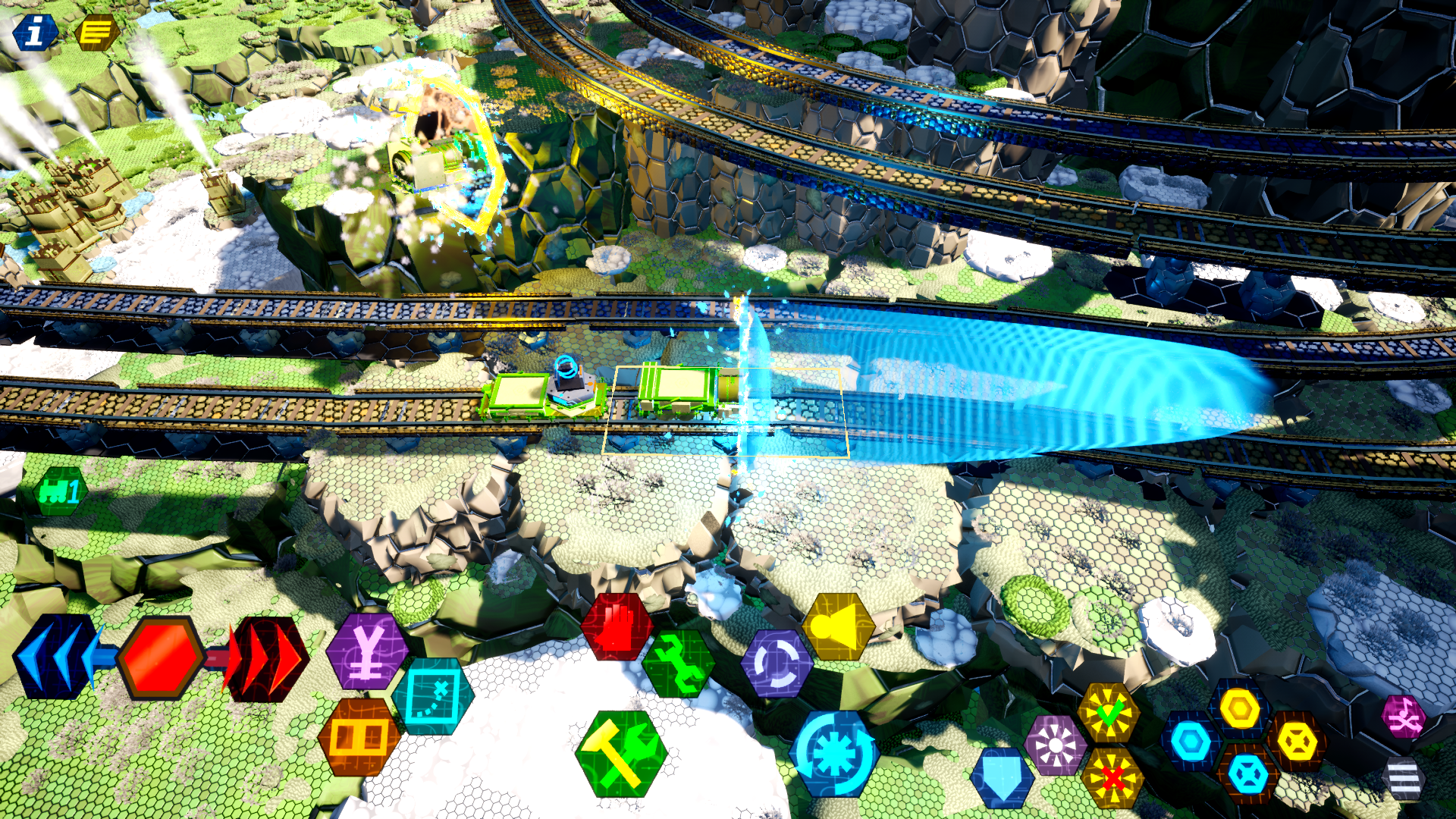
A portal has two mouths and whatever goes into one comes out of the other. That part you can guess. Here's the part we're pleased about.
The far side can open over nothing at all. Not a tunnel, not a doorway onto more track. A hole in the air, three kilometres away, with no ground under it. Drive into it and your locomotive comes out into open sky.
Your cars do what cars would actually do. They cross one at a time, and the moment a car is through it stops being on a rail and starts hanging from its coupler, swinging under gravity like something on a chain. Keep going and the whole train follows, pulled through the hole like a rope over a pulley, each car dropping off the end of the world in turn.
If that sounds like a problem, it is. It's also the point.
- A car that crossed is really there. Both mouths live in one physics simulation, so nothing is being copied or faked on the far side. Shoot the dangling half of your train and you're shooting real cars.
- Pull works in both directions. Put a second locomotive on the back and it can haul the dangling half back out again. Whether it wins depends on how much train is hanging in the air.
- Rounds go through too. Fire into one mouth and the shot comes out of the other keeping its speed and heading. Guns on the far side of the map are suddenly guns on this side.
- Hits and pulls cross the gap. Anything physical that happens on one side is felt on the other, because there is only ever one train.
A partial list of how not to do portals, every item learned the hard way:
- Don't let a car keep its rail after it has gone through. It will go on obeying a track three kilometres behind it, and the way it obeys that track is by trying to get back to it.
- Don't hand a collision to the other side as a shove. Bump something at the far mouth and the near end gets fired back out of the hole like a cork. Worse, the harder you hold the throttle, the harder you get spat out.
- Don't let the thing keeping the far half moving decide that a blocked car is merely being slow. It will helpfully push it through whatever stopped it, and then two trains are politely occupying the same piece of sky.
- Don't put two copies of one train in one physics simulation if there is any way at all to avoid it. We have developed strong feelings about this.
Every one of those was on somebody's screen before it was on this list.
The first time a train went through into open air, the note in the design doc just says "glorious". We stand by that.
The rescue button
Every one of you has, at some point, put a train somewhere a train cannot leave. Off the rails, nose into a cliff, sitting in a field looking embarrassed.
There's now one button for that. It opens a portal in the ground underneath you and drops your train through onto the nearest track. It works on a consist that's only partly through another portal, which was harder than it sounds and came up more often than we'd like to admit.
We are aware this is the most useful thing in the update and that it exists because we kept needing it.
The road to 128
Sessions run two to eight Pioneers today. We want that number to be a hundred and twenty-eight, and this is the most up to date progress report rather than a promise.
The session capacity is already configured and enforced at 128. That part was never the hard bit. The hard bit is knowing whether the networking survives it, and you can't answer that by asking a hundred and twenty-eight people to stand in a field for you. Running 128 real copies of the game needs about 400GB of memory and mostly measures itself thrashing.
So we built ghosts. The game can now fabricate up to 127 fake peers that speak the real wire protocol, answer pings, join, leave, and drive real trains. Every gate they hit is the real gate. As far as the netcode knows, they're strangers.
- 126 proxy trains, on two machines, zero rescues. A rescue is what happens when a mirrored train drifts so far from the truth that it has to be teleported back. Over a full soak at that density, on both machines, it never happened once.
- Players leaving mid-session, on purpose, repeatedly. Every thirty seconds a ghost dies cold and a new one joins. Twenty-two departures a run, eleven of them deliberately killing a machine that was elected to relay traffic for others. Every single one was correctly declared gone within about forty-five seconds.
- Elections held at 128 nodes and 13 relays while the elected set kept changing underneath them, because we kept shooting the elected ones.
- One real bug fell out of it. When a player left, the cleanup was deleting the neutral wreck of their train about a minute later. Silence is how we detect a departed player, and silence is also exactly what a departed player's abandoned train sounds like. Those wrecks stay now, and they're still couplable.
Now the part we're not going to skip.
That density costs frames. We measured roughly 350 hitches over 150ms per minute at 126 trains, against nine per run with no ghosts, and that was two editors sharing one machine, so a real client pays less. We also haven't simulated realistic movement at that density yet, only presence, and we still owe ourselves a calibration run with a couple of dozen genuine game clients to check the ghosts aren't flattering us.
So: not a hundred and twenty-eight players today, and we're not going to pretend otherwise. What we have is a road, several of the hard problems solved, and numbers we measured instead of hoped for.
And it's twice as fast
We got feedback about the pace. The polite version was about pacing. The less polite version involved people describing what a long straight did to their eyelids.
Point taken. Top speed is doubled.
The map got smaller in the only way that matters, and the stretch between two interesting things is now about half a stretch. Thank you to everyone who told us, and particularly to the ones who didn't put it gently.
Where this is heading: the Deck
Here's something you might not notice about this update. Every new control in it is a button or a key. Taking a turret, hopping between the guns on a car, holding fire, arming Focus Fire, calling the rescue. Not one of them is a mouse gesture, and that isn't an accident.
Anything you do by pointing precisely at a small target stops working the moment somebody hands you a thumbstick. Anything you do with a button survives the trip. So the guns moved onto buttons first, because that is the part that would have been miserable to retrofit later.
The goal is Great on Deck. We are not claiming it, because that badge is Valve's to hand out and we have not earned it yet. There's real work left, and the simplest example is our own: a HUD control has to be reachable by pad navigation rather than by pointer, and some of ours are not registered for that yet. But the controls are now the right SHAPE to get there, which was the expensive half.
Train Trek speaks twelve languages, reads thirteen, and shows twenty-seven
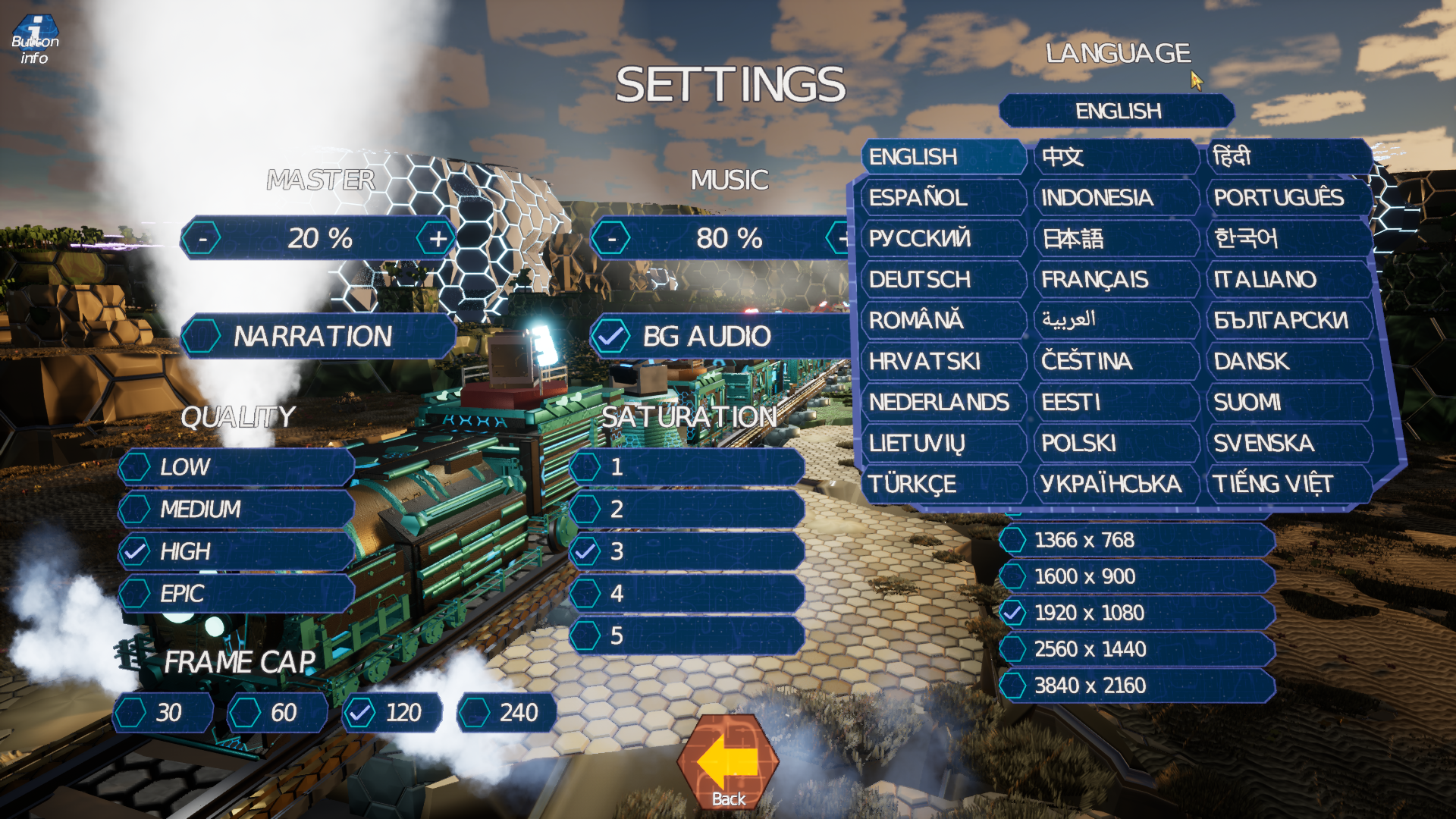
Menus, tooltips, the tutorial, the button labels on the 3D dial, and every line your advisor says out loud, including the one about the metal running low. Twelve languages plus English have all of that, and in eleven of the twelve the advisor's lines are spoken aloud in your language rather than only written.
Fourteen more sit in the language menu with their interface and their tutorial finished, waiting on the advisor. His lines are the bulk of the writing, so those arrive a language at a time rather than all at once.
The story chapters and the later mission briefings are still English. They are the next thing we pick up, and we would rather tell you that than let you find it in chapter three.
Steam sorts language support into three boxes, so here is every language in the menu and exactly which
boxes it ticks. Interface is the menus, the tooltips, the tutorial and the labels on the 3D dial.
Subtitles is every line your advisor says, written on screen as it is spoken. Full Audio is that same line
spoken aloud in your language.
LanguageInterfaceSubtitlesFull Audio
EnglishYesYesYes
中文YesYes
हिन्दीYesYesYes
EspañolYesYesYes
Bahasa IndonesiaYes
PortuguêsYesYesYes
РусскийYesYesYes
日本語Yes
한국어YesYesYes
DeutschYesYesYes
FrançaisYesYesYes
ItalianoYesYesYes
RomânăYes
العربيةYes
БългарскиYes
HrvatskiYes
ČeštinaYes
DanskYesYesYes
NederlandsYes
EestiYes
SuomiYes
LietuviųYes
PolskiYes
SvenskaYesYesYes
TürkçeYesYesYes
УкраїнськаYes
Tiếng ViệtYes
Thirteen of those have all three. Fourteen have their interface and their tutorial, and are waiting on the advisor's spoken lines, which is the bulk of the writing and the part we are working through now.
Greek, Hungarian, Latvian, Slovak and Slovenian are further back and are not in the menu yet. They have their dictionaries and they are next.
Now the part where we ask for your patience.
We are a very small studio and we do not speak twelve languages. Somewhere in here is a menu item that reads like it was written by an enthusiastic tourist. Somewhere there is a word for "boiler" that means something else entirely, and we very much hope it isn't rude. If your language has grammatical assignments, we have almost certainly assigned the wrong one to a locomotive, and if it has formal and informal address, we have probably been far too familiar with you about a coupler.
So if you find one, please tell us. We will fix it and we will not argue, because you are right and we are the people who asked a computer how to say "bogie" in Estonian.
And where a line isn't translated yet, it comes out in English rather than in something we guessed at. So you may get an English quip in the middle of a French game. That is deliberate, and it is temporary.
In the meantime, in your own words:
- English. Train Trek has always spoken English. If something reads wrong here, that one is entirely on us.
- 普通话. Train Trek 现在支持中文了。如果我们弄错了什么,请告诉我们。
- हिन्दी. Train Trek अब हिंदी बोलता है। अगर हमसे कुछ गलत हुआ हो, तो हमें बताएं।
- Español. Train Trek ya habla español. Si nos hemos equivocado en algo, dínoslo.
- Português. O Train Trek agora fala português. Se errámos alguma coisa, digam-nos.
- Русский. Train Trek теперь говорит по-русски. Если мы что-то напутали, сообщите нам.
- 한국어. Train Trek이 이제 한국어를 지원합니다. 잘못된 부분이 있으면 알려주세요.
- Deutsch. Train Trek spricht jetzt Deutsch. Wenn wir etwas falsch gemacht haben, sagt uns bitte Bescheid.
- Français. Train Trek parle maintenant français. Si nous avons fait des erreurs, dites-le nous.
- Italiano. Train Trek ora parla italiano. Se abbiamo sbagliato qualcosa, faccelo sapere.
- Dansk. Train Trek taler nu dansk. Hvis vi har lavet fejl, så sig til.
- Svenska. Train Trek talar nu svenska. Om vi har gjort fel, säg till.
- Türkçe. Train Trek artık Türkçe konuşuyor. Bir hata yaptıysak, lütfen bize bildirin.
- Bahasa Indonesia. Menu Train Trek kini berbahasa Indonesia, tapi penasihat masih berbicara kepadamu dalam bahasa Inggris untuk sementara ini. Sisanya menyusul, dan kalau ada yang salah, beri tahu kami.
- 日本語. Train Trek のメニューが日本語になりました。アドバイザーはしばらく英語のままですが、残りも近いうちに。間違いがあれば、ぜひ教えてください。
- Română. Meniurile din Train Trek vorbesc acum română, dar consilierul îți vorbește deocamdată tot în engleză. Restul urmează, iar dacă am greșit ceva, spune-ne.
- العربية. Train Trek يتحدث العربية الآن. إذا أخطأنا في شيء، فأخبرونا من فضلكم.
- Български. Менютата на Train Trek вече говорят български, а съветникът засега остава на английски, но и той е на път. Ако сме сгрешили нещо, кажете ни.
- Hrvatski. Izbornici igre Train Trek sada govore hrvatski, a savjetnik ti se zasad još obraća na engleskom. Ostalo stiže, pa ako smo nešto pogriješili, slobodno nam javi.
- Čeština. Menu hry Train Trek už mluví česky, poradce ale zatím zůstává u angličtiny a zbytek dorazí brzy. Jestli jsme někde udělali chybu, dej nám vědět.
- Nederlands. De menu's van Train Trek spreken nu Nederlands, en de adviseur is ongeveer halverwege: een deel van wat hij zegt is al Nederlands, de rest volgt. Als we iets fout hebben gedaan, laat het ons weten.
- Eesti. Train Trek räägib menüüdes nüüd eesti keelt, nõustaja aga kõneleb sinuga esialgu veel inglise keeles. Ülejäänu on tulekul, ja kui me midagi valesti tegime, anna meile teada.
- Suomi. Train Trek puhuu valikoissaan nyt suomea, mutta neuvonantaja juttelee sinulle toistaiseksi vielä englanniksi. Loput ovat tulossa, ja jos jokin meni meiltä pieleen, kerro siitä meille.
- Lietuvių. Žaidimo Train Trek meniu jau kalba lietuviškai, o patarėjas su jumis kol kas kalba angliškai. Visa kita jau pakeliui, o jei kur nors suklydome, praneškite mums.
- Polski. Menu gry Train Trek mówi już po polsku, a doradca jest mniej więcej w połowie drogi: część jego kwestii jest już po polsku, reszta w drodze. Jeśli gdzieś się pomyliłiśmy, daj nam znać.
- Українська. Меню Train Trek тепер розмовляє українською, а радник поки що звертається до вас англійською. Решта вже в дорозі, і якщо ми десь помилилися, напишіть нам.
- Tiếng Việt. Menu của Train Trek giờ đã nói tiếng Việt, nhưng cố vấn thì tạm thời vẫn trò chuyện bằng tiếng Anh. Phần còn lại sẽ sớm có, và nếu chúng tôi có chỗ nào sai, hãy cho chúng tôi biết.
Reality doesn't hold its punches
Meanwhile, in the ongoing series where you find things we were certain about:
- Enemy turrets now actually fire at you. They were armed, hostile and in range the whole time, measuring the distance to where your train spawned instead of where it is. So they decided you were miles away and dropped you. Every pass, all match.
- Wanderers arrive instead of spiralling into the sky. Each craft was reading its own gun mounts as an obstacle dead ahead and escalating to the emergency climb, forever.
- Your consist stops getting folded. A shell could shove a car hard enough that the couplers gave up and re-settled with the tender inside the locomotive, permanently.
- Capture costs about a quarter of what it did. Three quarters of every mender rocket was being thrown away. Over one measured capture, 45 of 60 rockets moved it nowhere at all.
- EMP weapons can finish what they start instead of stripping a shield beautifully and then stalling.
- Cars you cut loose can be shunted. A detached rake used to brake itself to a halt and then sit there welded to the rail, impossible to push. Only a section that takes a locomotive with it brakes now. Everything else coasts and then sits free.
- A body buried in rock stops eating your framerate. Anything whose centre ends up inside solid terrain is quietly frozen where it is. It still looks the same and you can still shoot it, it just stops asking the physics engine to solve a problem with no answer.
Go and put a train somewhere it shouldn't be. That's the whole feature.
See you out there, Pioneers.