Howdy, word-slingers,
First, thank you. In just a few weeks, more than 450 of you have wishlisted Utterance on Steam. Seeing so many Word-Slingers gather this early means a great deal to us, and every wishlist helps more people discover the game.
Over the last few weeks, Utterance has also crossed an important development threshold: we now have builds that support full Act One test runs. That means we can stop asking whether the pieces connect and start asking more interesting questions: How clearly do they communicate? How sharply do they challenge you? How much should every sacrifice haunt the rest of a run?
Most of our recent work has revolved around three goals: making monsters both challenging and fun, making bosses more epic, and making your deck feel increasingly unstable as your Sanity begins to slip.
Everything below is work in progress. Art, balance, terminology, effects, and even entire mechanics may change before release.
From concept to calamity
We have also been building the game's opening cinematic from the ground up. The sequence has moved from rough storyboards and composition tests through a final render and lighting pass, giving the threshold beneath the earth, and the force waiting beyond it, a much stronger first impression.
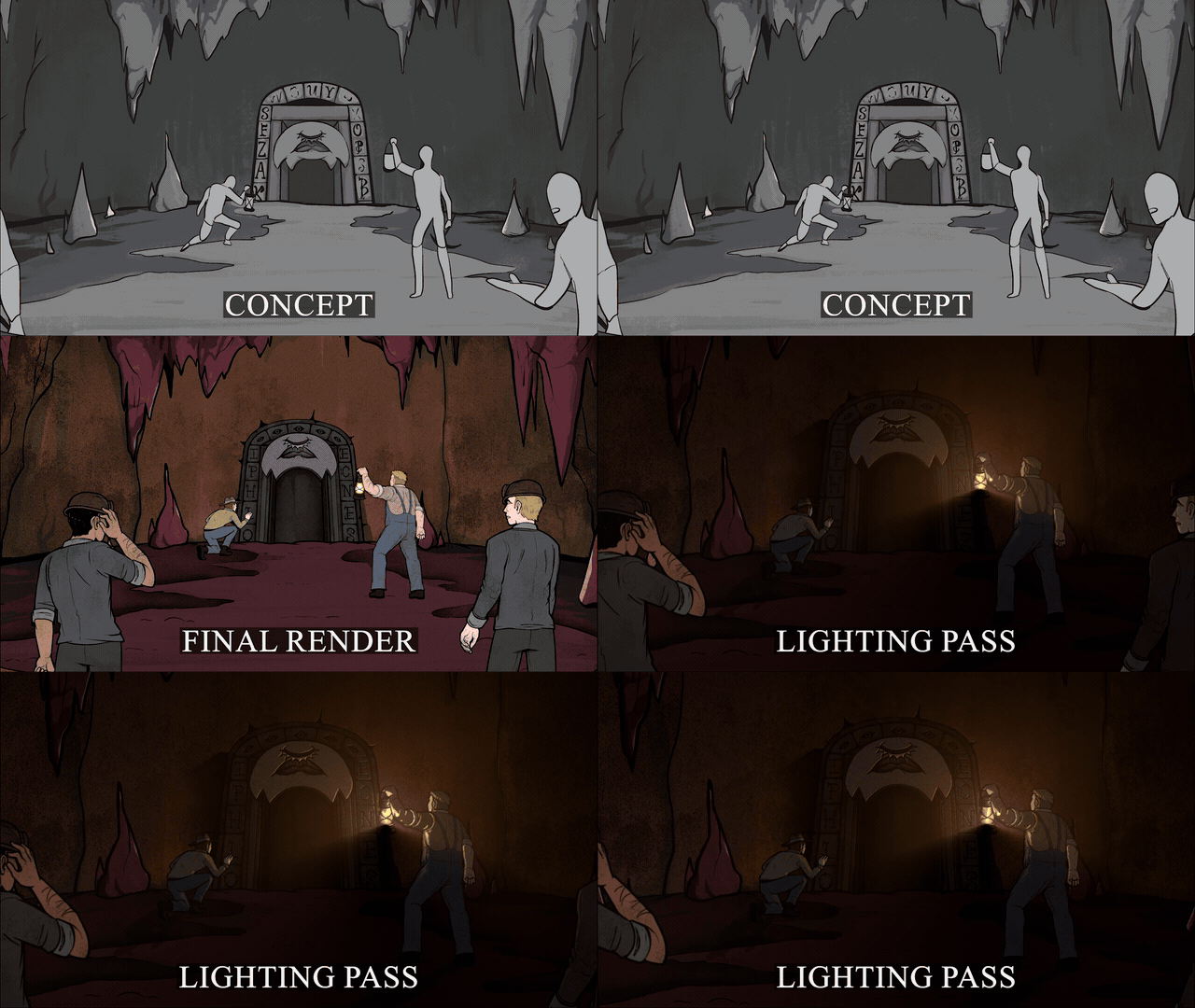
That opening is being shaped alongside narration, title-reveal timing, and the wider sound of the world. We have been testing how the score should shift once the Utterance is revealed, exploring frontier instrumentation, and building out an FMOD workflow so music, ambience, and combat audio can respond more deliberately to the game.
A clearer showdown
We have rebuilt large parts of the combat and monster UI. The latest layout gives your letters more room while bringing enemy health, upcoming actions, and weakness information into a cleaner visual hierarchy.
Enemies now arrive with a dedicated introduction that establishes their theme and offers a clue about how they want to be fought. During combat, a growing set of Omen icons communicates actions such as attacking, guarding, healing, afflicting cards, corrupting the deck, manipulating letters, or summoning help. Weaknesses have also received clearer symbols and explanations, so the puzzle is something you can plan around instead of something you only understand after it hurts you.
The damage preview now shows the result before you commit to Speak. Every letter contributes Power, word length multiplies the total, and each creature's health is divided into Seals. Triggering a thematic weakness shatters the current Seal while the word's normal damage carries into the next. The right short word can matter more than the longest one available.
We have finished our player attack animation and are pretty happy with it.
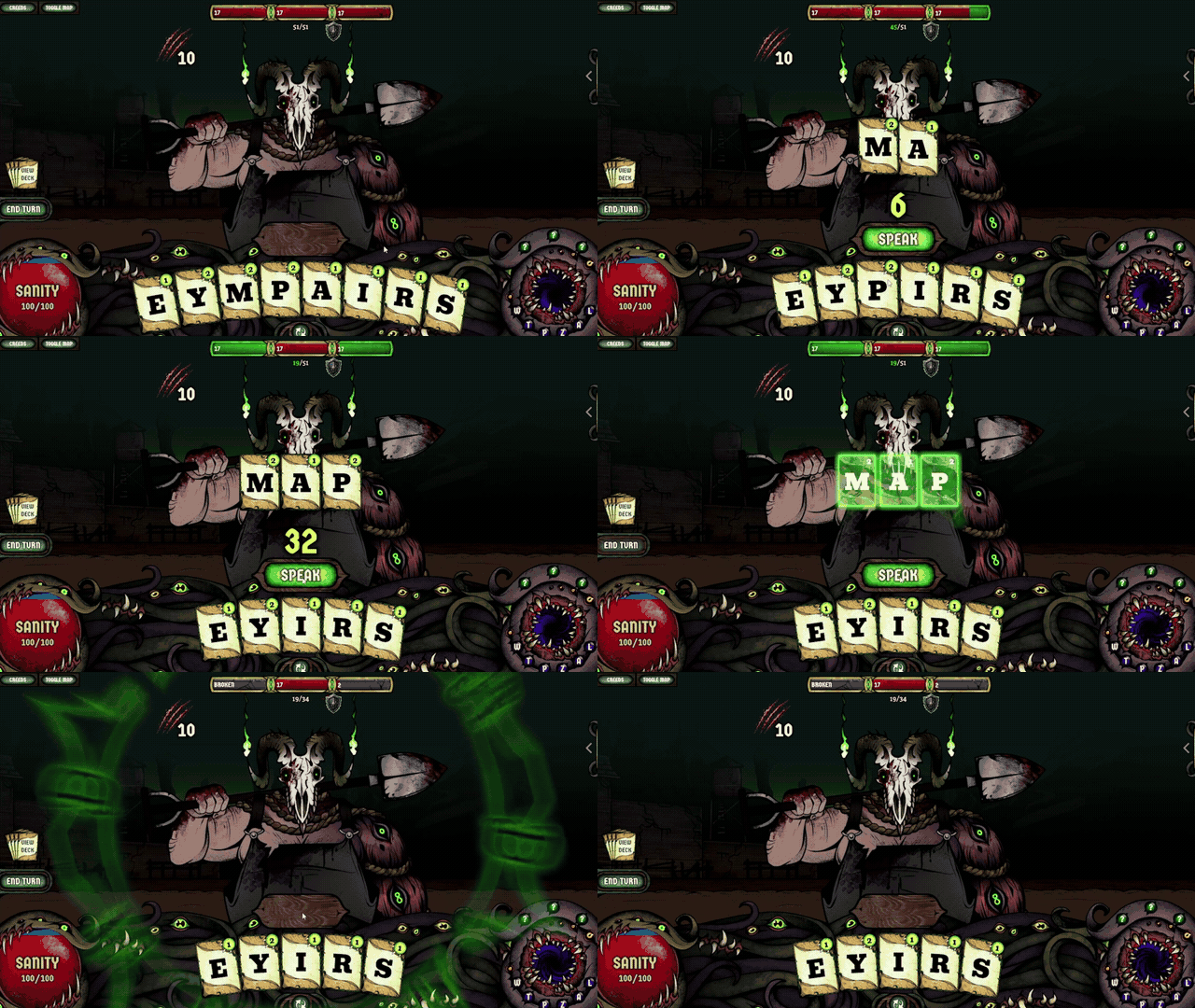
The goal is simple: Use words as your main attack and we hope we nailed it. Next on the production list is how should an enemy attack look.
Bosses should change how you think
Two very different boss problems have been moving through our internal builds.
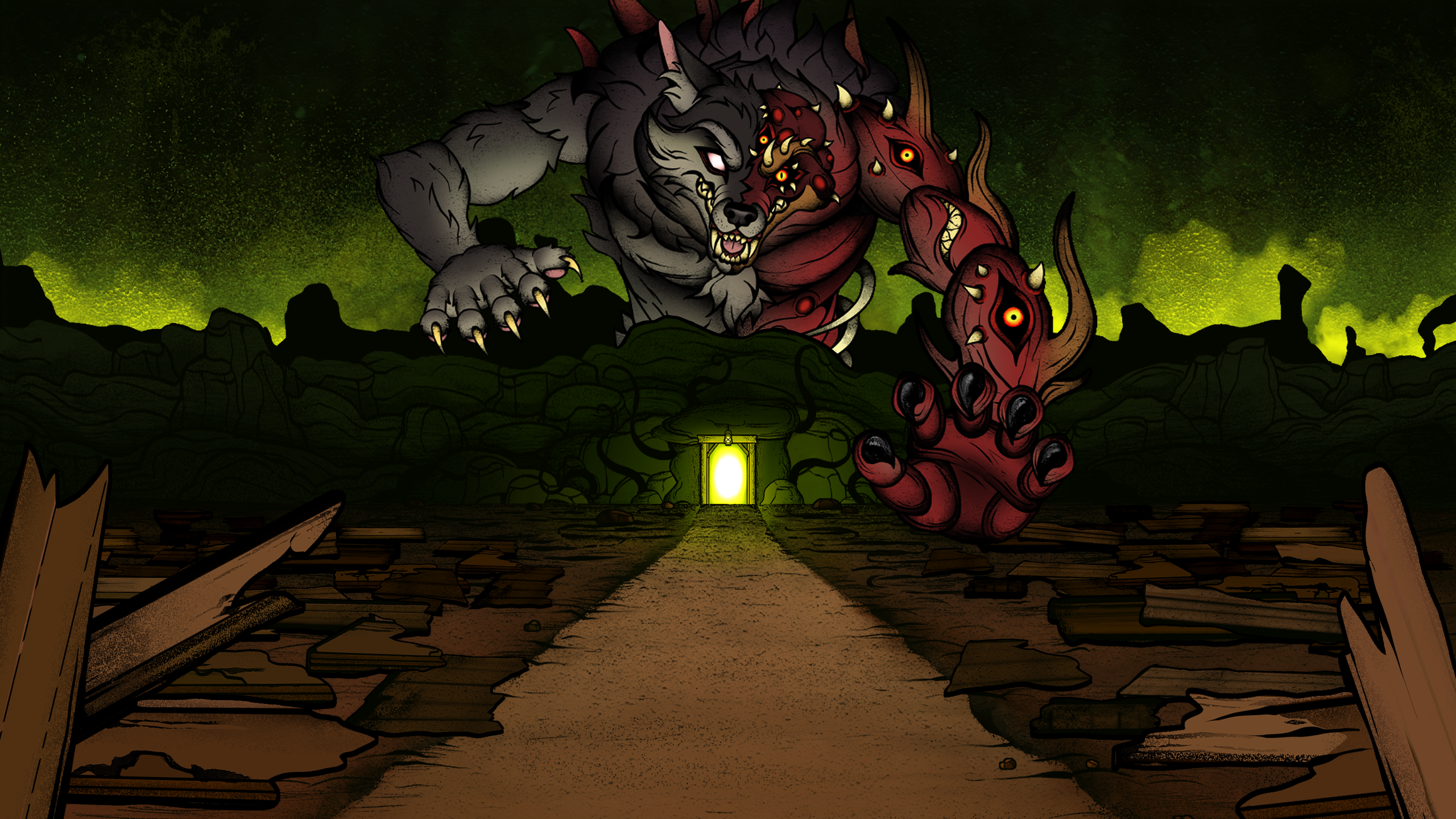
Lucian is built around a three-phase duel that changes the rules of word-building as the moon rises. In his human form, players must chain words together by beginning each new word with the final glyph of the one before it, all while Lucian fires from cover and prepares increasingly dangerous attacks.
Once transformed, Lucian becomes a towering werewolf who demands carefully ordered word sequences to break his Seals. His final phase combines both puzzles while corrupting cards, restricting your hand, and threatening to heal from your mistakes. The goal is a boss that makes players study every glyph and plan several words ahead instead of simply submitting the longest word available.
The Rat King is forcing us to solve a different problem. His encounter is pushing our systems toward multiple enemies and multiple stages in the same fight. That work strengthens the foundation for future encounters, not just one boss.
Neither fight is finished. We are still tuning difficulty, clarity, pacing, and how much unique boss logic can be added without burying the deck you spent the run building.
Building and breaking a Word-Slinger
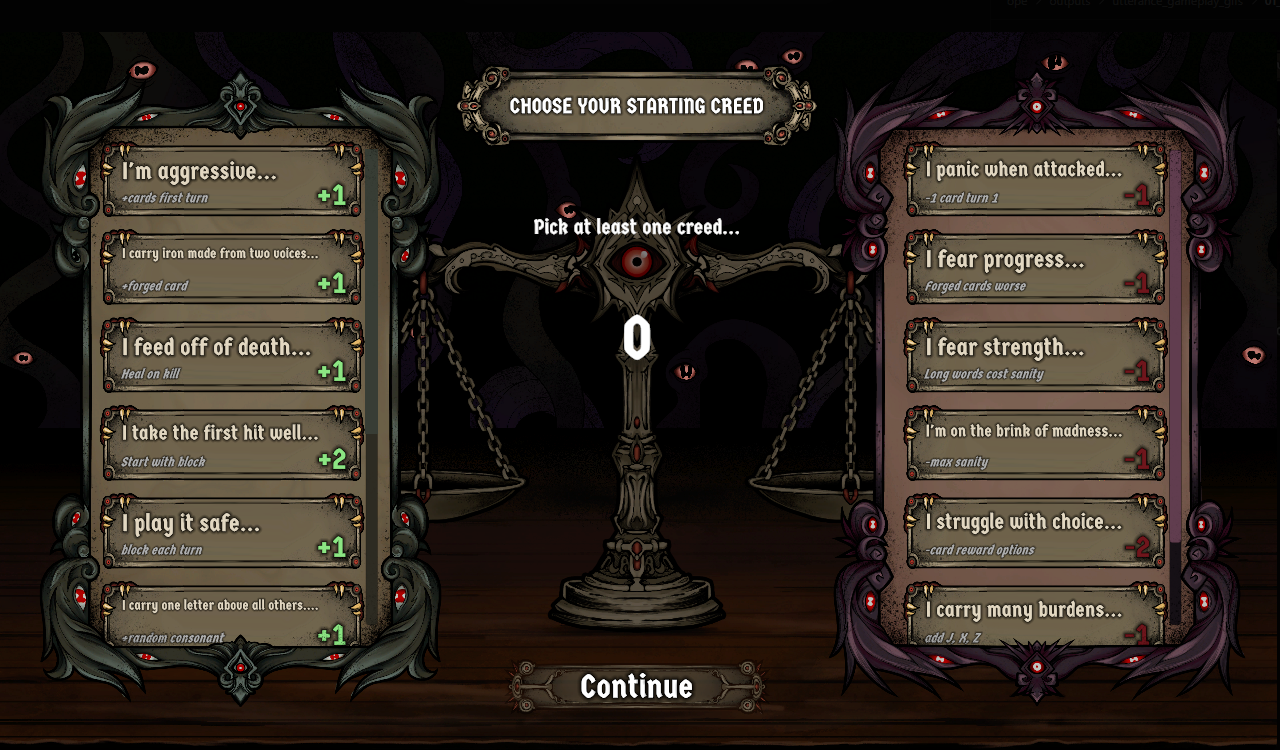
The shape of a run begins with Creeds: positive and negative promises combined before setting out. Their strengths, restrictions, and risks let us create distinct builds without handing the player a wall of disconnected upgrades, but balance will be the key.
Forging changes the deck from another direction. Multiple characters can be combined onto one card, such as TH, ER, ING, or stranger combinations. That does more than save hand space. It changes hand density, opens different word patterns, and can make future rewards valuable in entirely new ways.
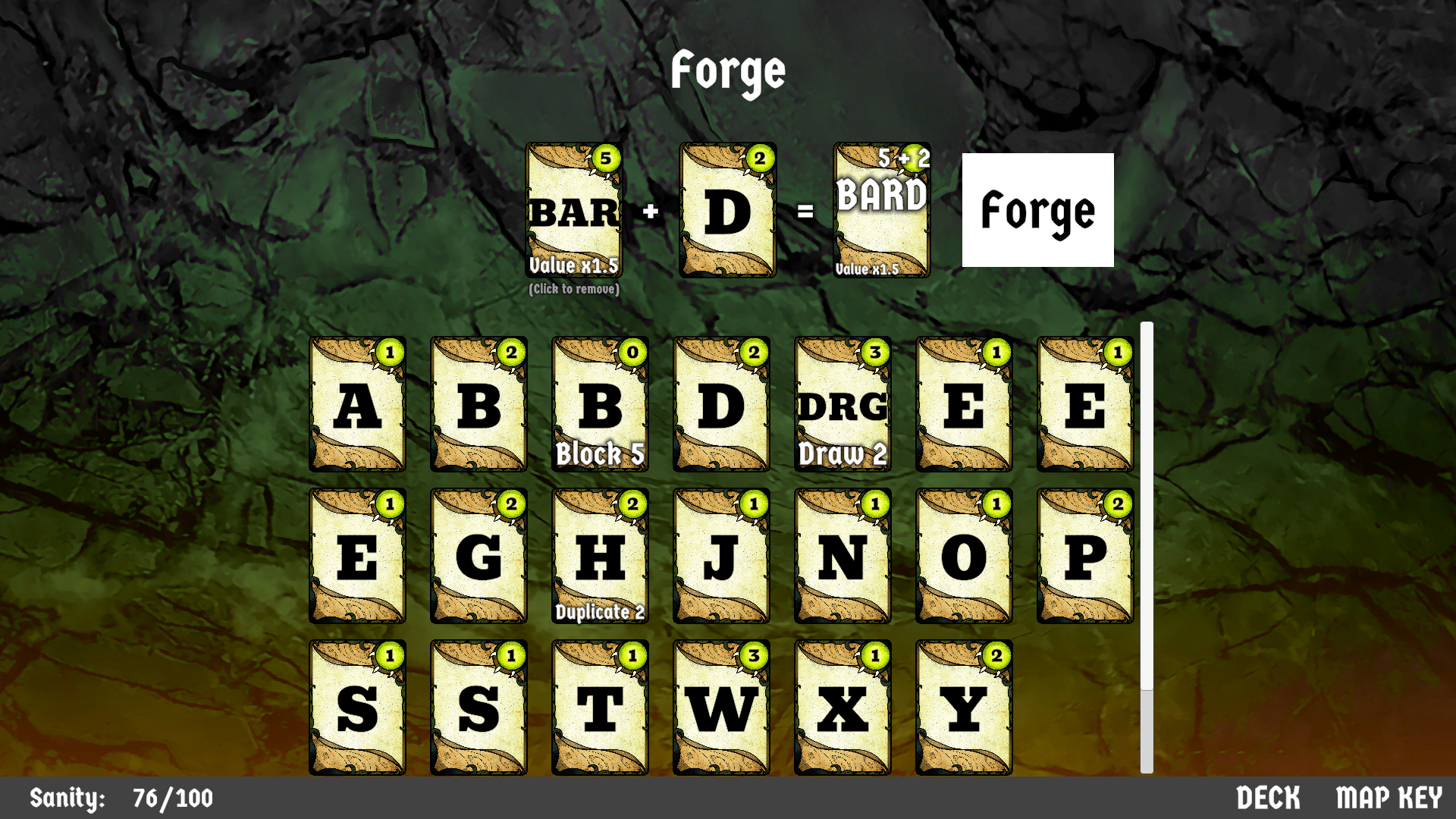
Fractured Cards are now part of the normal card-reward flow in our internal build. These will be slightly different than forged cards. These cards will have more than 1 letter on them and will split when used, allowing you to reorganize them into your word as you see fit.
Sacrifice has been evolving from a one-off exchange into a permanent deck-shaping decision. Earlier external builds let you remove a card for the rest of the run, and returning up to 4 different letter options, usually at a Sanity cost. In our newer internal build, we have also revised the replacement pool so sacrifice remains dangerous without arbitrarily stranding you with an unusable hand. Currently we are playing around with it being more of a inconsistent swap method rather than a temporary change of letters.
One of the other new ideas around sacrificing cards is our new Sanity and Affliction system.
Sanity is becoming a system, not just a number
Sanity and Afflictions are now functioning together in the build.
Our current design allows enemy attacks, repeated use of forbidden language, and desperate sacrifices to seed Afflictions into your deck. Minor and Major Afflictions add Strain; as that Strain builds, your Sanity falls through increasingly dangerous states. Afflictions take up valuable deck space and will cost health to sacrifice to remove them. So you will need to balance your health with having too many afflictions in your deck.
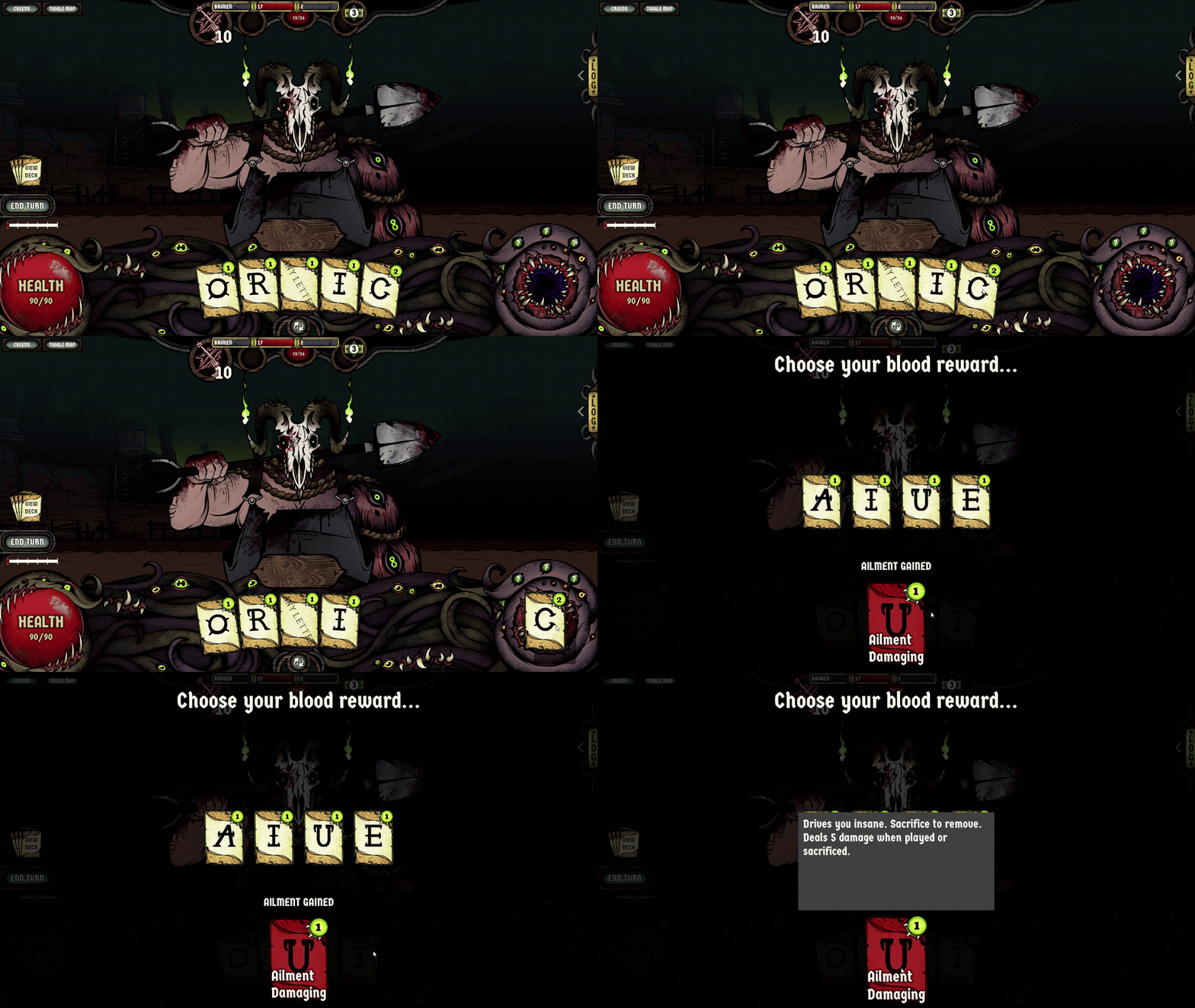
The important part is that Sanity is not intended to be a simple countdown to failure. Losing your grip should create new problems, but it may also open stranger possibilities. We want the player to look at a damaged deck and ask, “Can I survive this?” Then, almost immediately, “Can I use this?”
The underlying loop is working. The presentation is not finished. We are currently adding clearer feedback for when an Affliction enters the deck, building the first set of Major Afflictions, fixing edge cases, and tuning the thresholds and effects between Sanity states.
Making words feel dangerous
Combat has also received its first substantial VFX pass. Speaking a completed word now has a stronger ritual quality, with letters lifting into the attack and the screen reacting to the cast.
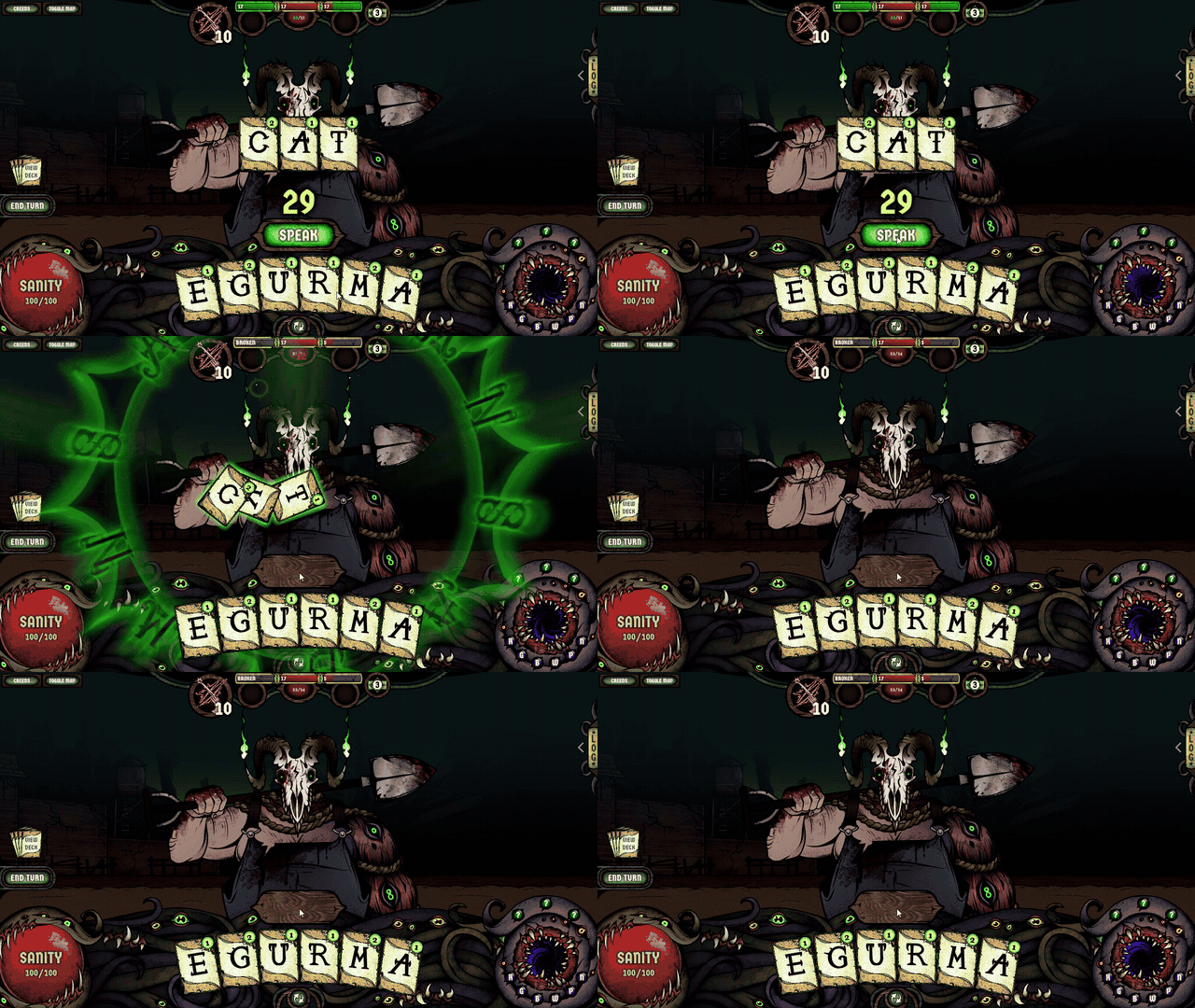
We are now testing the other half of that exchange: what it feels like when a monster speaks back.
On the art side, Lucian and the Rat King are moving through a final detailing pass, while new creature concepts are being tested for addition into the game.
What our playtests changed
Recent testers have consistently called out the sacrifice loop, the evolving deck, the enemy introductions, and the cleaner combat layout as steps in the right direction. One themed encounter in particular became a favorite because its mechanics and personality reinforced one another. That is exactly the standard we want every monster to meet.
They also found the seams, which is their job:
- The difficulty curve can swing too sharply between encounters.
- End Turn and sacrifice information need stronger visual priority.
- It is not always clear whether a sacrificed letter advanced a forbidden word.
- Several enemy attacks need better telegraphs and impact feedback.
- A few icons can overlap cards or patterns in busy combat states.
- Music transitions between the map, battles, the forge, and the menu still need polish.
That feedback is already shaping the next builds. We are not waiting until the end to discover whether a system reads correctly.
What we are testing now
- Sanity UI and clearer Affliction feedback.
- The first Major Afflictions and their sacrifice consequences.
- Fractured Cards in normal rewards and full-run deck builds.
- Lucian's encounter tuning and final art pass.
- Rat King multi-enemy and multi-stage behavior.
- Enemy-hit VFX, audio response, and attack telegraphs.
- Act One difficulty, route pacing, and a more in-world map presentation.
- Complete map overhaul.
There is plenty here we can explore in more detail. Would you like to alpha test the game? Wishlist and join our Discord to find out how.
https://discord.gg/Ung4V5jQxM
Thanks for following us into the dark.
The Boltz Entertainment team