The term "deathball" comes up whenever players complain that roaming around the map with a single army is too powerful. The complaint conflates whether deathballs are unfun to use, or just unfun to fight, but it is worth keeping both possibilities in mind. Most RTS designs address deathballing to some extent, but vary on how much they mitigate its issues or just outright discourage it.
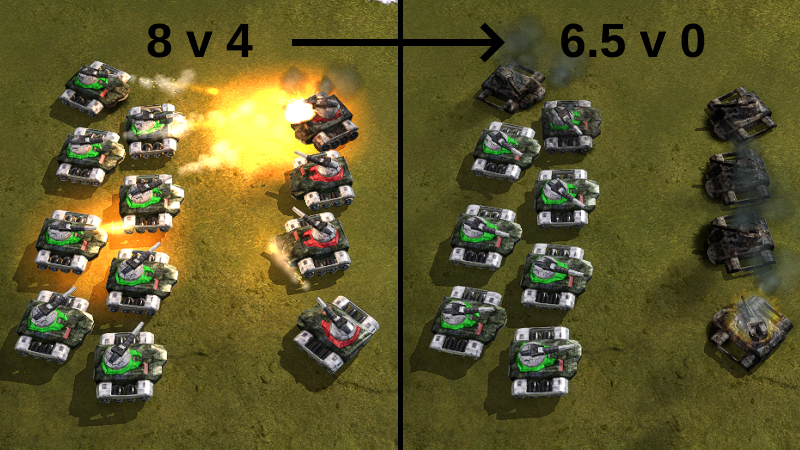
Deathballing is the natural state of RTS, in the same way that without a balanced strategic triangle, players would end up playing either all-in rushes or greedy economic booms. Another way to think about it is if you randomly throw together a generic RTS, it is going to be a game of deathballs. In fact, the deathball would probably consist of one unit type. This is a result of Lanchester's Square Law, which states that an army of ten units is more than twice as powerful as an army of five. Without any reason to give up this power, players will build deathballs.
There are many ways to avoid or reduce deathballing. At the strategic level, they can be discouraged by scattering multiple objectives around the map. These could be the metal spots in Zero-K, the control points in Company of Heroes, or even the creep camps in Warcraft III. These objectives offer greater rewards to players that split their army to control multiple at once. This approach tends to be most effective early in the game, when the map is empty, as maintaining control is often easier than taking control. A deathball in the centre of the map can control a large amount of territory by threatening to counter-attack any attempts at a flank.
Deathballs can also be discouraged on a tactical level in a few ways, although they all boil down to taking the "square" out of Lanchester's Square Law. Melee battles follow Lanchester's Linear Law, where army power scales directly with army size, as long as the extra units of the larger army cannot find space to engage. This effect makes games with large units, relative to their range, sit somewhere between square and linear. Zero-K units can pack quite tightly if they have to, and few are melee, but the way allies block our simulated projectiles has a similar effect. Another way to limit deathballing, or at least provide counterplay, is to use area of effect damage, which causes your damage output to scale with the size of the enemy army as well as your own.
Area of effect damage is perhaps the most popular anti-deathball measure in RTS, but its power often hinges on fighting the UI, so it is weaker in Zero-K. We have a lot of area of effect weapons, and it keeps swarms of smaller units in check, but mid-sized units are generally able to spread out and still form effective armies. Zero-K should involve flanks and manoeuvres, rather than just mashing armies together, and we need to support drawn out multi-front battles for large team games. This requires relatively weak deathballs, so we ended up with a loose rule against scaling buff auras.
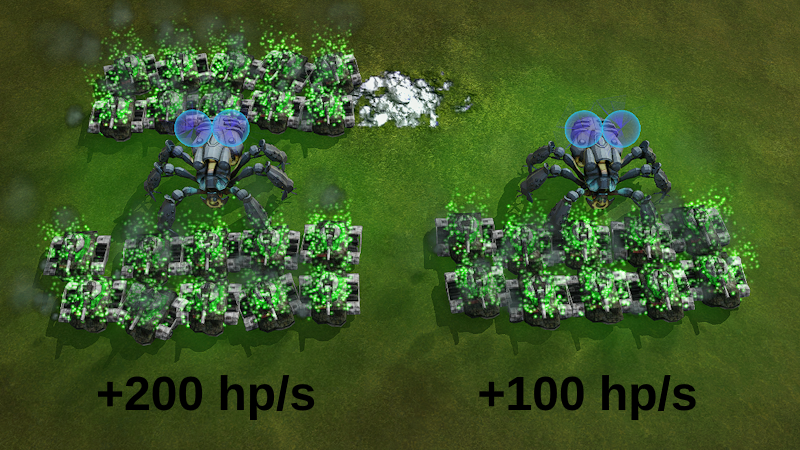
An aura is an ability that applies a constant effect in the area around a unit. A scaling buff aura is one that boosts friendly units in some way, and that is more effective the more friendlies are nearby. For example, it has been suggested that Funnelweb could passively heal nearby allies, which would be a scaling aura since the total rate of healing would increase with unit count. There are auras for any kind of buff, and most of them are in Warcraft III. A lot of the auras found in other games would also be too numbery for Zero-K, but effects such as healing or increased speed would otherwise be fine. Negative slow damage is possible.
Zero-K has a few mechanics that behave like auras, but which do not scale. Cloak fields fit into this category due to the specifics of how cloaking is used. Recall that there are two types of cloaking: strategic and tactical. Strategic cloaking does not scale with army size because revealing a single suspicious unit gets you most of the way towards discovering the whole cloaked army. A large cloaked army is scarier than a smaller one, but the army does not gain extra cloak power due to its size, in fact, a larger army is easier to find. Tactical cloaking is similar: while it makes it harder for the enemy to pick their targets, as long as there is a target to shoot, the army as a whole takes damage.
Bubble shields are similarly non-scaling, since they block the same amount of damage regardless of how many units are covered. There is an exception here in that shields that block area of effect damage can prevent that damage being taken by many units. This protection scales with unit count, which is why shields are particularly good against high AoE bombers and artillery. Shields also indirectly buff the damage output of Felons, which is why shieldballs survive as one of the most deathbally strategies.
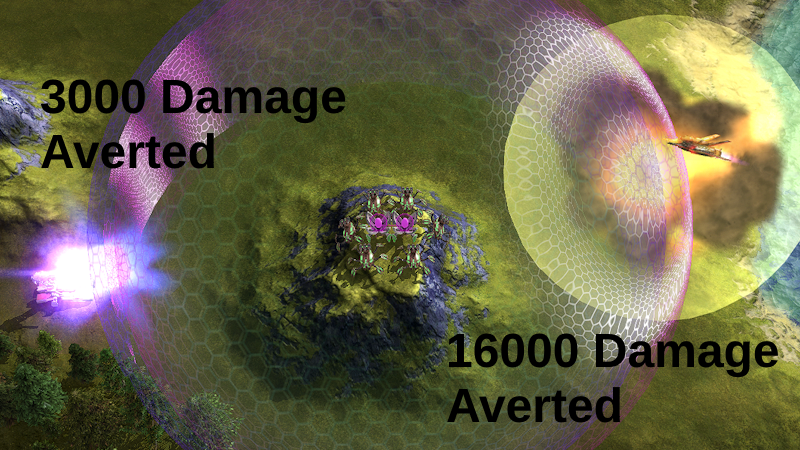
The most aura-like mechanic in Zero-K, in terms of giving a scaling buff to allies in an area, may well be the lob of the Lobster. This is an active ability, but the threat of a lob makes the nearby units a lot safer. Lobster scales with unit count, as each unit in range feels the benefit of the lob, which is why Lobster is often included in shieldballs and other types of tightly clumped armies. So it turns out that, even with a rule against auras, an aura-like effect managed to sneak in. At least Lobster has a small area of effect, and as an active ability, has a cooldown.
Many things look like auras if you squint hard enough. Anti-air units have an aura of aircraft repulsion, while riots have a similar effect on raiders, and units that are weak to aircraft or raiders like having these auras around. The purpose of avoiding auras is not to stop good army composition, rather, the purpose is to let our wealth of subtler interactions shine by avoiding simple multiplicative bonuses. Designing a strategy game often involves culling the simplest and most effective approaches in favour of strategic diversity.