BRICK BY BRICK #04: Building "Brick By Brick" In LEGO® Bricktales
LEGO® Bricktales · published
Hello there, builders!
I've previously written about why we made building with LEGO® bricks one of our design pillars, but now it's time to dive into the how, and the challenges that came with it.
When Joni Mitchell sang "You don't know what you got 'til it's gone" she hardly meant the 10 fingers and 3D vision we are usually endowed with, but hoo boy, in the context of building it surely applies. Consider this, with real, physical LEGO bricks there's all these little things we don't pay much attention to, but ultimately contribute to our building experience: Turning your construction around to look at it from all angles within seconds, focusing your eyes on a particular piece, the tactile feel to assess shapes, using your fingers to precisely place a brick while little knobs guide it into the right position, there's really no competing with that. But at least we could try to create a digital building experience that's worthy enough and maybe can even offer some new possibilities.

Our earliest documented movement prototype. Yes, we had a brake button. No, it wasn’t good.
First comes the input method of choice. Barring some future experiments we support mouse and keyboard, gamepad, and touch. All 3 work with the concept that you have a pointer to manipulate your bricks with. Intuition would say that it's simple enough, wherever the pointer goes you draw a line into space and plonk the brick onto whatever it hits, right? What you see is what you get. Well, not quite.
Depth is out the window so you end up with tricky situations where one moment you hit something that's close up front, and the next moment you move the pointer across something that's way in the back, and within few millimeters of movement you end up with a brick that's jumping around more than X-Men's Nightcrawler after 5 cups of coffee. No dice. How about a relative approach? We grab a brick and the pointer movement just tells you which direction the brick should go. This is a variant we had early on. All sorts of values drove the movement, speed ramping up and down, resistance when you were bumping against other bricks, or even when you were on a surface or off a surface.
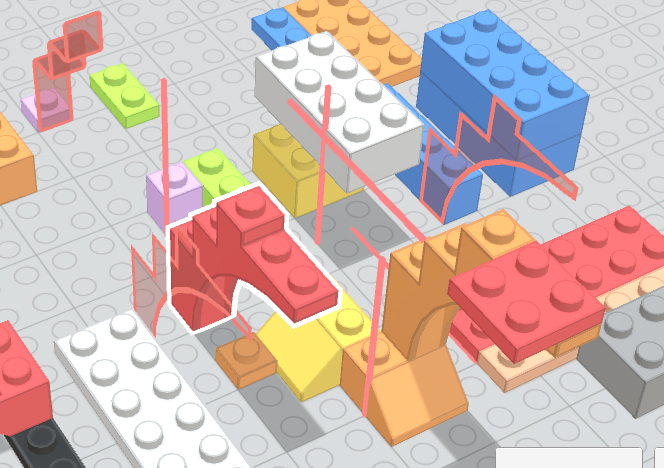
Early projections prototype. It got a bit crazy.
In some places it felt nice, but in the long run it proved tough to dial in reasonable values for different situations and input methods. Not to mention the code that governed the movement of a brick became complicated enough to give a programmer block-shaped nightmares. In the end we settled on something that I'd best describe as: let the brick follow the pointer as much as possible, but with some restrictions and tweaks in regards how far it can travel. As you play you might notice little things like a brick riding up a wall or a rubber-band effect appearing when you bump against an obstacle. There's numerous little things like that we which we put in there to affect how a brick moves.
Next up on the list of challenges, spatial perception. Interestingly enough this is a problem that 3D platformers also have lamented since their very inception. It simply isn't all that easy to gauge depth on a 2D screen. In turn, if you want to position something, whether it's Mario jumping over a pit or a LEGO 2x4 brick, you're going to have a harder time. What do they do in the case of 3D platformers? Slyly add a shadow that projects straight down regardless of the light angle. Similarly we ended up playing with some visualizations to support your spatial awareness. And similarly to our movement experiments, we went way overboard in the beginning.
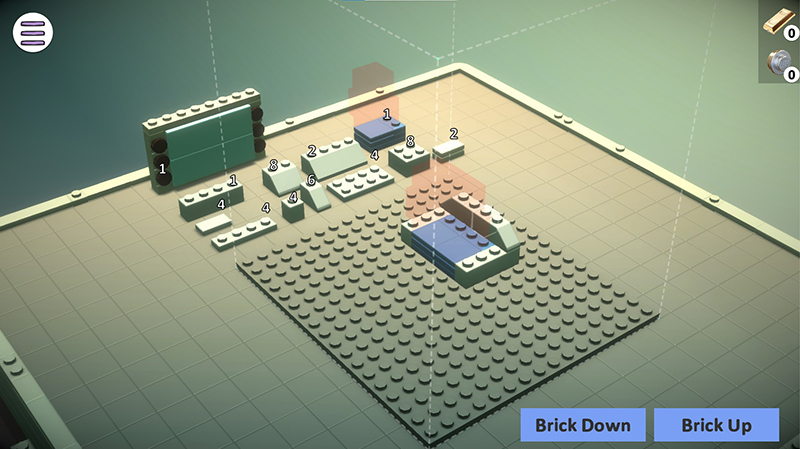
Early prototype after changing to 3D palettes.
We tried everything: lines, projections, planes, shadows, all of them combined, some more intrusive, some less so. And while most of those additions added some information for the player, we had to be careful not to make it look like some view through a cyberpunkian set of AR glasses. Your focus should be on the bricks, and ideally we'd have a view that is as clean as it can be. So again after what felt like throwing buckets of paint at a wall we ended up dialing all the visualizations back to what we have today. Hopefully enough to help you, but not so much that it becomes intrusive.
One very interesting detail that we came across when dealing with the topic of spatial perception was the palette of bricks that one builds with. Early iterations of the game put all the bricks into a 2D menu. They'd be tidily packed away and it gave us a lot of flexibility to have a variety of them. But something was lacking. Something about squeezing LEGO bricks into a 2D interface took away from the building experience, even if we couldn't quite put our finger on it.
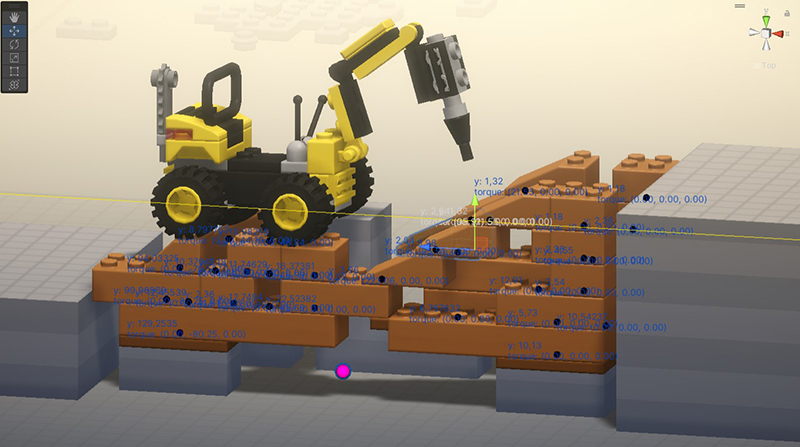
A lot of math under the hood.
A quick experiment to place the palette in the 3D space gave us the confirmation, and it's subtly ingenious. From the moment you start seeing LEGO bricks in three-dimensional space in front of you, your brain immediately starts perceiving them differently, turning and tilting them in your head, going through the countless permutations in which you can combine them. It made for a stark difference in how a player could approach a puzzle, so the feature of having 3D palettes stayed, even if it meant having to laboriously figure out how to arrange them.
I could probably dig into the nitty gritty of how building works more, but for now that was some insight to illustrate how rocky the road has been, just with the controls alone. But we are not done yet. Now that the player has the tools to build with, what is it that they should even build? Let's start with laying some groundwork. We knew we wanted the building to be goal-oriented, and we knew that we wanted to involve physics.
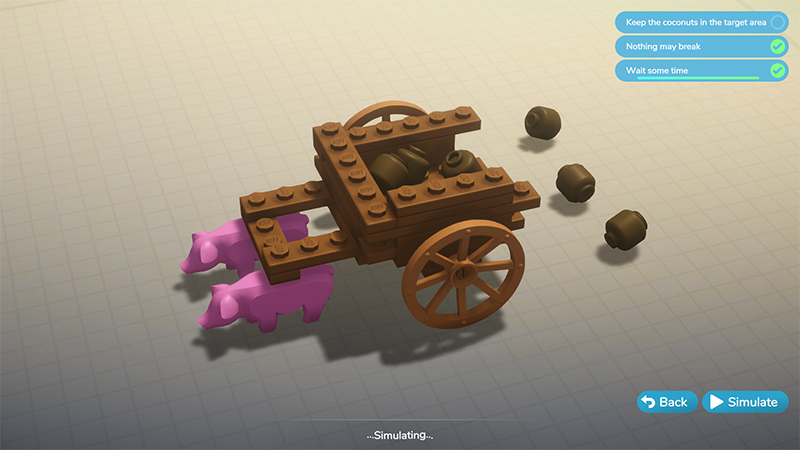
A cart to collect coconuts. Alliterations optional.
With physics, LEGO bricks again displays their unique quirks. The stability of a cluster of bricks is defined by its knobs and tubes and how they connect together. Putting weight in certain places creates unique forces of torque that distribute within. But up until a cluster breaks apart it is simultaneously amazingly rigid. With stock physics engines you have the give and flex of joint connections and small imprecisions that make it incredibly hard to model such behavior, especially when it must run smoothly. So our resident physicist and mathematician Michael ended up writing a custom physics engine just to simulate LEGO bricks realistically.
With physical simulation in our bag of tricks we could then start thinking what kind of challenges the player could encounter. How do you define goals for building? How do you define success? How do you distill something like a table, or a car into a clear set of criteria? In the end we tried to come up with a large variety of building challenges that range from the very physical, like a bridge (we really can't escape our past, can we) or walkway, to the very aesthetical, like a throne. Sometimes stability is important, sometimes balance, other times you are tasked to incorporate specific parts or place them in a certain way. And most of the time we give the player the freedom to find their own solution. Because when you can get creative, building with LEGO bricks becomes special.
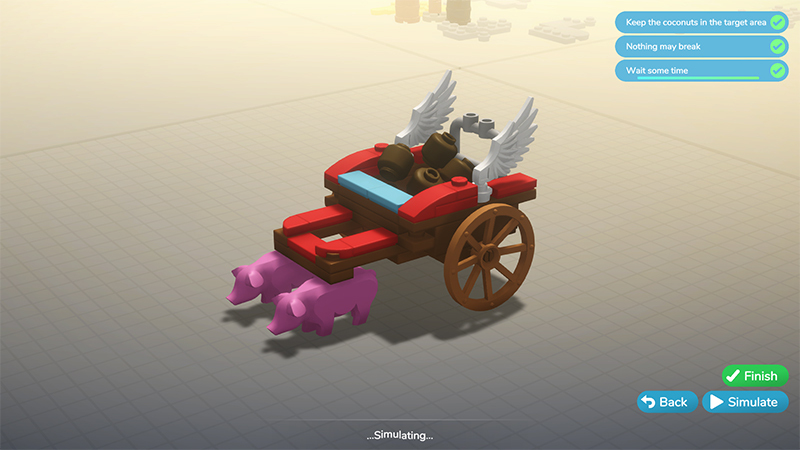
Might as well do it with style then.
Speaking of creativity, to top it off, the puzzles have what we call a Sandbox Mode. Once you solve a puzzle you can activate said mode and in addition to having you regular brick limits removed, you also get new sets of bricks that you can use to take your constructions into new, creative and beautiful directions. These bricks include different colors and one set for each of the 5 worlds you travel to, and you can unlock them as you progress through the game. So make sure to uncover all the secrets to maximize your creative potential.
This concludes our peek into what it took to realize building as a game mechanic, the challenges we as developers faced and the type of challenges you'll encounter in the game. We're almost through, in the next and final piece for this series I'll delve into the story, the different worlds you'll travel to in the game and some of the techniques we employed to build the 40+ beautiful dioramas.
Until then, stay safe and keep building.
Tri Do Dinh & the ClockStone Team
https://store.steampowered.com/app/1898290/LEGO_Bricktales/