The Very First Department Store in Taiwan - Kikumoto Hyakkaten
台北大空襲 Raid on Taihoku · published
In Raid on Taihoku, in addition to bringing the players to witness the cruelty of war and the struggles of the relationship between people, we hope to help players to learn Taiwanese history from different perspectives. Players will be able to see historical sites and landmarks in Taihoku during the period of Japanese occupation. Some of them were completely destroyed by the ruthless war and are now beyond anyone’s recognition. Others were seen as important historical buildings, but were unable to acquire a formal recognition of their historical status and failed to gain the much-needed protection due to various reasons.
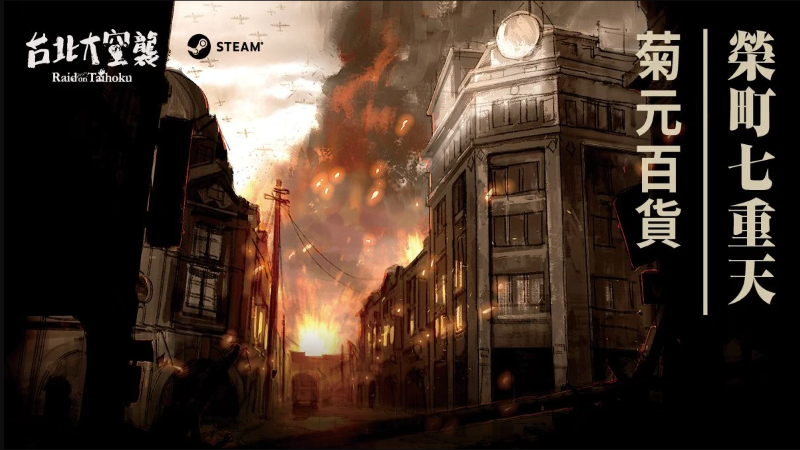
The department store “Kikumoto Hyakkaten” was one of the historical buildings under such condition. It was built in the year of 1932, and was located in Taipei Sakaemachi Street (the intersection between Hengyang Road and Boai Road in modern day Taipei). It was the very first department store in Taiwan. The building was 6 stories high, with a watchtower built on top. It was nicknamed as “the Seventh Heaven” due to its height. Kikumoto Hyakkaten had the signature facility of a modernized building – elevators, in place. It was located in the heart of Taihoku, with Japanese customers as the primary visitors. Therefore, the merchandise inside was mainly imported luxury goods, resulting in Kikumoto Hyakkaten being seen as an important pop culture showcase floor in Taiwan.
Until this day, the owners of Kikumoto Hyakkaten shifted multiple times. Sadly, the very first department store in Taiwan was unable to acquire a formal monument status from the Taipei City Government. The building is only identified as a “historical building”. Therefore, the authority cannot prevent the owner of the building from reconstructing it. There are a number of cultural and historical workers, dedicating to file an appeal on the authority, with the hope to do their part in the preservation of historical buildings. If Kikumoto Hyakkaten could be more actively repaired and preserved, instead of being kept only in texts or images, it can deliver a more meaningful cultural value.