There's no mistaking the fact that Chicory is inspired by plenty of other games, but in a lot of big ways it's like no other game we've seen before. Where did the idea start? How did we get here, and why does it look the way it does? I wanna address these questions today! Let's go...
Back to the beginning
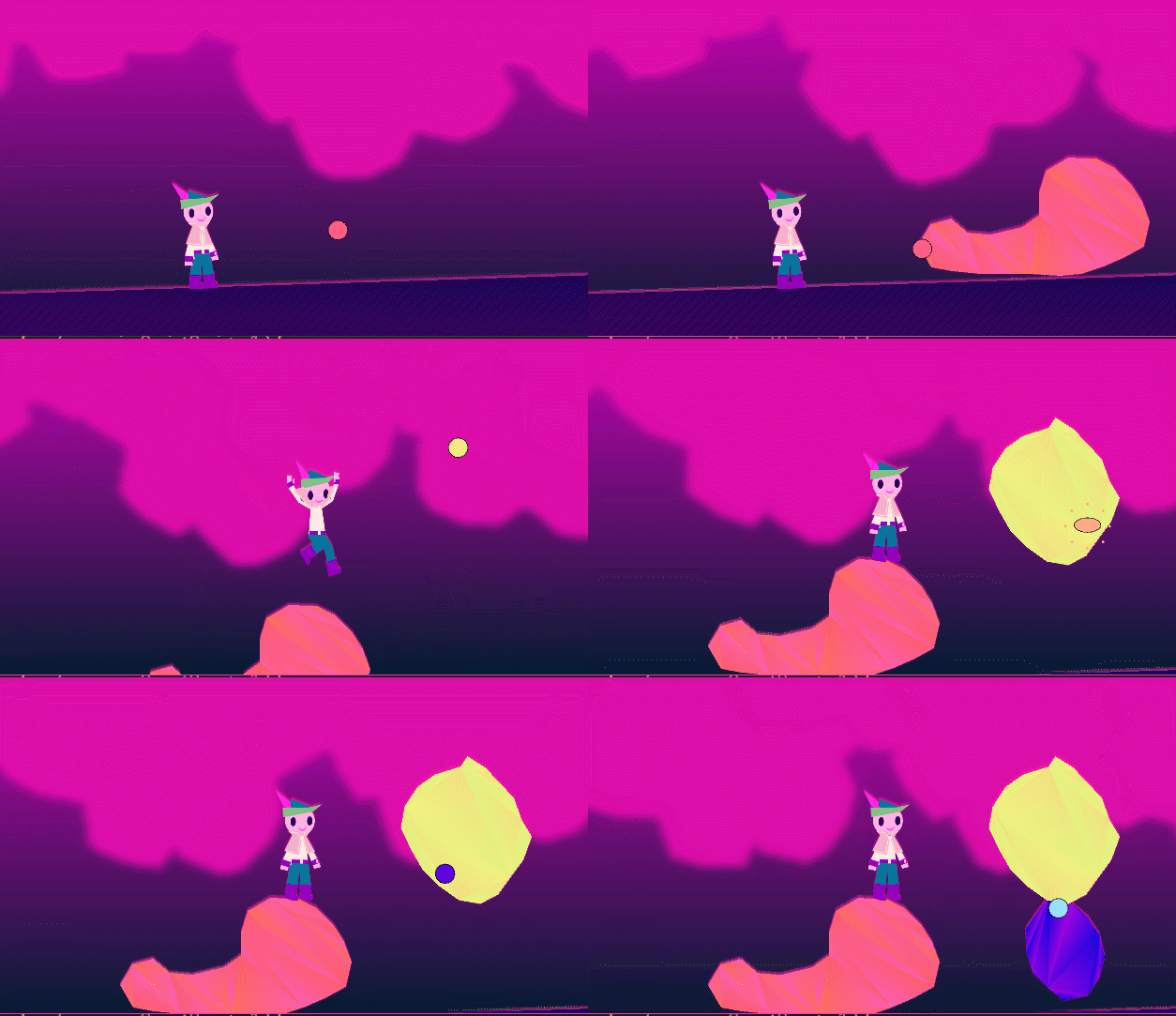
August 20th, 2018. Wandersong had entered the final stage of certification, our launch date was scheduled (9/27/2018) and I had nothing to do!!! So I started thinking about some new game ideas. I wanted to make a game about drawing, in the same way Wandersong was about music and singing, but I wasn't sure what kind of shape that game would take. I started out by modding an idea into Wandersong.
I was thinking about games like Crayon Physics, and the fun, tactile way they let you draw anywhere! I really enjoy that sense of freedom. But there were a few ways that experience didn't quite click for me. Because the game is built around goals and puzzles, you end up having to think more about problem-solving, and you're not really having fun with drawing anymore... you're solving physics puzzles! I also found the lack of limitations made it really hard to think about interesting challenges as I brainstormed my way further through the above Wandersong thought exercise. If you can just draw platforms anywhere, what would an interesting challenge be? And if I add restrictions to your drawing ie. limited "ink" and/or lots of no-draw zones, then doesn't it lose the sense of fun with drawing and just become a physics puzzle again?
I looked around for other drawing games to see how others had tackled it, but I couldn't find anything satisfying. In many, "drawing" would be something you did sometimes but wasn't the main verb of the game (ie. Drawn to Life, which is mostly a platformer). I didn't want to draw only for special events!!! I needed to ABD (Always Be Drawing). I would settle for nothing less.
Shifting Perspective
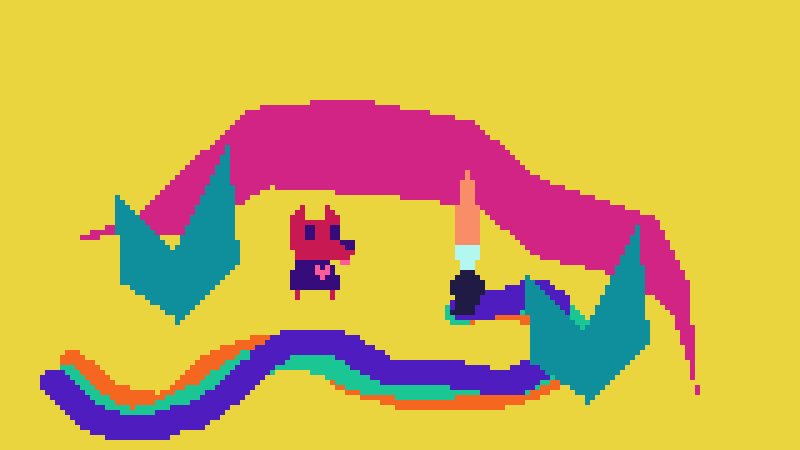
When I tried going from side-on to top-down suddenly unlocked a huge gate of ideas! The whole screen became a flat canvas you can walk on, full of things to interact with your drawings. And your drawings would just be that--drawings! They're not platforms or solid or have weight or anything, so all you have to think about is how they look. Wandersong had prepared me pretty well to make a game like this. I knew from experience that if I couched creative challenges in character interactions (ie. have a character ask you to "draw me something tough!!!") that it's going to be fun and people are going to feel open to solving problems their own way. It becomes less about strict problem-solving and more about setting up jokes where the player gets to make the punchline. And when I want to challenge the player more, I can create unique props and paint interactions that don't necessarily need to scale up for the entire game (whereas if you were painting platforms or something, that's pretty much going to be the gameplay forever...).
Coming from an intensive period of optimization and console porting on Wandersong, I was pretty worried about optimization from the get-go, so I cautiously chose to make the game really low resolution so that there were only so many paintable pixels on the screen to deal with and calculate. But the style felt like it would be creatively restrictive for a player. Also, I noticed that when the game world was so bright and vivid like in Wandersong, it was pretty tough to make your paint stand out. I love extremes, so I decided to go completely in the other direction...
Black and White
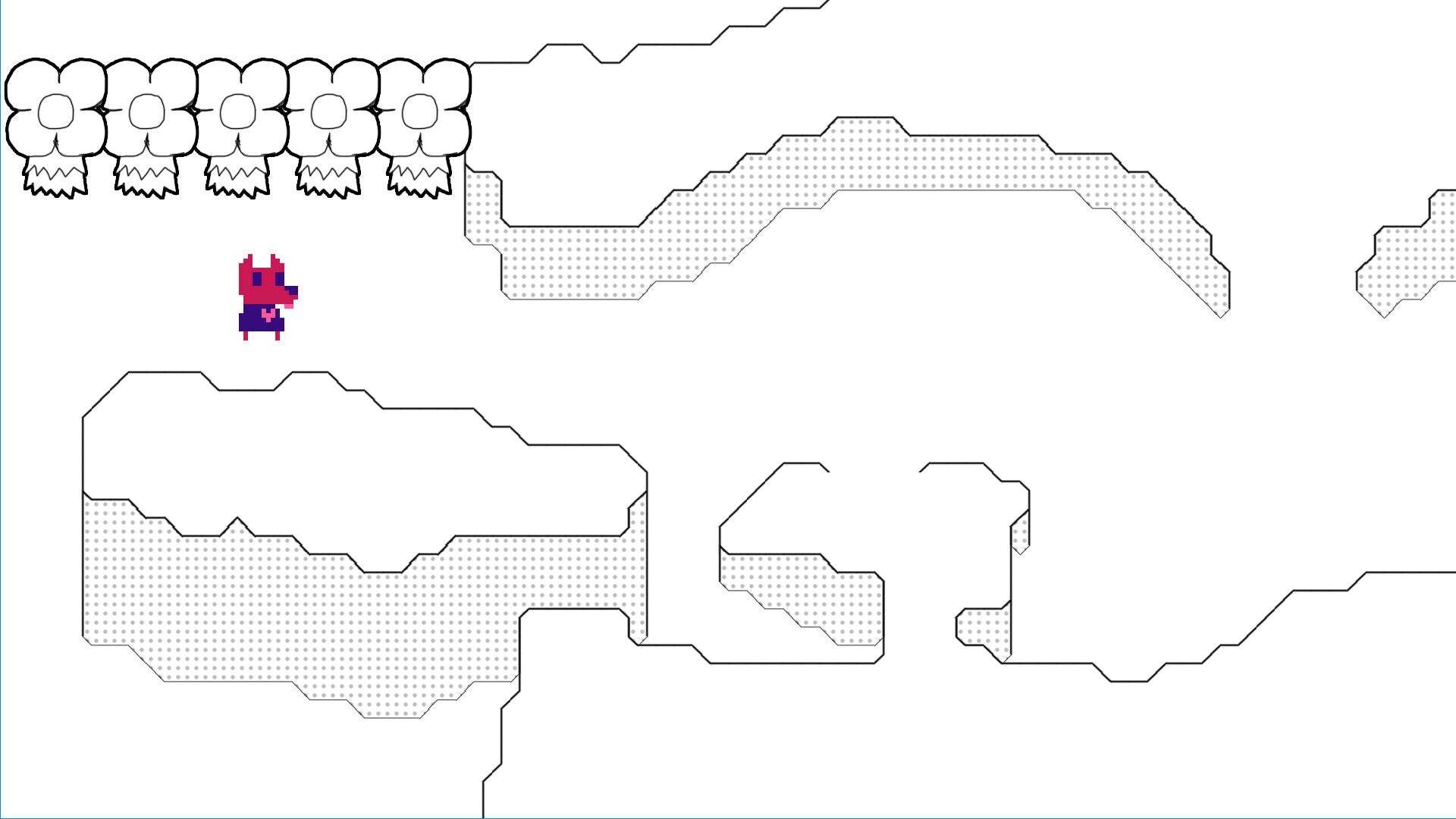
I also scaled the game up a lot, using a programming technique called Marching Squares to keep the terrain and paint high-resolution looking but still optimized. I felt like I was getting somewhere!!! The look was clean and simple, but it was lacking the character and energy it had before. And to be honest, I really like working with colors... looking at an entire game where the art was going to be black and white, I was feeling really out of my depths. Enter Madeline.
Madeline's a local comics artist with an artstyle I really adore; also, they happen to be my roommate. I sent something like the above screenshot to Madeline and asked if they could draw over it, as if it were a background in their comics or something. They sent this back:
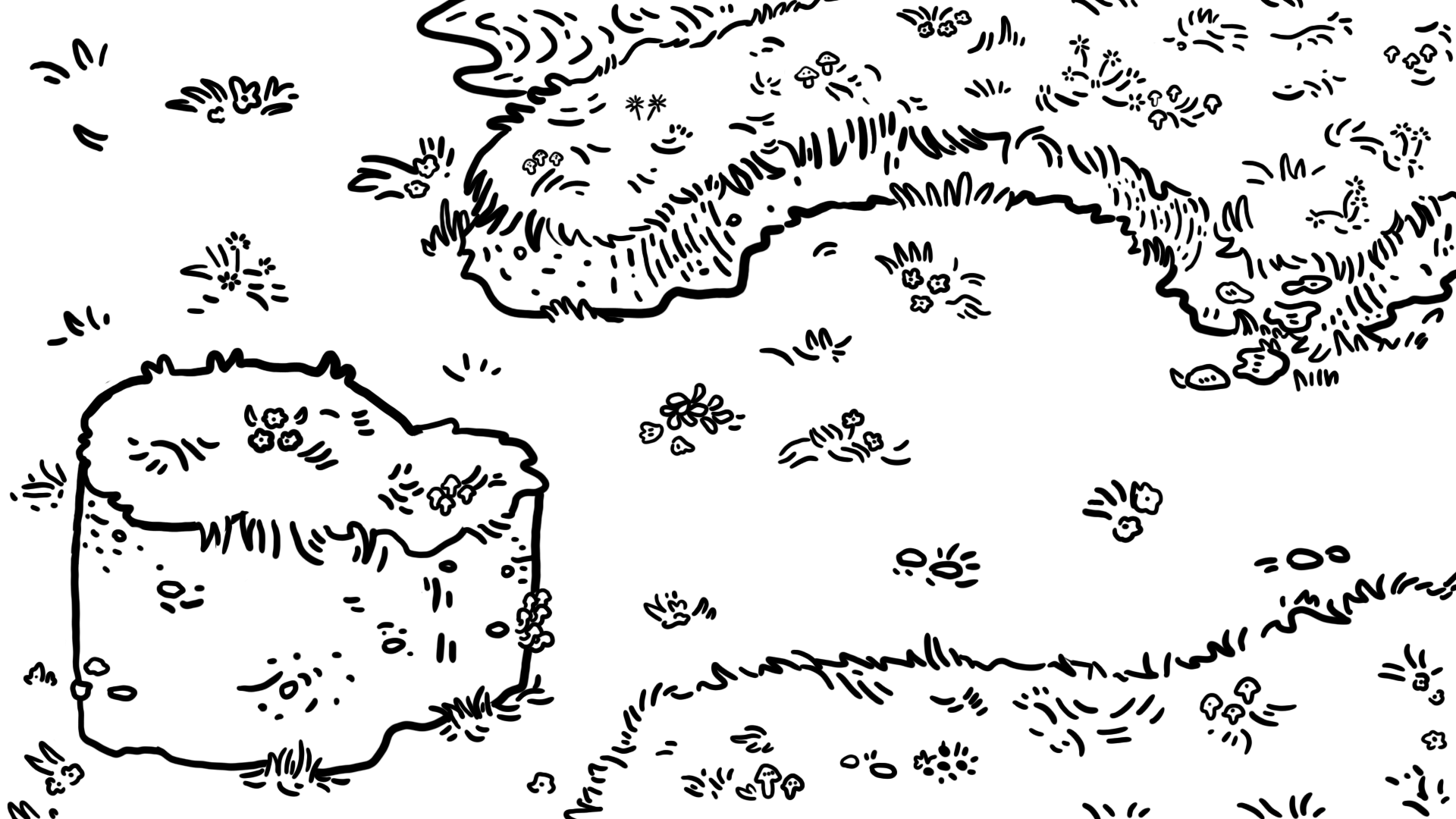
Awesome!!!!!
I dropped that drawing directly into the game and tried walking around, but found almost right away that it was really tough to parse from a gameplay perspective. When you're navigating a space in games, you absolutely need to understand basic information like "what can I walk on?" at a glance, and this art was failing that test. Also, because of the organic human-drawn lines, it was quite difficult to line up the points of collision... and since this is a game about coloring things in, that was a pretty major obstacle, since you (might) want your colors to stay in the lines.
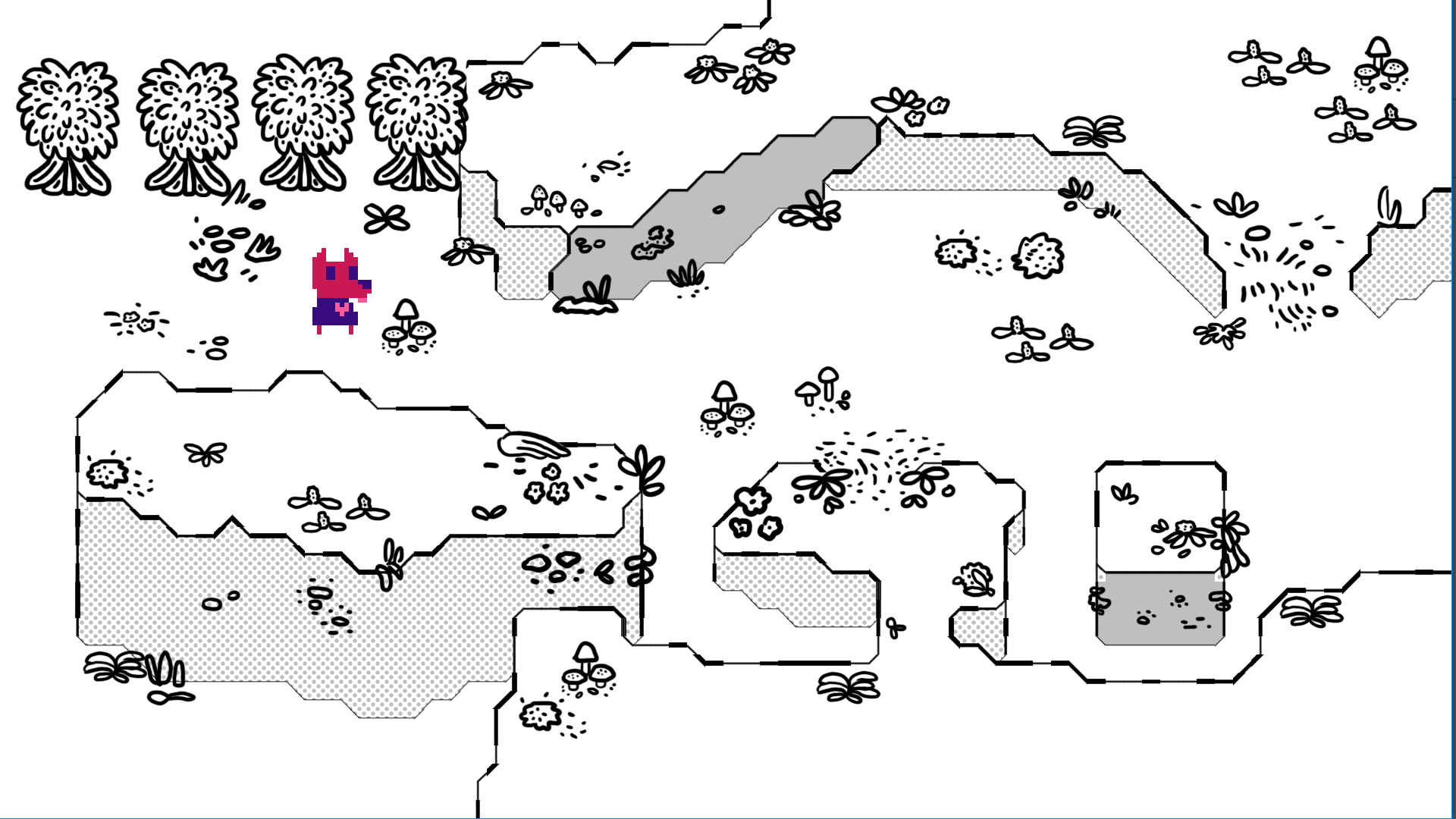
So I went back to program-generated lines, and we started to look at how Madeline could spice it up with props and decorations. This was getting closer! The game geometry was clearly separate and easy to read, but the screen had more life than before. It still was missing some of the "zing" of the fully hand-drawn screen. On some level that was going to be inevitable, because we had to compromise some of the organic-ness to make it work in a game. But there was clearly a lot of room to grow and improve to make it closer to Madeline's concept. Also, that pixel dog really needed to change... with the help of Alexis Dean-Jones!!!
The Final Step

It took a LOT of trial and error, but eventually we settled on line weights and a set of terrain patterns that worked well without needing to re-haul the rendering style in a major way. Amazing what a difference those things make, right?! Having an animated character also breathed a ton of life into the game. It was at this point that I decided I liked the look of the game, and started to build out what would become the first area of the game. In January 2019, 4+ months after my first experiment, we showed this first little peek to a surprisingly energetic audience on Twitter. And the rest is history.
In hindsight, it's easy to talk about where our mistakes were and why our different ideas didn't work. But when we were still in the process, we really had no idea! It took a lot of thought, time and dead-end experiments to find our footing and turn this game into what it is. And compared to plenty of other games, I would still say this was one of the easier, less painful stories I've heard of early development! I hope sharing it will give others courage to experiment with weird ideas, think outside the box and find new solutions to tough problems. The world needs more weird games!