Picking Up Speed
Development has been picking up speed! I've made some major improvements in the tooling I use to build Come Bye, which has let me build features a lot faster! Here are a few of the latest things I've been shipping to playtesters.
Expanding the game loop
Now that the dog and sheep behaviours are feeling really smooth and natural, I've been working on expanding into the main loop of the game. Creating and balancing the economy of the game, based on research into how real farms run, figuring out how the sheep eat grass, how grass grows, and how all that can be tied together into a fun and engaging game loop.
Grass is measured in centimetres
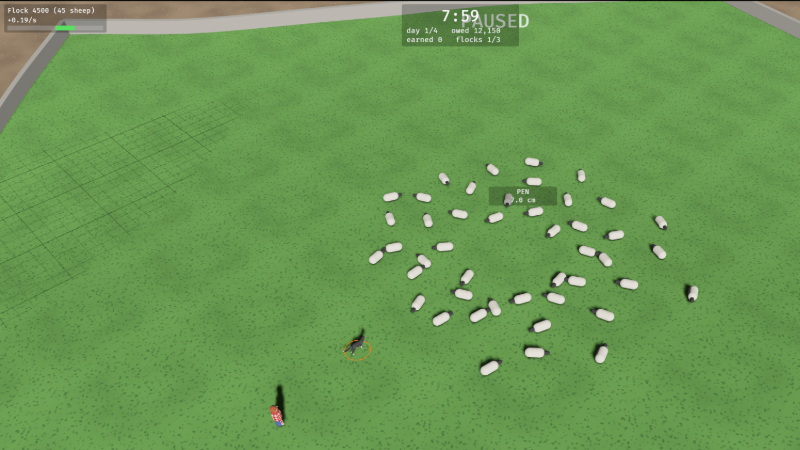
The grass model got rewritten around a real number. A field's sward is now a height in centimetres over an area in hectares, and the overlay reads 5.2 cm against a 4 cm residual instead of a percentage that meant nothing outside its own head. Every rate is stated per game-day.Real regrowth is a twenty-to-thirty-five day process, and even at peak May growth a four-day season returns about half a centimetre of the four you have to spend. So a season is not a rotation — it is a grazing budget you spend down. The nine fields you are dealt open at various heights, and that roll is the season's difficulty. Regrowth still happens; it is a slow background trickle rather than a bar that refills while you are not looking.The default farm comes out short of grass on purpose. You are not meant to be able to feed everything.
End of Day Report
Each day now ends on a report. Under the day's tally is a table with one row per open field: the sward standing in it, the head standing on it, and where that leaves it — spent in 1.4 d, full in 30 d, holding.That last column runs each field forward through exactly the same arithmetic the grazing systems use, stepped rather than solved, so what the readout promises is what the simulation will actually deliver. Colour does the triage for you: red for a field that runs out before the season does, green for one that fills back up in time, plain text for anything past the horizon.
Rolling hills
The farm used to be a flat table. It has terrain now — a height field cut from the same seed as the fields and fences, so a farm is still one seed end to end.
A lane past every field
The road used to be a trunk with a couple of forks, which left two or three fields hanging off the back of their neighbours with no frontage at all. The lane now keeps growing — cheapest spur first — until every field stands on it, and every field gets a gate in its own longest roadside stretch before any other gate is placed.Field-to-field gates are still there. They are shortcuts now rather than the only way through.
Controls Screen
It's now much easier to see the list of controls in case you forget them while playing.