What is this about.
Patch 3 gave you three difficulties and promised HARD would keep a scouting book on you and play near-perfect fundamentals. It did do those things to some extent, and it felt reasonably better during QA, even if always betting and folding to anything after remained profitable.So, then I coded the IAs anew and ran them through a headless harness. Thousands of hands and four blind IA playtesters also tried it... I could not make HARD measurably harder than NORMAL. What it mostly did was sand off the personalities out of the table until every seat played like the same competent stranger. So HARD comes off the menu until I can figure out a safe, fun, and reliable difficulty lever that keeps archetypes and personalities on the table.
So:
EASY — the classic AI you know. Unchanged, still super exploitable, still there. Good if you want to cruise through the game and just pass some time.
NORMAL — Everything below. New careers start here now. We will keep aiming at what feels like a real table with this one. Shouldn't be a breeze, at least not from the mid-game onward.
Careers already in progress keep what they're on. If you were on HARD you move to NORMAL and keep the new opponents. Nothing is lost and, presumably, you wanted whatever the hardest mode of the game could bring.
The good part of the old HARD that is now a switch
The scouting book was the one piece worth keeping, so it's been pulled out of difficulty entirely and given its own setting: Scouting Book, in Options, ON by default.
With it on, the players at your table watch what you do even when they are not at your table. How often you defend your blind, whether you fold the flop, whether your raises mean anything. The lore, again, is that after the televised events, the ones with cameras, they keep the tape. You gain notoriety, so they get to study you. It is not under Difficulty, and that's deliberate. I measured it, and I cannot honestly tell you it makes the game harder. It makes it different. So it's a switch you can flip any time, from the pause menu, mid-run, without resetting your career. This is not the same as reacting to your style while at the table, that is always the case.
The raise-every-hand exploit is dead
Reported by a player, something that was known and ignored by me as ok-enough: open-raise every hand, fold to any resistance, come out ahead. Measured, that line won +74 to +102 big blinds per 100 hands against the old bots (still there on EASY). A strong human professional wins 5 to 10. The cause: villains folded to a single 3bb open somewhere between 90% and 99% of the time — every archetype, every difficulty. A "shark" defends under 4% of hands, whereas a competent player defends about a third. Opponents now play real starting-hand ranges from every seat, at frequencies that match published 6-max charts. That line now loses. There's an automated test that replays it every build, so it stays dead on NORMAL.
They couldn't lay down once committed.
When a villain worked out its equity, it dealt you a completely random hand, even when you'd just fired three streets. That inflates their equity, in their minds, so they called everything down. A solid regular folded low single digits of flops to a two-thirds-pot bet. A real player folds 40–50%. It wasn't calling you down because it had read you. It couldn't fold. Almost 40% of hands used to end with somebody down fifty big blinds or more. In real 100bb poker, as far as I can tell, that's supposed to be a few percent.
Nine opponents, and none of them look like what they are
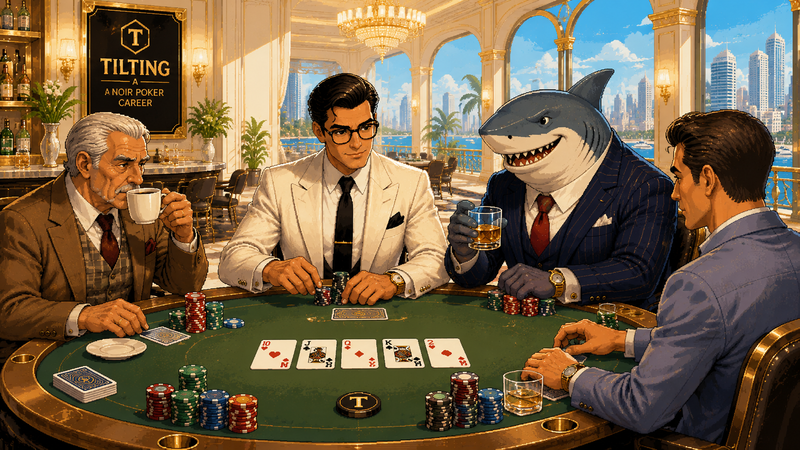
There are some distinct archetypes at the tables now. Each is built around one signature you can take from watching: how they size their bets, how often they fire... even how long they sit there before they act. There is no stats overlay, and there won't be one. If a read can't be taken from watching the table, it doesn't exist. I'm not going to list them. Working out who you're sitting with is half the game, and the portraits will not help you: the face and the way they play are dealt independently. The rich socialite in the good coat may be there for the coffee and nothing else. The low-life who looks like he's angling to hustle you may be the best player at the table. Play the player. Not the picture. (If there is interest in linking portraits and styles, we can do that, though I fear it turning into a LA Noire deal where it ends up looking a bit cartoonish and obvious... even though I love that game).
Still a solo project, and the observation from the store page stands: these opponents play reasonable poker, not solved poker. But they fold now. They bluff for actual reasons, they'll pay you off less, and if you let them, they'll remember you.