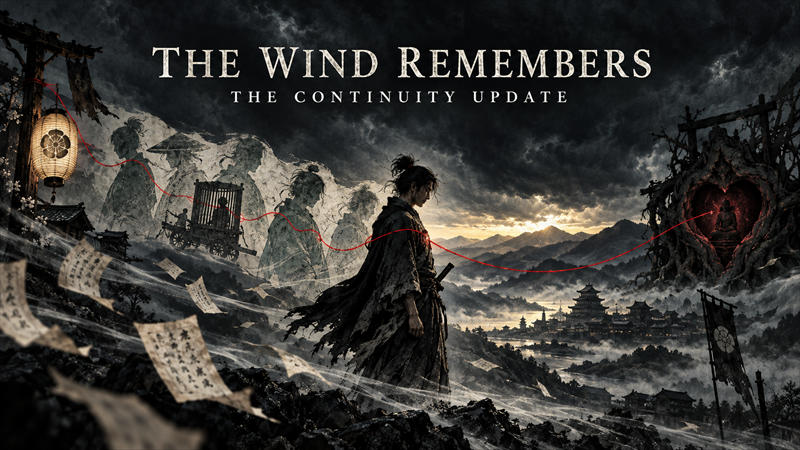
The world may value a person as labor, flesh, family, prisoner, heir, or prey.
But the value is not the person.
This update rectifies the deepest launch issues in Way of the Wind.
Until now, different parts of the simulation could sometimes maintain competing versions of the same person. A family member might be correct in one menu but misidentified in another. Children could be attributed to the wrong household. Captured combatants could fall between systems. In some cases, opening an interface could influence events that should have belonged only to the passage of time.
These were not isolated cosmetic bugs. They violated the central promise of the game:
What happens to a person must remain true everywhere.
This update rebuilds that foundation.
One world. One People Store.
Every historical people registry now resolves to one canonical source of truth.
A person encountered through the Hearth, People menu, battlefield, household, caravan, Pot, Heart, Barge, Weaver ecology, or another system is now the same persistent person—not a convenient reconstruction created by whichever menu happens to need them.
Materialization may reveal an identity that was already decided. It may never reroll the decision that caused that person to exist.
Family and Hearth repairs
Pregnancy, birth, parentage, relationships, households, and heirs now share the same continuity authority.
This addresses problems including:
Children appearing too quickly
Children being assigned to the wrong parents or household
Unrelated household children appearing as player heirs
Hearth and True Love progression disagreeing
Family simulation advancing through unrelated input or observation
Duplicate template names surviving identity reconciliation
Established lineage changing when a person was rematerialized
The Hearth now reports the family you actually have—not the family another subsystem approximated.
Capture, rescue, and transformation
The custody pipeline has been reinforced from battle through its later consequences.
Capture, transport, rescue, digestion, transformation, release, and arrival at the Heart now preserve exact identity and causal history across their transitions.
This includes repairs for:
Battle casualties failing during transfer into physical custody
Captured people occupying contradictory locations
Destroyed transports retaining impossible occupants
Heart arrivals rolling backward into earlier lifecycle stages
Rescued people remaining trapped in obsolete custody
Missing or duplicated transformation events
Save and load boundaries erasing or inventing custody facts
If someone is taken, the world must know who was taken.
If someone is rescued, their captivity must actually end.
If someone is transformed, the game must remember what they were before.
A faster, quieter People menu
The People menu no longer tries to become the entire world simulation every time it opens.
Its projections have been constrained and streamlined so that observation remains observation. Opening, filtering, and navigating People should not decide lineage, advance households, materialize unnecessary populations, or mutate canonical state.
The menu remains dense because the people matter, but it should now be substantially more responsive and navigable as the population grows.
Hostile testing
This repair was tested with an automated continuity gauntlet designed to be the worst Way of the Wind player imaginable.
It repeatedly attacked the simulation with badly ordered lifecycle transitions, rapid capture and rescue sequences, repeated family progression, saves during active custody, contradictory container states, transport destruction, identity migrations, large populations, and menu observation inserted into active timelines.
Every repaired failure became permanent regression coverage.
The release package completed 212 automated tests, focused battle-custody regressions, a universal People Store audit, and packaged executable, asset, and soundtrack verification.
This is not primarily a content expansion.
It is a declaration that the existing world deserves to be truthful.
The people wandering through Way of the Wind can be loved, employed, married, captured, consumed, transformed, rescued, remembered, and mourned. Those systems only matter if they agree about whom those things happened to.
Now they share one history.
The flesh may fail.
The household may scatter.
The world may call a person by a hundred values.
How this differs from previous updates
Previous updates often repaired individual symptoms while preserving too many overlapping versions of the same systems. That made the game larger and more complicated without always making its world more truthful.
This update takes a different approach. It removes conflicting mirrors, reduces unnecessary simulation work, and restores a lighter but more faithful version of Way of the Wind.
The result is not simply more content or another layer of machinery. It is a game that is more capable of remembering what actually happened. Families correspond more closely to their real members. Captivity has physical consequences. Rescue means release. Menus observe the world instead of secretly rewriting it. The simulation is allowed to be strange, but it should no longer be strange because several systems disagree about reality.
I do not want to pretend that this means Way of the Wind is now perfect.
The simulation remains unusually large and interconnected. Very long playthroughs may still accumulate enough people, history, relationships, and active processes to gradually affect performance or expose rare continuity problems. Runnability may decay under the weight of a sufficiently long campaign.
What has changed is that the game is now genuinely more playable, more accurate, and easier to repair without sanding away what makes it Way of the Wind.
Issues discovered after release will continue to be investigated and updated. Future repairs will build on this shared source of truth rather than introducing another competing version of the world.
This is not the end of development. It is a much stronger place from which to continue.
The flesh may fail.
The household may scatter.
The world may call a person by a hundred values.
But the Wind remembers.