Strategy games are seemingly synonymous with scale. The focus on scale is a bit less for real-time strategy, at least if the fact that my RTS games are not marketed as "epic" is any guide. But even "small" RTS games scale up, or escalate, as the game goes on, and doing so is a powerful pacing tool. So in this post we will look at some ways to approach scale and how we handle scale in Zero-K.
Contrast is an important part of imbuing a sense of scale. A game that is entirely about huge armies of huge units may feel big for a while, but players will acclimatise to it so the scale ends up feeling somewhat superficial. Big things need to be near small things to reinforce their bigness, at least in a genre where the player looks down at everything from above. Lumbering units and massive armies can definitely help sell scale, but they should not be the whole game. This seems to be widely accepted, as even games with huge robots or capital ships start the player at a smaller scale.
Luckily for us the core RTS loop involves starting small and building up. Bases expand to collect more and more resources from the map, which are spent on larger and larger armies. Even RTS campaigns, which often give players prebuilt bases, tend to scale up from mission to mission. Escalation in Zero-K is a complicated combination of multiple systems, but it can be roughly split into a few phases.
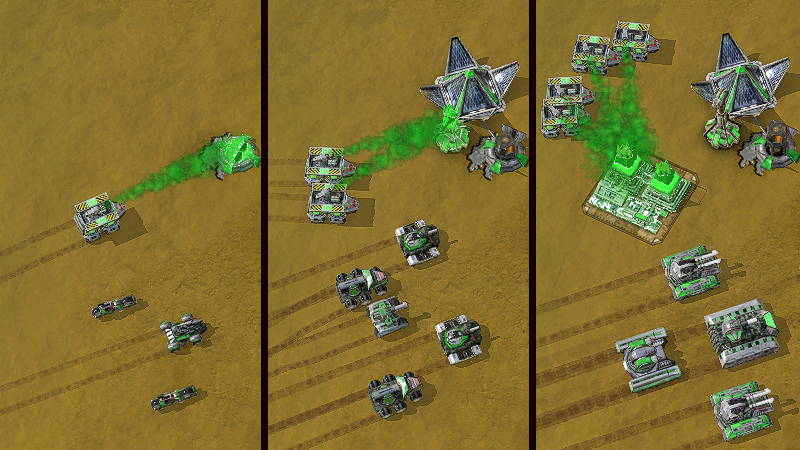
The first phase of escalation occurs as players expand beyond their starting area and take metal extractors. The speed of this phase is moderated by needing to produce enough energy to spend the increased metal income. Expansion is often followed by securing territory with defences to deter raiders. These defences both require larger armies to breach and give players breathing room to build such armies, so a lot of the income from expansion goes towards increasing unit production. Metal incomes steadily increase for the rest of the game due to overdrive and reclaim.
Reclaim causes the metal available on the map to build up over time as each unit of metal pulled from a constructor can be recycled multiple times. It likely has another beneficial effect on escalation due to the way the extra metal comes in bursts. Units in Zero-K are built as fast as resources can be poured into them, so any resources tied up in incomplete constructors are essentially wasted until done. A sudden influx of metal causes a brief burst of production that can let a large unit roll out of the factory sooner than it might otherwise.
Repair is our other big enabler of escalation. All units can be repaired by constructors for two-thirds of their original energy cost, with no metal required at all. This makes large units incredibly efficient if you can hold onto them, provided you can build up the energy and constructors required for repairs. Energy turns out to be behind most of our systems of escalation, as more energy means more repairs, more overdrive, and more capacity to spend reclaim. The types of units that can be repaired change as armies increase in size, since the raw health required to retreat and fight another day increases as battles become larger. So any given unit can shift from being the backbone of an army to more supporting or specialised roles as armies scale up.
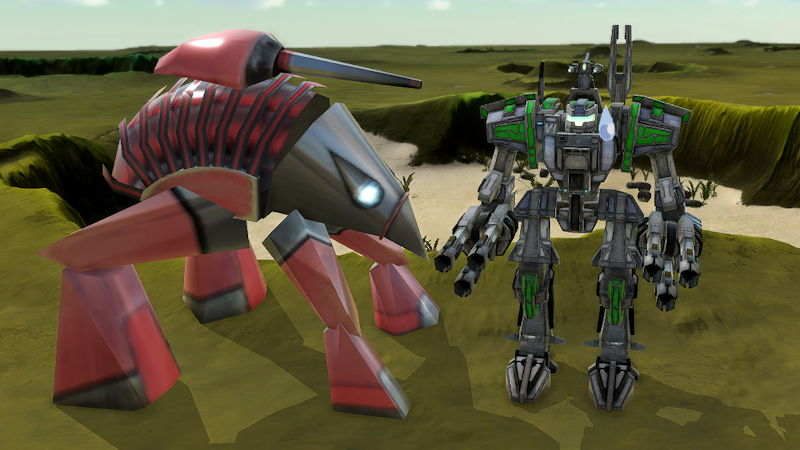
Small units are kept competitive with big ones by being much more efficient in terms of raw power for cost. Consider this: would you rather fight a Detriment-sized Flea or a thousand Flea-sized Detriments? The answer is the Flea-sized Detriments because a scaled-down Detriment would have abysmal stats, especially damage. Two Detriments take over a minute to kill each other, while a scaled-up Flea could kill a Detriment in less than two seconds. Big units are able to exist alongside smaller ones because small units suffer from many drawbacks. As well as being harder to repair, armies of small units are hit by Lanchester's square law as they take losses, are liable to block each other, and effectively multiply incoming area-of-effect damage.
Escalation involves much more than building larger units, with the real meat of it coming in the form of increased complexity. More systems become relevant as the game goes on, including cloaking, shields, nukes, and missile silos. On top of this, players add extra factories to their repertoire to mix in synergistic units or open up new vectors of attack. Air factories are common escalation options as they open up a whole new domain of combat and have the speed to benefit from repairs. We deliberately avoided making Gunships and Planes viable 1v1 openings because they make the game too complicated too early.
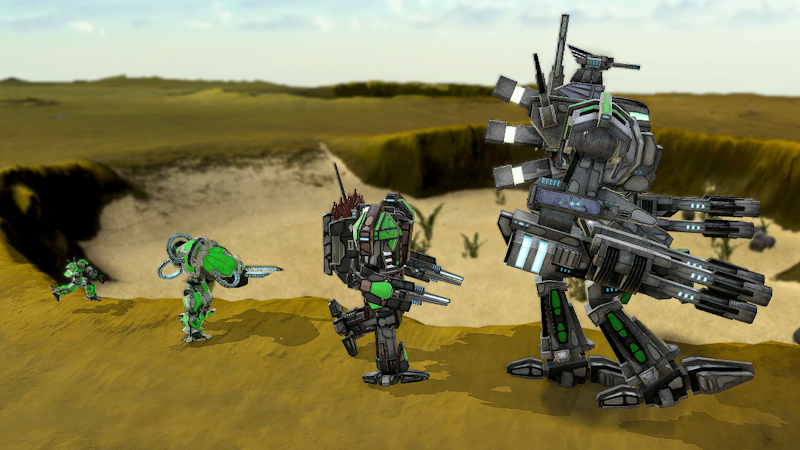
Late-game escalation often involves striders and demi-striders. The striders are a disparate set of units that can be built from the Strider Hub and include the most expensive units in the game. Demi-striders are relatively expensive units that are scattered throughout the factories and that exemplify their factory in some way. The demi-striders are quite versatile units as they can be fielded fairly early and can keep their value deep into the late game. They are very rarely spammed, though, and tend to be surrounded by smaller units with more specialised late-game roles. This is a break from our Total Annihilation roots, as we lack two cornerstones of the TA approach to escalation: tech levels and an exponential economy.
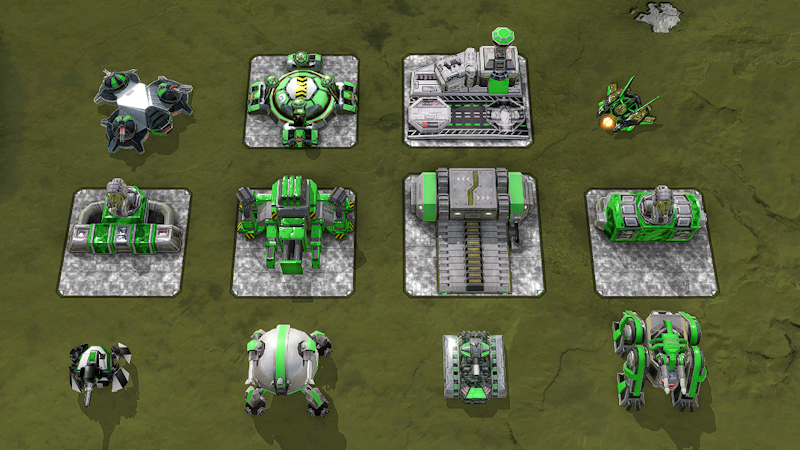
Tech levels in a TA-style game usually take the form of a ladder of increasingly expensive factories that build increasingly powerful units. Higher tier units generally make earlier units obsolete, although there is a period in which both are used as the new units filter in. The Complete Annihilation fork inherited tech levels, but the power disparity was steadily toned down until it was safe to make all factories inexpensive and buildable from the start. This laid the groundwork for treating these factories as factions, although the remnants of the tech levels lived in the morph system for a few years.
We removed tech levels because it felt wasteful to design a set of tier one units only for them to become obsolete once tier two is unlocked. We had a lot of unit ideas so were loath to spend twice as much art just to make weaker and stronger versions of the same unit. Some pairs of large and small units were kept, such as the light and heavy assault vehicles, but repeated application of Quant's Rule has pushed them apart over time. We were also worried about tech levels in team games, as controlling a high-tech factory is individually fun, but an optimal team would want to pay the high cost of building one as little as possible.
The term "flat balance" was used for a few years to describe our approach to tech levels. Part of the goal was to let players creatively combine any units they want, even across the previous tech levels. Flat balance just meant that no unit should unambiguously outclass any other, not that all units should be built all the time. Choosing what to build and when to escalate from small to large units is in the hands of the player. For example, raiders are great for harassment early on but fall off when more turrets go up, while artillery is only really good once solid battle lines are drawn.
The legacy of TA modding also left us with an exponential metal maker economy but it was quickly removed and replaced with overdrive. This worked out fine, which makes sense since few RTS games have unbounded growth, yet they all escalate. There is still plenty of scope for increasing your income before the soft cap kicks in, initially via expansion and later with overdrive. The growth is less explosive in the mid-to-late game, which is by design as it lets battles linger at intermediate scales where Zero-K really shines.
No RTS works equally well at all scales, so most of them take steps to keep the game within some kind of reasonable range. The bluntest approach is to use a hard cap on army size - a population cap. Some sort of population cap is a technical inevitability, but many games set this limit intentionally to prevent games from reaching degenerate scales. For example, a game like StarCraft would probably break down with double the army size, as armies have trouble fitting on the map and on the screen. This approach is too arbitrary for Zero-K though, so we use more subtle methods to avoid endless scaling.
Zero-K is designed to work across a wide range of scales, but not all scales, and eventually your PC would grind to a halt. We limit scale without a population cap by giving attackers more and more advantages over the defender until eventually the only defence is to kill the enemy first. Early defences are quite strong, a nuke in the mid-game can cost more to block than to build, and late-game striders and superweapons barely have counters. Sufficiently long games end in bold base-flattening plays, with each side rushing to be the first to build and protect some sort of superweapon. This is an old approach as most TA and Command & Conquer style games also have game-ending superweapons and avoid population caps.
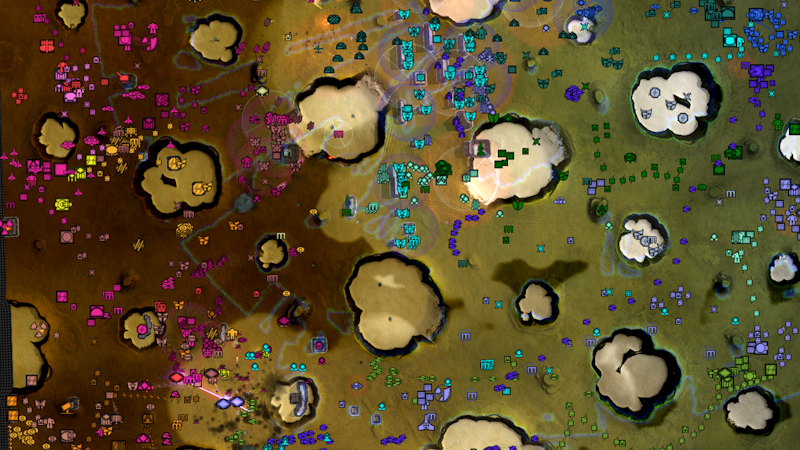
One final way to create a sense of scale is to make the player feel like a small part of something larger. This is hard to do in an RTS, at least at a mechanical level, because so much of the genre revolves around total control of a fighting force. In Zero-K we tap into this sense of scale with our huge team games, up to 16 vs 16. At even half this player count it becomes hard to track the battle across multiple fronts of fighting, so while teams can discuss strategy, no one player can hold all the details in their head. These games also tend to scale up faster, with superweapons and striders acting as events that bring the enemy team together to coordinate a response. The strategies of late-game large team games are something else and deserve their own post, if I ever feel like I understand them well enough. There are so many approaches that I would be surprised to hear of anyone who had mastered them all.