v1.4 - HANDS ON
Officiating is something you do with your body, not your keyboard.
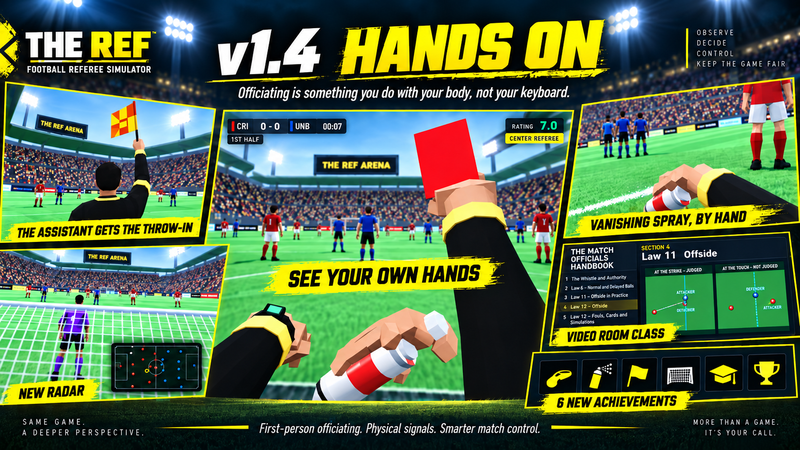
YOU CAN SEE YOUR OWN HANDS
Switch to first person (C) and you are finally in there. Every physical act the official performs is now something you watch yourself do:
- The whistle comes up to your mouth — kickoffs, fouls, restarts, the end of a half.
- The card goes up and is held there — yellow and red, arm high, then dropped.
- The can comes out of your pocket for the spray, tilts to the turf, and hisses.
- The flag is in your hand on the line, and the referee's arm points the way he has given a throw.
Forearms, sleeves, the whistle on its lanyard, the watch on your wrist — all of it rendered where your eye actually is.
VANISHING SPRAY, BY HAND
V used to paint a perfect line for you. Now you do it yourself, and the wall respects the line YOU drew:
- Spot it — V at the ball marks it and draws the can.
- Pace it — walk back with the can out. A faint arc follows your feet. No numbers, no hints: you pace ten yards by eye, like a referee.
- Draw it — hold V and strafe. The line paints under your feet as you walk it.
- Live with it. The wall forms on your line. Too close and the kicker complains; too far and the wall argues, because they know 9.15m as well as you do.
Skip the ritual and the wall places itself — and creeps. The Long-Reach Spray gear now means a steadier hand on the can instead of a longer reach.
THE ASSISTANT GETS THE THROW-IN
When the ball leaves play over your touchline, it is your call to make. Flag (F), then A or D to point the way — the referee reads your signal and points with you. Point the wrong way and you are OVERRULED: he points the other way in front of everyone, and it goes on your record. Say nothing and he calls it alone.
THE RADAR
A small radar in the bottom-right corner: the ball, both teams, you, your assistants. Dots only — there is no offside line on it, because reading the line is the assistant's whole job. On by default at Amateur, and there are ON / AMATEUR / OFF settings if you want it always or never.
THE GAME LOOKS DIFFERENT
A full colour pass: managed colour end to end, sRGB output, ACES tone mapping with a lifted toe so the referee's near-black kit holds its detail, softer shadow edges, and the grade moved into the render pipeline properly. There is a new EXPOSURE slider in settings if you want it brighter or moodier — it applies live and remembers.
THE VIDEO ROOM CLASS
A new lesson in Referee School teaches the VAR seat in two checks: a clean goal you close silently, and a howler you recommend. Close the clean one silently and it tells you that is the job done well, not avoided.
SIX NEW ACHIEVEMENTS
- Clear and Obvious — your first recommendation upheld at the monitor
- Silence Is a Skill — five correct silent checks in one match, no howlers
- The Laptop and the Kettle — finish a VAR match at the bottom of the ladder
- The Man in the Truck — finish one at the top
- Stockley Park — ten matches in the video room
- Overruled — a human referee declines your recommendation in co-op
RATINGS
The assistant's and the VAR's moments now count for more, so a quiet match on the line or a slow night in the van no longer caps what you can score. The video room is no longer charged for drifting off a touchline it never stood on, and the referee's positional bonus is capped so it cannot run away with a match.
ALSO IN THIS UPDATE
- The referee's arm no longer clips through the frame when you show a card up close
- Fixed a phantom positioning arrow appearing on the fourth official during VAR matches
- The video room no longer captures your mouse — drag to look, wheel to lean in, double-click a monitor to inspect it
- The check queue moved clear of the rating panel
- Goal replays now show the ball actually going in, and review footage runs far longer both ways
- The van no longer double-processes its own monitor feeds, so the screens match the live pitch
- Free-kick walls, throw-in signals and spray lines all behave correctly in co-op