Hello there! My name is Nathan and I’m the Lead Level Designer for Ground Zero.
I just wanted to say up front that I'm extremely humbled and excited at the level of interest that you, the reader, and so many others have shown for our game. Thank you so much for the support, it really means a lot! In this dev diary, I wanted to give some insight into what goes on behind-the-scenes when designing and creating the levels for GZ and maybe even teach some of you something new!
A little about me.
I’m a lifelong gamer and survival horror superfan. My gaming roots are primarily in first person shooters and I grew up playing a lot of the FPS classics like Quake, Doom, Wolfenstein, and most importantly, Half-Life 1. HL1 was my entry point into modding & level design as a kid and it singlehandedly ignited my passion and led to me pursuing it as a career. My love for survival horror came almost entirely from my dad, who I watched play countless hours of Silent Hill and Resident Evil games back then. When I played the games myself, the gameplay loop had me addicted and I loved the feeling of being scared and having to make good use of limited resources. There isn’t anything quite like it in my opinion!
How do you get started when making new maps for Ground Zero?
As with most games, the first objective when starting a new map is to nail down the design. Some games rely heavily on the layout of the level being specifically tailored to support the game’s mechanics (for example games that incorporate parkour / movement mechanics or basically any stealth game), while other games lean more on the storytelling and pacing. GZ falls primarily in the latter category. For the most part, we can design our maps based on what we find cool and what works for specific ideas (puzzles, cutscenes, etc.) that we might have. It also means that nearly any setting or location is viable from a gameplay perspective, and this is a primary contributor to the high variety of environments seen in GZ.
Of course, there are still some cases where we design things in a very specific way. In those cases, I'll take the standard approach, which usually involves drawing a topdown and making a whiteboxed level to prototype the idea, then iterating from there through playtesting and feedback. It’s also common that I’ll write up a list of the gameplay “beats” and make a flowchart that we can use to figure out how the puzzles and other sequences will go before sitting down in the editor.
Here are a few examples of some old sketches of existing levels in the game:
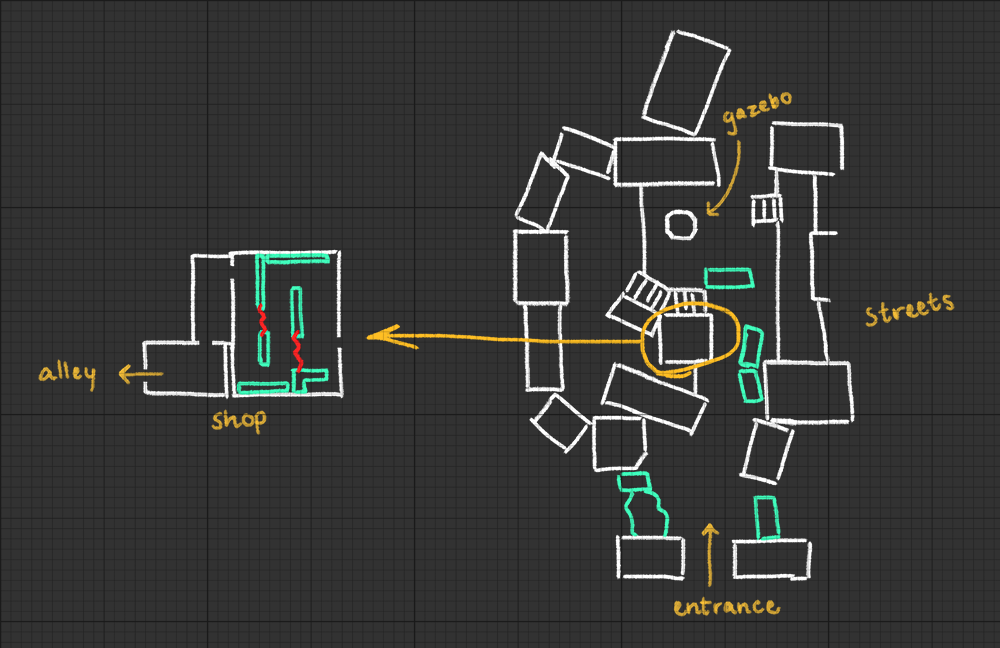
Original sketch of the Village map.
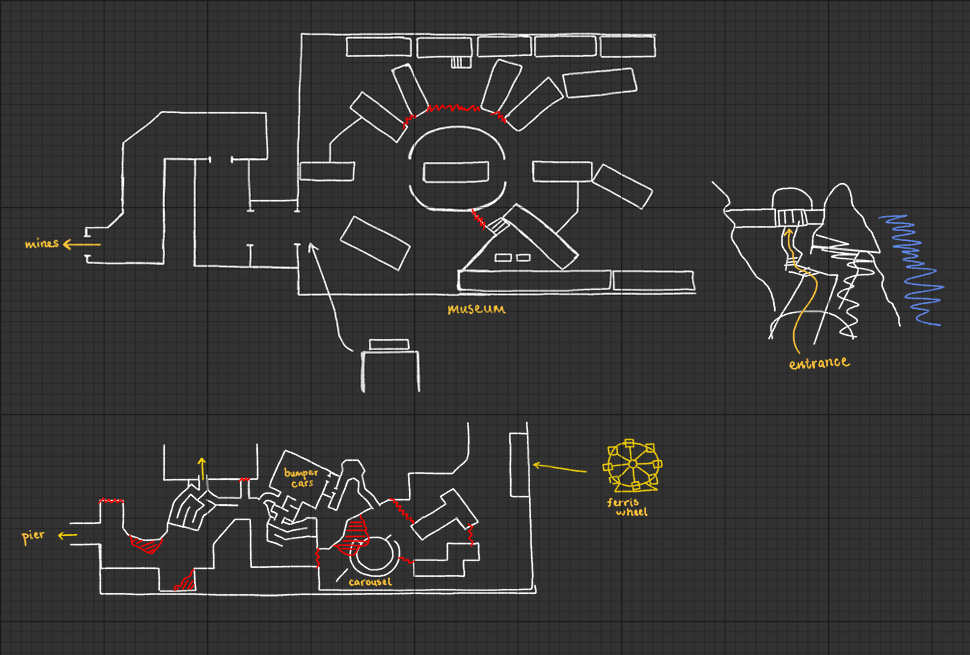
Original sketch of the Amusement Park map.
Are there any specific games that have influenced the level design in Ground Zero?
I’d say the classic Resident Evils (especially RE3) and the first three Silent Hill games, but there are many inspirations and references from a handful of games (some even outside of the survival horror genre) that can be seen all over the place in GZ’s level design. Maybe you'll notice some when you play!
How do you choose how to position the cameras?
This is quite a bit more complicated than you might think! When we first started the project, I thought of camera placement as being as simple as placing a camera in a position that you thought looked cool, and then calling it a day. I realized very quickly that there's actually somewhat of a “science” to it. GZ is a fixed-camera game, which means that the player cannot control what they see. This is in contrast to almost all other types of games, where as a level designer, you can create a scene and leave the player free to look around at their leisure and take in the world you've created.
In GZ, due to the fixed camera, we have to do it all. We have to allow you to see where you're going and what you’re doing but, at the same time, *also* show off the world and allow you to take in the environment through unique and interesting camera angles. It’s not uncommon at all that specific sections of a level are created with specific camera angles in mind, and this is easily one of the biggest differences between making levels for GZ and pretty much any other game I've ever worked on or modded for.
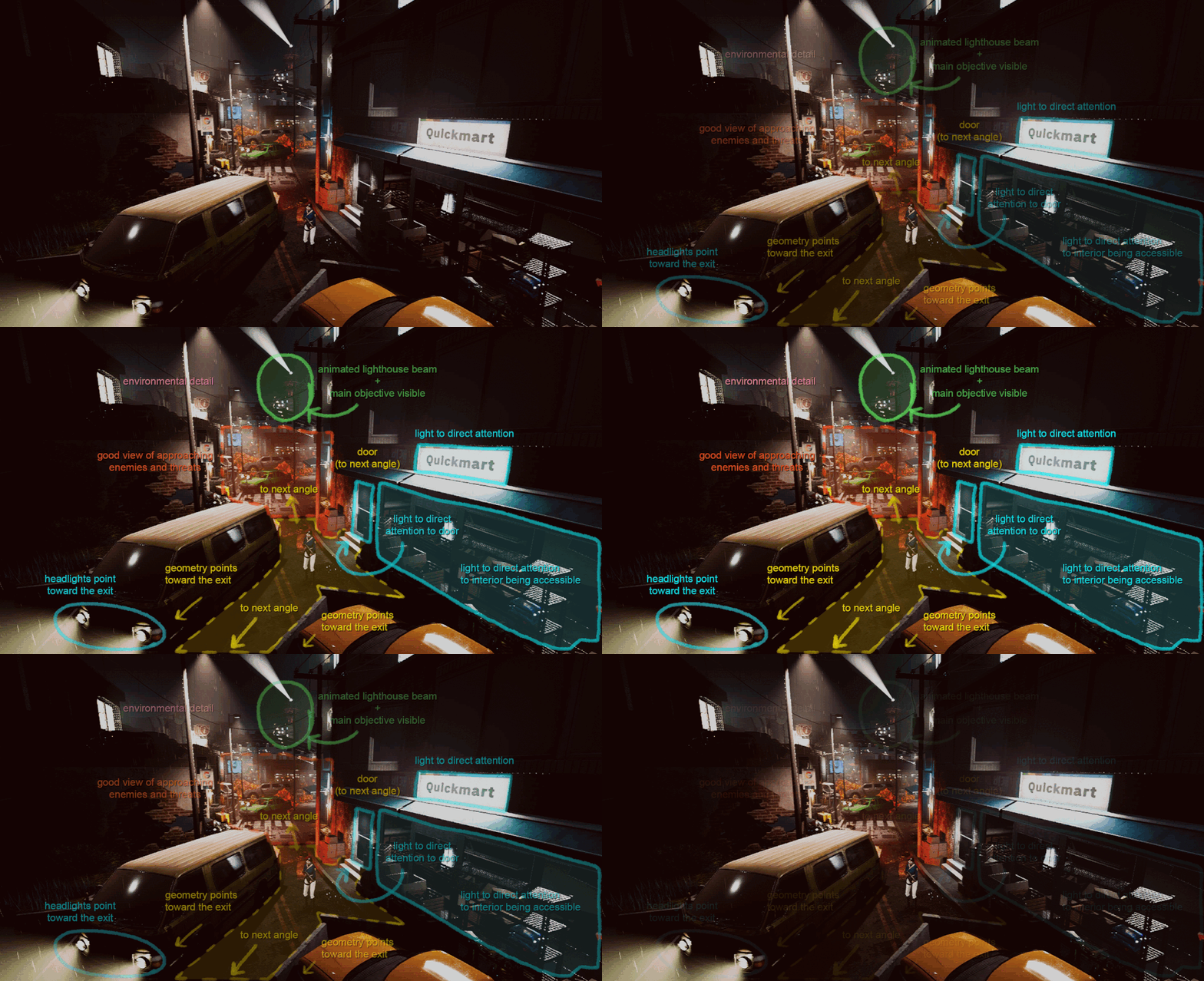
The best camera angles incorporate the following, in order of importance:
- Clear “exit routes” that show where the player needs to move to exit the camera angle and progress forward
- No locations where enemies, items, or the player themself are able to move completely out of sight of the camera
- Objectives, items, enemies, and any other objects of importance clearly visible
- A clear view of the scene so that the player can fight enemies and properly gauge the playable space. To this end, we typically keep the intended gameplay space clean of debris and other obstructions to make it easy to tell where the player can and cannot move. We can also use the high contrast created by clashing colors and lights to more clearly define the walkable space as well
- Aesthetically pleasing visuals
Here’s an example of a camera angle that I feel accomplishes all of these rather well:
What’s your favorite level that you’ve worked on for Ground Zero?
Without a doubt, it would be the top of the lighthouse that can be seen at the beginning of the game. It’s based on the real-life Yeongdo Lighthouse, and when we were considering it as a destination, I wanted to leverage it as a nice payoff to all the work the player has done.
You travel pretty far in the game, and once you finally arrive and reach the top, you get a breathtaking view of everywhere you've been up until that point, which helps tie it all together.
I've tried to incorporate these types of vistas into the game whenever I can, because they help to show off the sheer scale of the world in GZ, something which only adds to the immersion and atmosphere in my opinion.
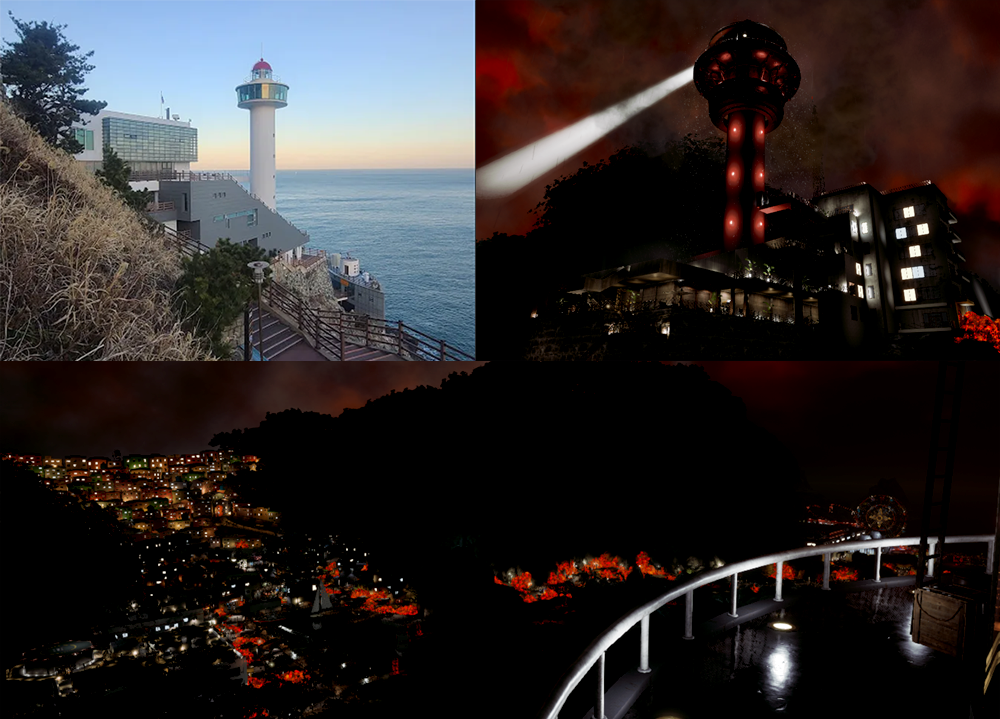
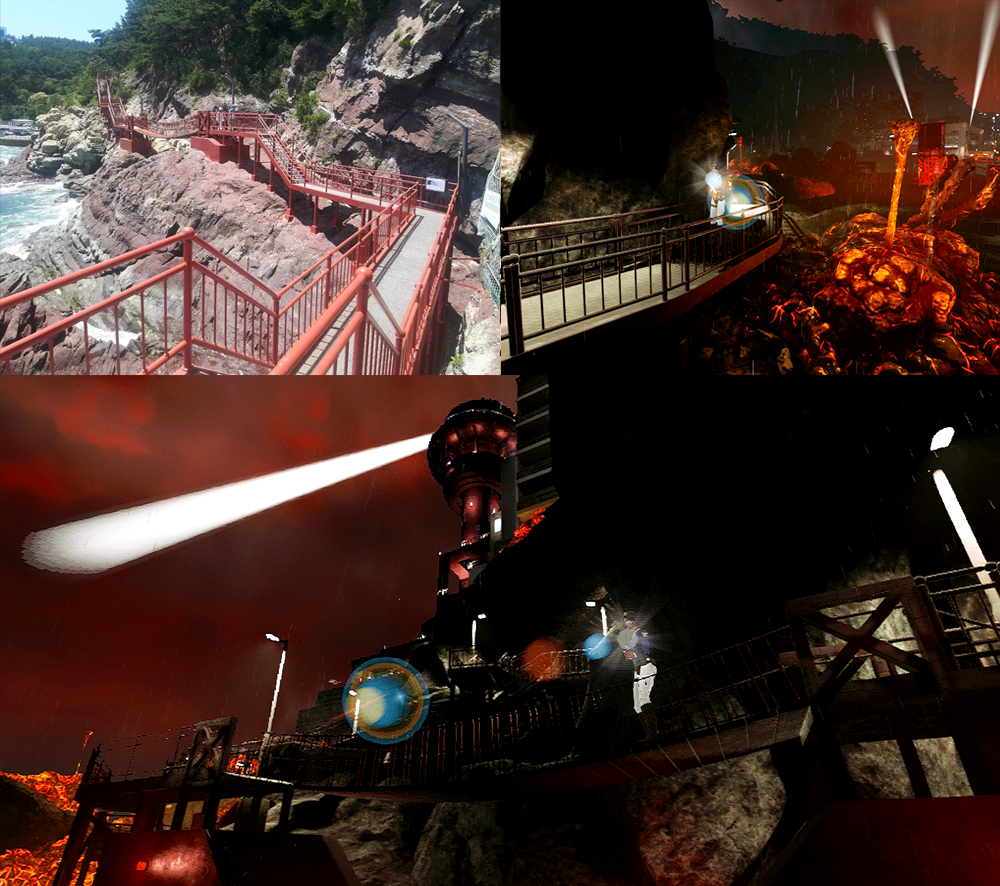
A close contender for me would be our in-game recreation of the Bolle-gil coastal trail. In real-life, it’s a really cool oceanside walkway in the Busan region that has a very distinct red metallic look and tons of beautiful viewpoints of the coast and city.
I love the winding nature of the trail and how it snakes around the cliffs, and I’ve tried to capture that essence as much as possible in the in-game version. It’s one of the most unique areas in the game and I had a lot of fun working on it!
That being said, I’ve thoroughly enjoyed working on just about every part of this game, and it’s honestly so hard to boil it all down to just one or two favorites. South Korea is a beautiful country, full of amazing architecture and cool areas that have kept me more than inspired while working on the game.
Thanks for reading and I'm really excited for you all to see the rest of what we have in store!
Until next time,
- Nathan
https://store.steampowered.com/app/2340130/Ground_Zero/
What aspects of Ground Zero would you like to know more about in future developer diaries?Let us know in the comments 💬